POLIS Political Group gathers in Utrecht to explore solutions for sustainable mobility
On 27-28 November 2025, the POLIS Political Group met for its second meeting of the year in Utrecht, the Netherlands, bringing together political representatives from member cities and regions to discuss recent developments and current challenges for sustainable mobility.
Directly after the Annual POLIS Conference 2025, the Annual POLIS Conference 2025, the POLIS Political Group, bringing together the political representatives of cities and regions within the POLIS membership, convened for its second meeting of the year. With more than 70 participants, this gathering marked a record attendance and highlighted the growing political momentum behind sustainable mobility.
The two-day meeting featured a broad and ambitious agenda, focusing on the governance, funding, and implementation of sustainable mobility measures. As local and regional authorities continue to lead Europe’s decarbonisation and accessibility efforts, participants examined the latest EU policy developments and reflected on the practical realities of delivering change on the ground.
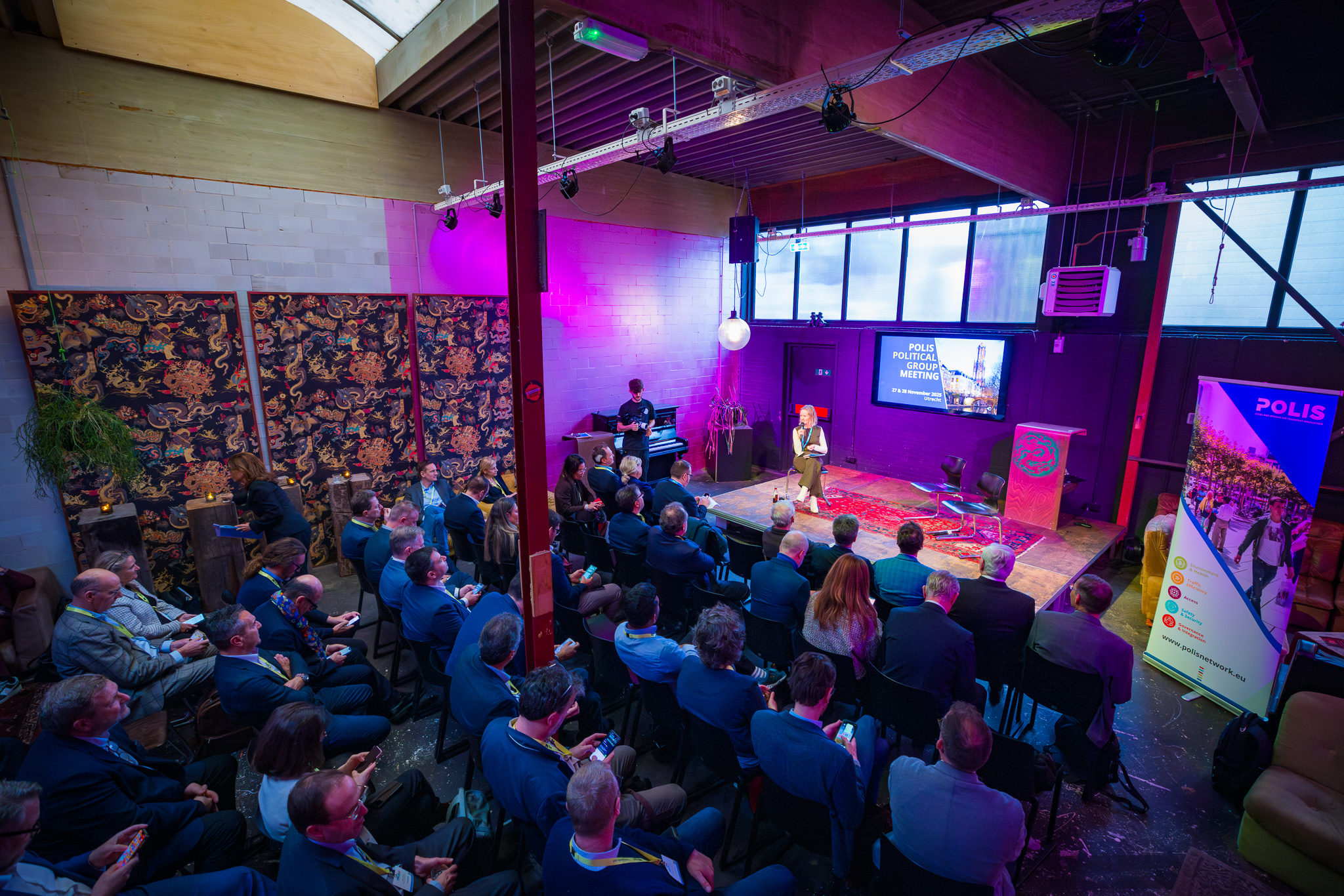
Day 1 at the POLIS Political group meeting in Utrecht. Photo credit: Michiel Ton
Navigating EU funding and regulation
One of the key topics of the meeting was the evolving landscape of European funding and regulation for transport. Beatriz Yordi, Director Carbon Markets and Clean Mobility, DG CLIMA, and Isabelle Vandoorne, Head of Unit, Innovation and research (and urban mobility), DG MOVE, took part in the discussions and actively engaged with participants, enabling political leaders to exchange directly with high-level EU officials on current and future policy directions.
Discussions included the newly drafted national plans under the Social Climate Fund (SCF), highlighting the balance between transport investments and other sectors such as the built environment, and the prioritisation of public transport, including bus electrification. It was noted that SCF funding proposals must explicitly address social and environmental objectives, supporting transport poverty rather than infrastructure aimed solely at higher-income or logistics applications.
A key takeaway was for local and regional authorities to engage more proactively with national governments to influence funding allocation and policy implementation, especially ahead of the upcoming roll-out of the ETS2 Directive. Some countries have yet to transpose related legislation, highlighting the need for stronger coordination and advocacy.
The meeting also examined the availability of funding options for Urban Nodes in the upcoming EU long-term budget (including the Connecting Europe Facility (CEF). With available resources covering only a small fraction of European cities, participants stressed the need for a robust and coordinated push for more equitable funding. It was encouraged for cities and regions to explore alternative financing sources alongside EU grants, including private investments, and for greater recognition of city-level mobility in future funding frameworks such as the upcoming Multiannual Financial Framework (MFF).

POLIS Political Group during the site visit at Utrecht's Central Station. Photo credit: Michiel Ton
Making it happen: Urban mobility on the ground
The second day of the meeting began with a joint site visit to the Utrecht Central station, one of Europe’s busiest and most innovative stations with over 200,000 visitors on average per day, and the city’s Railway Museum, giving participants first-hand insight into the city’s approach to multimodal hubs, rail operations, and station area development.
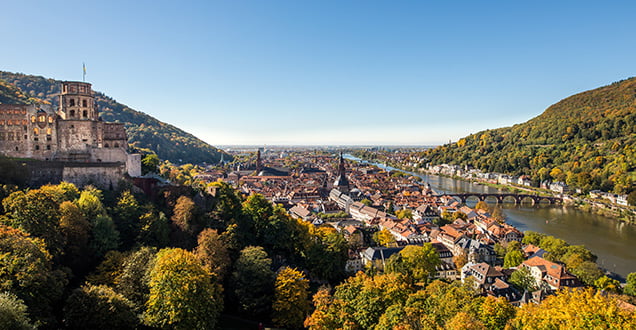
The discussions then proceeded to focus on more concrete, on-the-ground mobility challenges. Across European cities, pavement parking, illegal parking on sidewalks, and congestion in residential neighbourhoods remain persistent issues. Heidelberg, Germany, presented its work to combat illegal parking on sidewalks, following a state-level decree that strengthened enforcement. The city has adopted a step-by-step approach, identifying around 280 problematic streets and working progressively, street by street. A key element has been the involvement of civil society, including disability organisations and NGOs, as well as awareness campaigns with the fire brigade to demonstrate the real-life risks of blocked access routes. While the measures triggered both resistance and support, they have helped free up space and improve safety and accessibility.
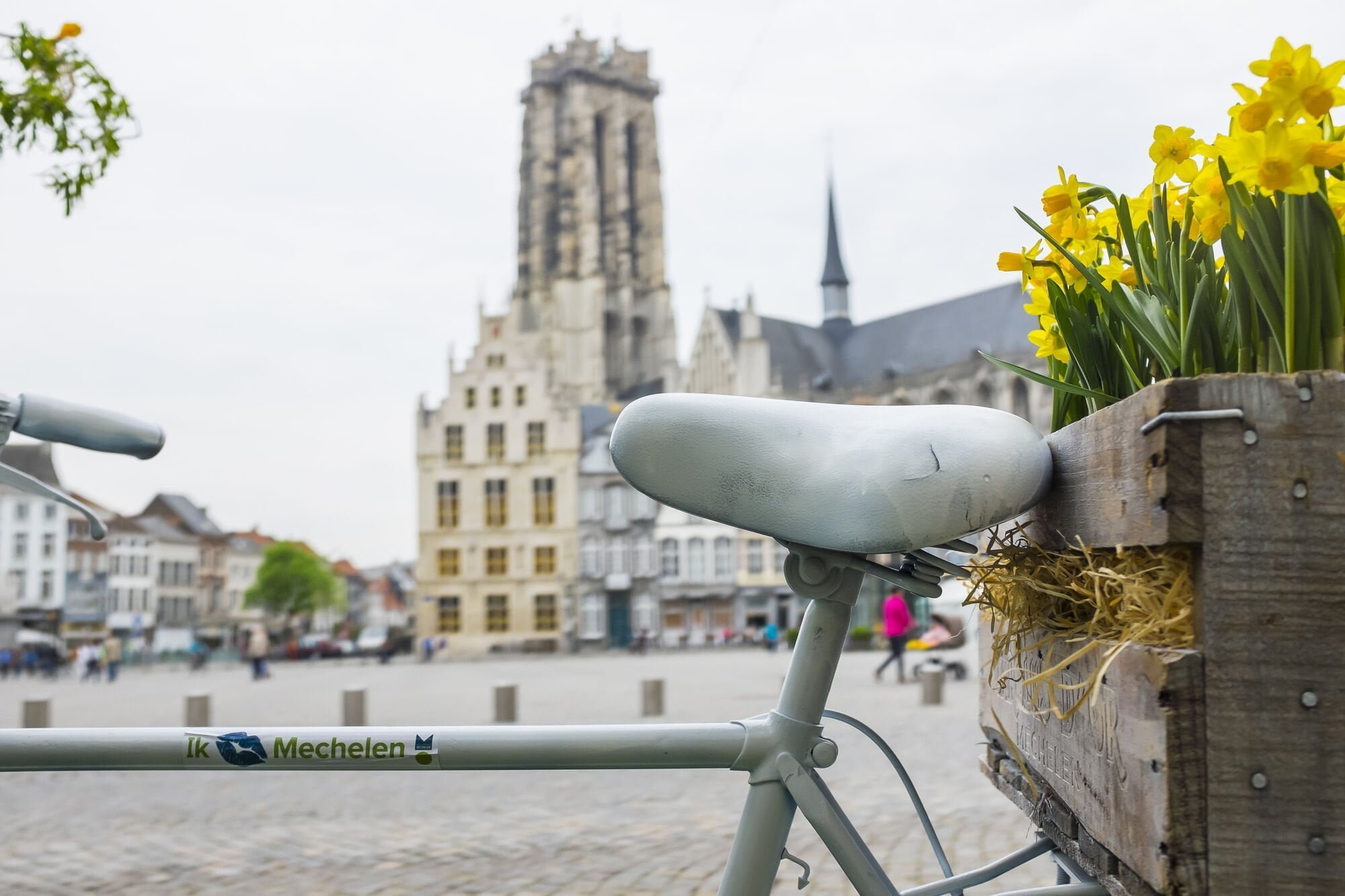
Meanwhile, Mechelen, Belgium, showcased how the city has been rapidly expanding its cycling network as part of a broader strategy to rebalance street space. The city has redesigned major corridors, transformed car-dominated inner ring roads into bicycle-friendly routes, and worked closely with local businesses to make private parking spaces available for neighbourhood use during street rebuilds, often supported by municipal funding. Despite initial backlash, public acceptance has grown over time, with many of the changes now widely seen as positive.
Indeed, one common theme was the need to pair enforcement with broader policy reform. In many places, enforcement alone met resistance, but combining it with street redesign, community engagement, and alternatives such as on-street cycle parking or subsidised parking for businesses helped reduce pushback and increased public acceptance.
Switching to sustainable mobility also means rethinking the dominance of private car ownership, particularly in cities where most cars remain parked on the street nearly all day. Several participants highlighted the importance of promoting shared mobility and public transport as viable alternatives to private cars, rather than simply electrifying existing vehicle fleets.
Funding sustainability and long-term vision
Baden-Württemberg, Germany, shared the region’s comprehensive investment structure in sustainable mobility, showcasing a diverse toolbox that includes a mobility pass, extensive parking management, state-owned rolling-stock procurement, and a dedicated fund for climate-resilient and future-proof infrastructure. Current plans to introduce a truck toll on regional roads illustrated the ongoing search for stable, long-term revenue sources.
This contribution opened a wider discussion on the need for stable and predictable funding. Many cities stressed that multi-year financing frameworks, rather than year-to-year allocations, are crucial to deliver major street redesigns, rail upgrades, and long-term modal shift strategies. Participants highlighted how vulnerable local mobility programmes can be to political turnover, contrasting regions that benefit from long-term investment certainty with those whose progress depends on budgets renewed annually, often at risk of delays or sudden reprioritisation.
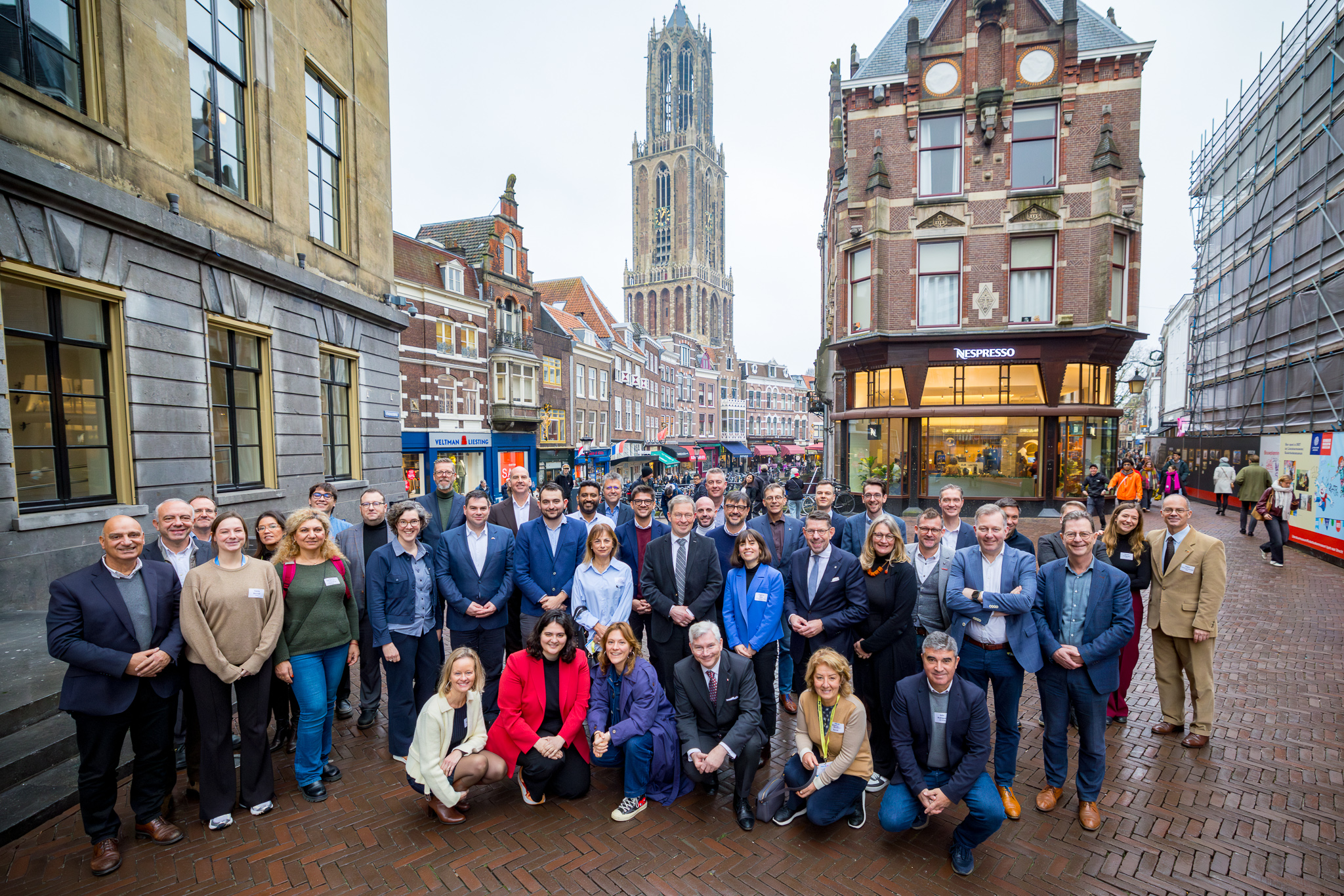
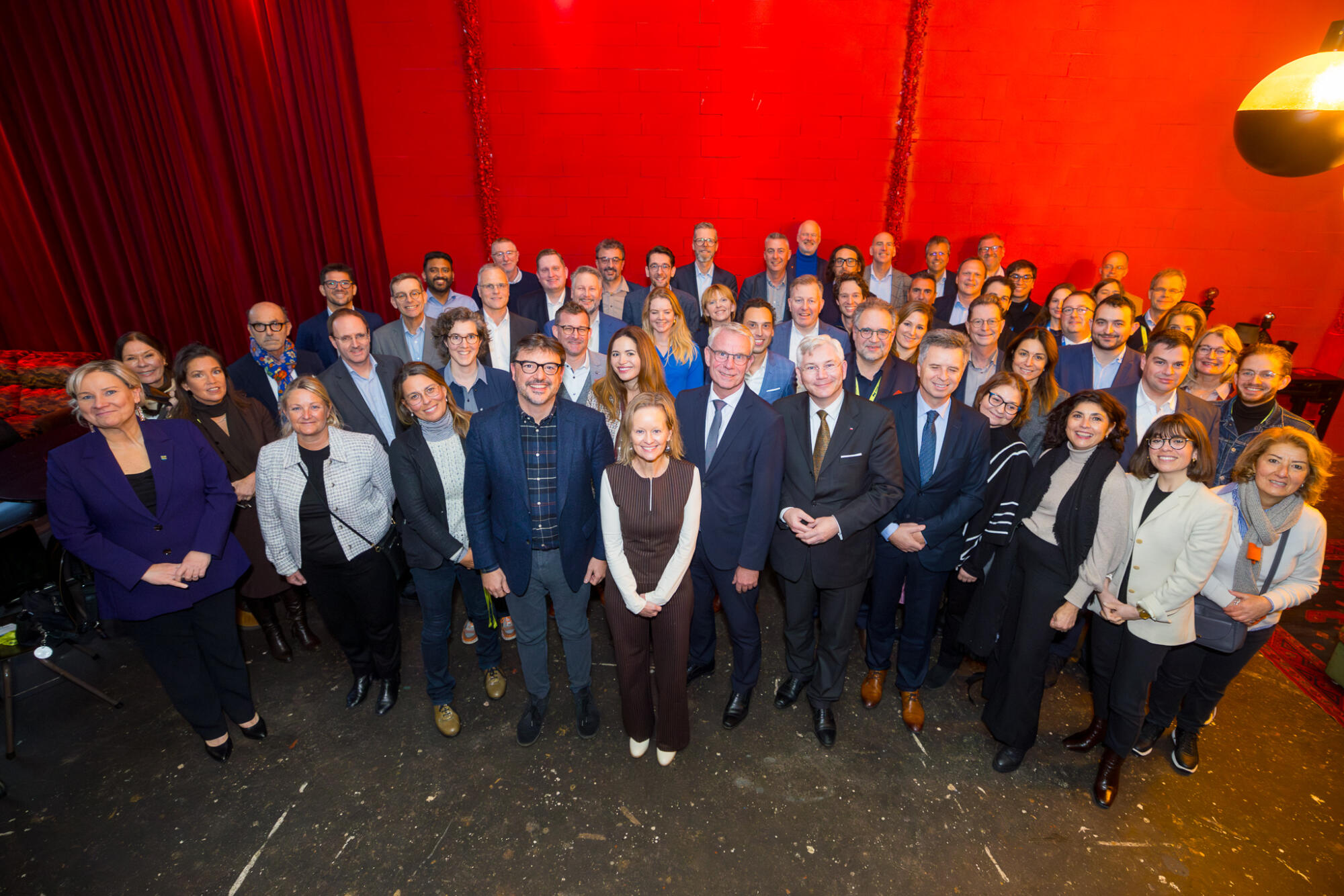
Group photo of the POLIS Political Group in Utrecht. Photo credit: Michiel Ton
A time for cooperation, not competition
The meeting concluded with a strong call for collaboration over competition. Political representatives called for continuous peer-to-peer exchange and coordinated action across local, regional, national, and European levels.
As Karen Vancluysen,Secretary General, POLIS, put it, “It is very interesting to see how, despite different local conditions and different political priorities, cultural attitudes, and economic constraints, all our political leaders share a clear determination to advance the European mobility transition, and a strong commitment to do it in a way that ensures inclusion, equity, and long-term sustainability.”
The conversations will continue next year with the upcoming Leadership Summit and Political Group meeting in Zagreb, Croatia, on 26 and 27 May 2026. Stay tuned for more information!
- Related Members

Baden-Württemberg