Coalition urges urgent public transport investment amid oil crisis, as Earth Day follows World Public Transport Day
Civil society organisations across Europe are calling on policymakers to urgently invest in public transport in response to the ongoing oil crisis, warning that continued reliance on private cars is leaving households, cities, and economies structurally exposed.
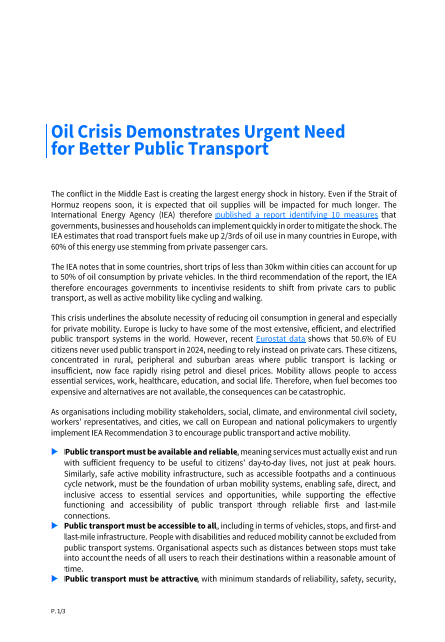 In a joint statement, a coalition of 15 organisations, including POLIS, calls on European, national, regional, and local authorities to act immediately on International Energy Agency Recommendation 3, which promotes a rapid shift from private car use to public transport and active mobility. The appeal comes as oil prices surge due to geopolitical instability, with the IEA describing the situation as the 'largest energy shock in history'.
A European malaise
Europe’s mobility model remains heavily oil-dependent, and insufficient public transport uptake is amplifying the impact of price volatility. Road transport fuels represent around two-thirds of oil use in many European countries, with private passenger cars accounting for roughly 60% of that demand. One might therefore expect strong public transport usage as an alternative, but this is not the case: according to Eurostat, 51% of EU residents did not use public transport in 2024—a stark reality check.
This is all the more relevant when considering the economic consequences of private car reliance: European households spend approximately €650 billion annually on operating private cars, while recent oil price spikes are adding an estimated €90 million per day to the EU’s oil bill for private car use alone. At the same time, congestion continues to impose a €100 billion annual cost on the European economy. These figures illustrate a dual inefficiency: high private expenditure paired with macroeconomic vulnerability.
A European remedy
From a POLIS perspective, broadly shared by the coalition, public transport is the structural remedy at the core of Europe’s mobility system. It is understood less as an environmental add-on and more as a foundational economic and social infrastructure, shaping productivity, accessibility, and territorial cohesion.
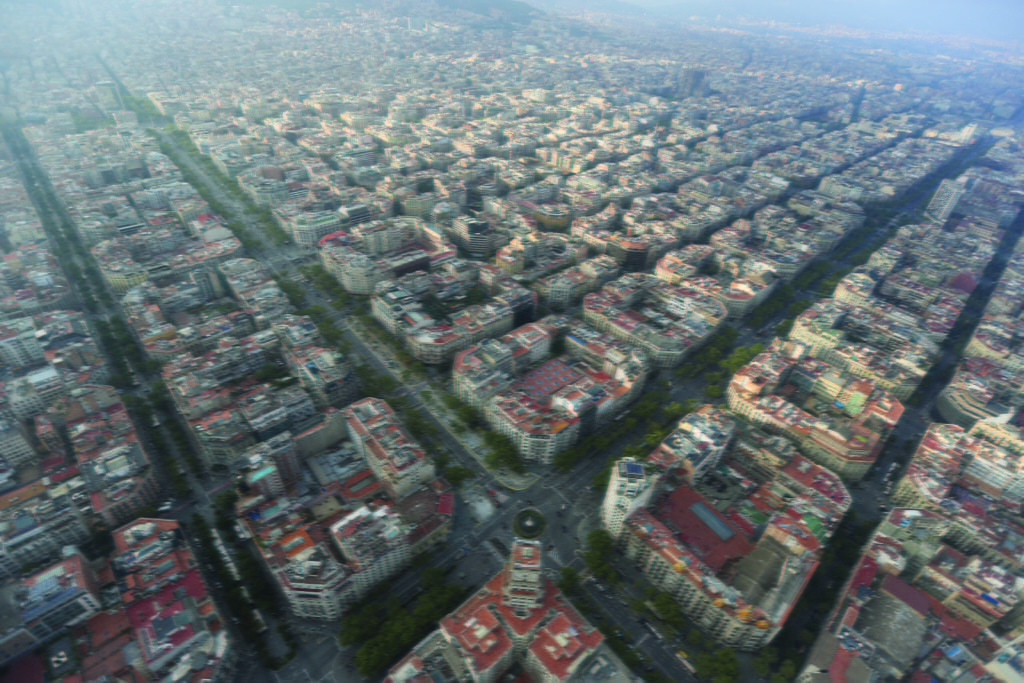
The sector generates between €130 and €150 billion annually and supports around 2 million jobs across Europe. Evidence from Barcelona underscores the scale of potential returns, where every €1 invested in public transport yields approximately €6.50 in regional economic benefits.
However, the coalition also emphasises that these systems are currently under significant strain. Years of underinvestment, combined with staffing shortages and uneven territorial coverage, particularly in rural and peri-urban areas, are limiting their capacity to function as intended. In practice, this constraint translates into a preference for private cars that often reflects the absence of viable alternatives altogether.
Raising awareness on World Public Transport Day
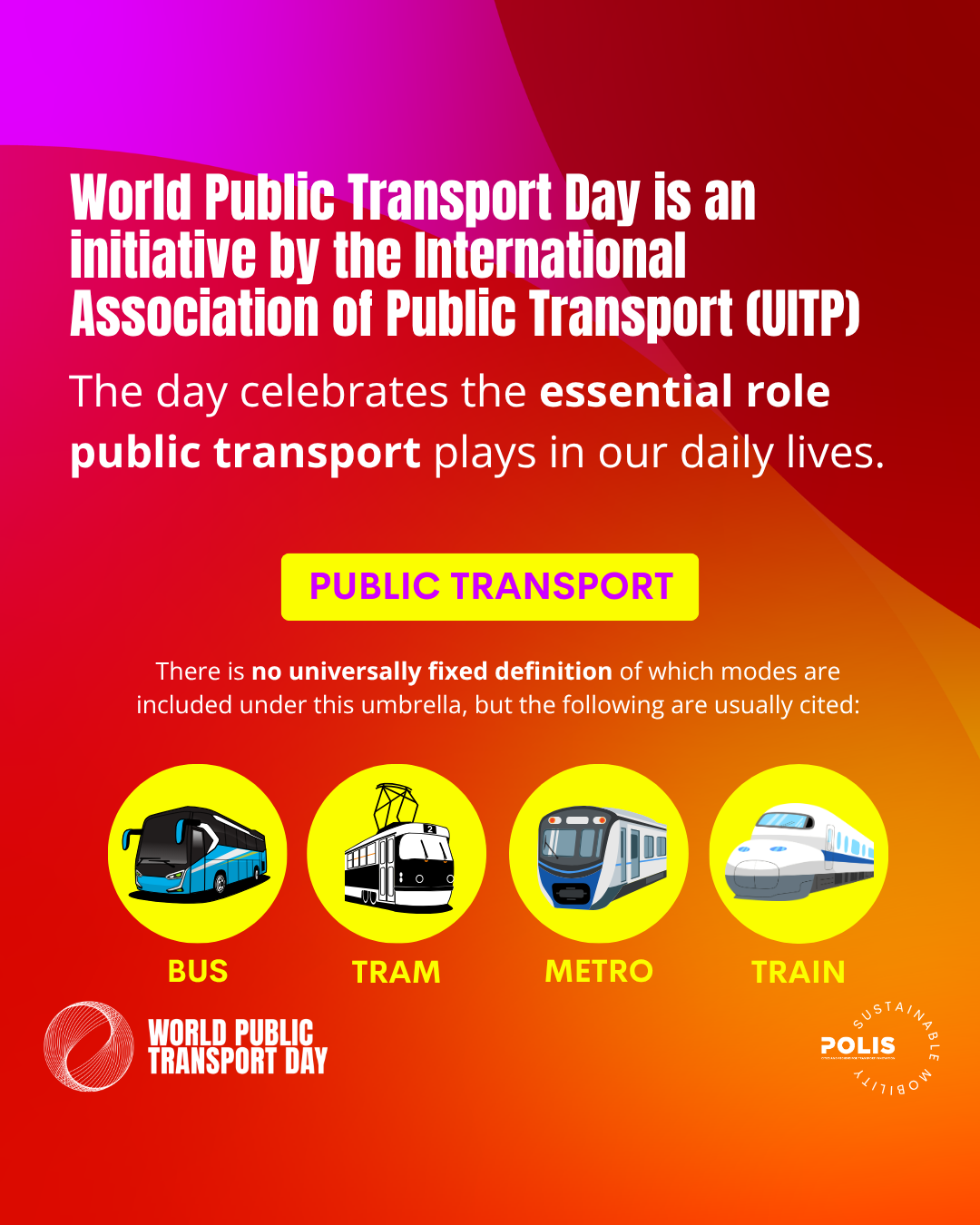 This is precisely where the timing of World Public Transport Day becomes relevant. Led by UITP, the International Association of Public Transport, the initiative underscores the structural role of public transport in enabling inclusive, efficient, and low-emission urban systems. The framing aligns closely with the coalition’s message: public transport is not a residual mode—it is the backbone of functioning cities.
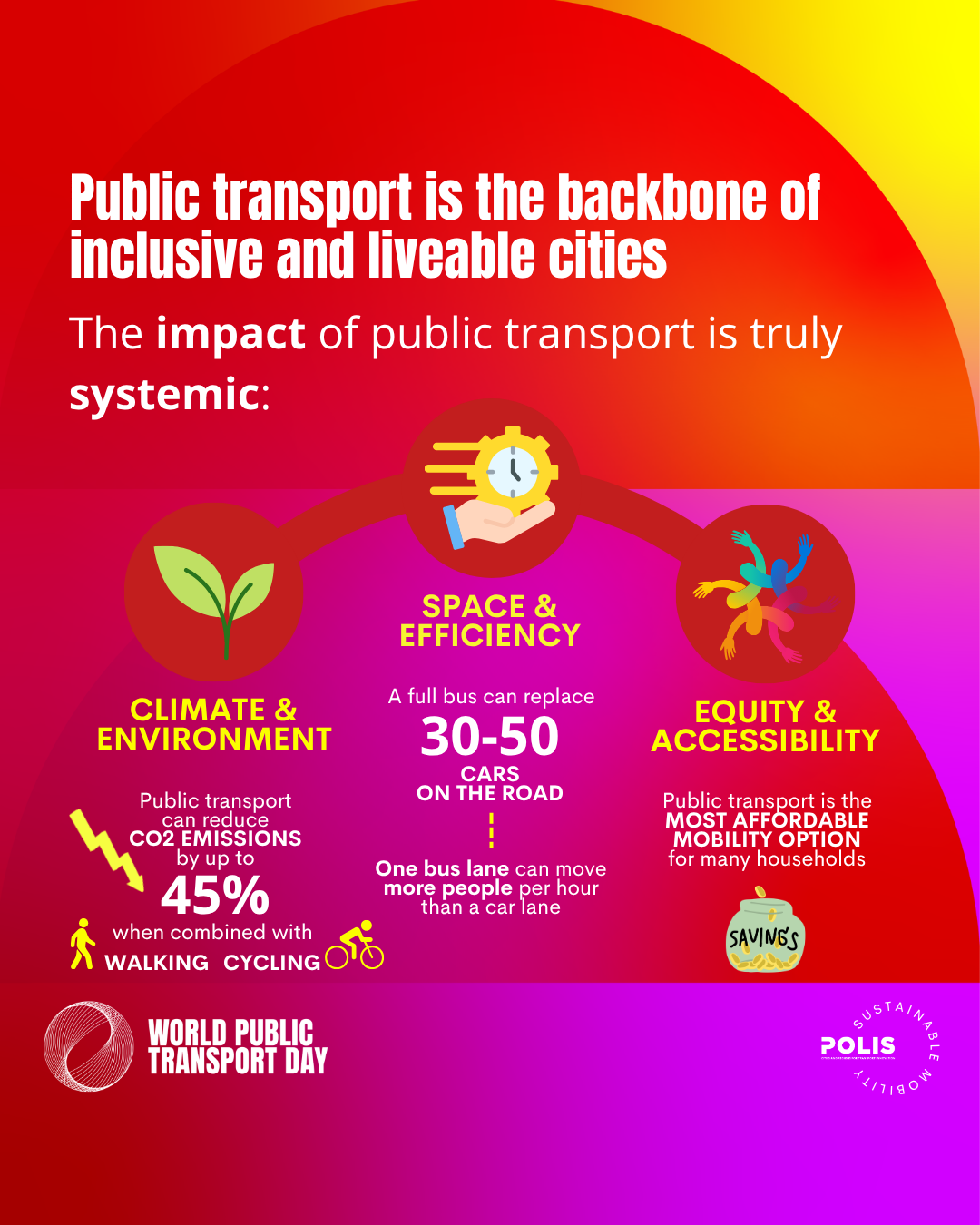
Public transport can reduce urban transport emissions by up to 45% when combined with walking and cycling. A full bus can replace between 30 and 50 private cars, while dedicated bus lanes move significantly more people per hour than car lanes. Spatial efficiency, cost efficiency, and environmental performance converge in a single system. Public transport also remains the most affordable mobility option for many households, a critical factor in a context of rising living costs.
POLIS members leading the way
The World Public Transport Day campaign, amplified by POLIS in the lead-up to Earth Day, moves beyond general principles to demonstrate implementation. Across European cities and regions, tangible solutions are already in place.
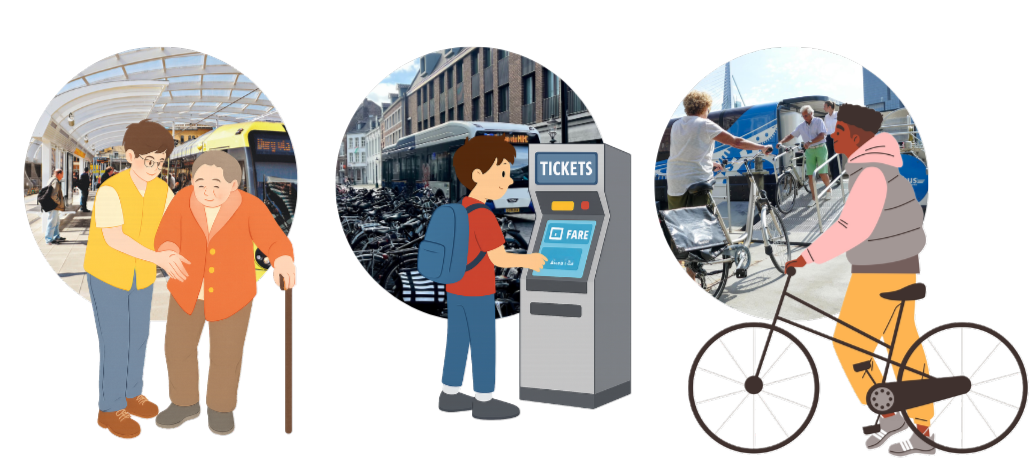
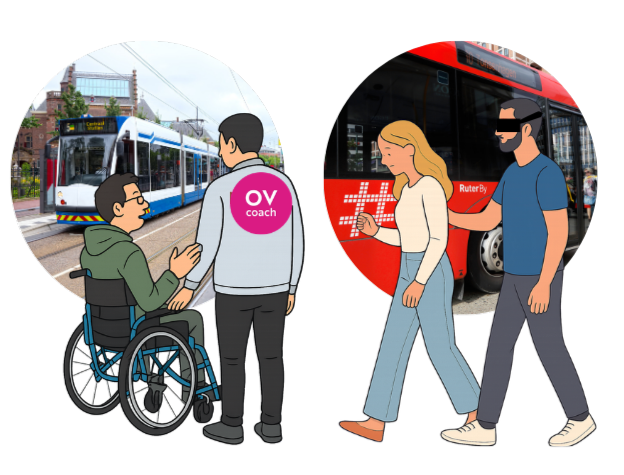 Accessibility emerges as a central theme. In Amsterdam, the OV-Coach programme has supported more than 1,000 individuals in travelling independently, with a 95% continuation rate after three months. The implication is clear: accessibility is not limited to infrastructure and requires targeted support and user confidence. Similarly, in Oslo, embedding equity within Ruter AS organisational strategy and training over 150 drivers in disability awareness demonstrates how inclusion must be institutionalised, not treated as an add-on.
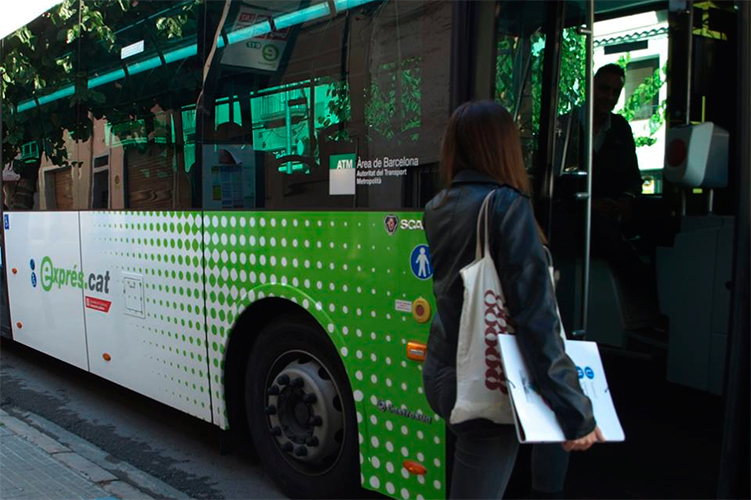
Service quality and reliability are equally decisive. The rapid bus corridor connecting Girona and Salt in Catalonia, operating a fully electric fleet with high-frequency service, has driven significant ridership growth while avoiding hundreds of tonnes of CO₂ annually. This illustrates a key dynamic, where high-quality public transport does not merely shift existing demand, but it generates new demand.
Data and governance innovation also play a critical role. In Barcelona, GIS-based analysis of 20 million daily journeys is being used to identify and address accessibility gaps, linking mobility planning with socio-economic realities. This type of integrated approach is essential for ensuring that digitalisation translates into equitable outcomes.
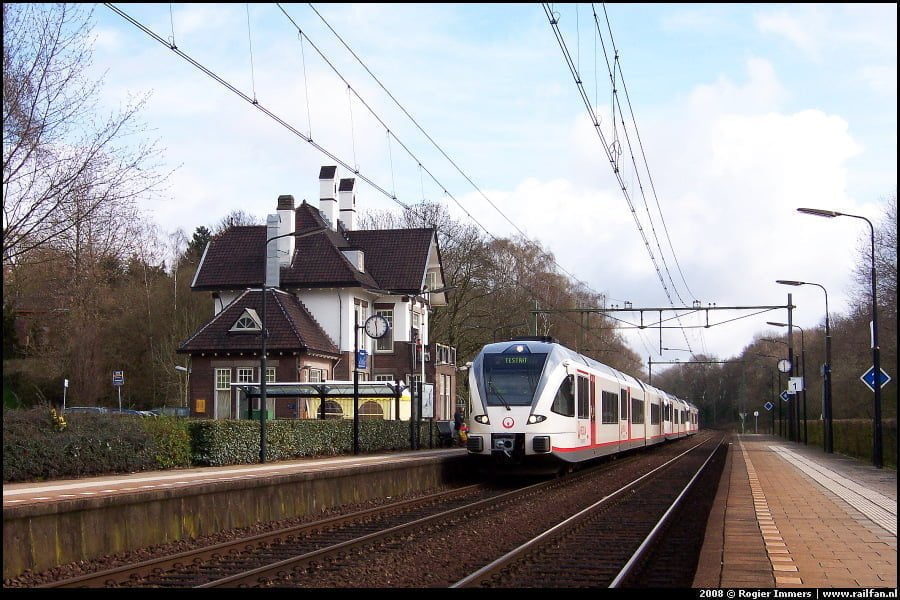
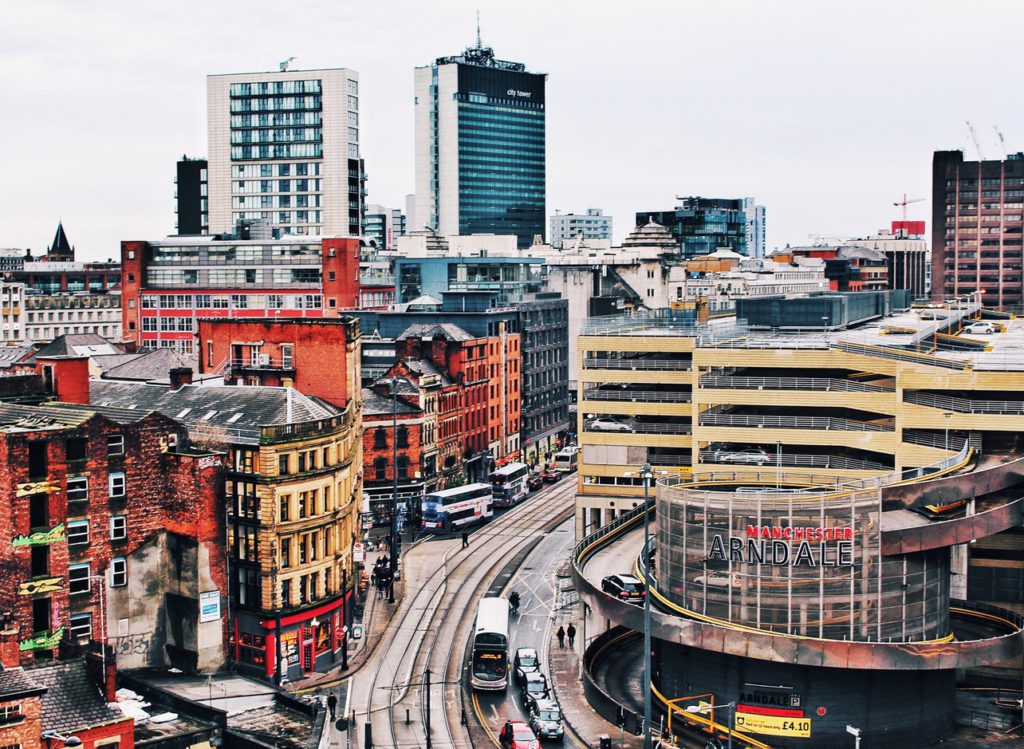
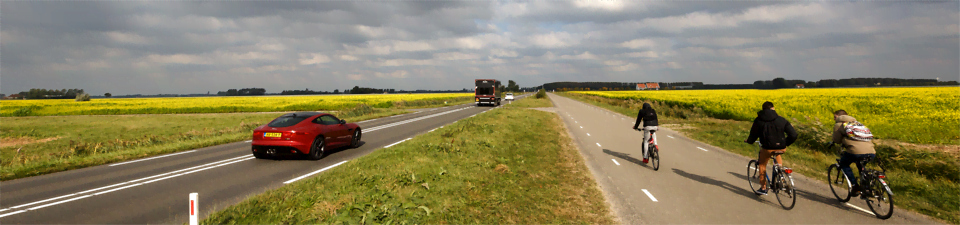
 Affordability and flexibility are being tested through targeted measures. Greater Manchester has extended concessionary travel to 400,000 people by removing peak-time restrictions, improving access while maintaining system usability. In parallel, regions such as Limburg and South Holland are experimenting with free or off-peak travel schemes for low-income users, demonstrating both strong uptake and the importance of sustainable funding frameworks.
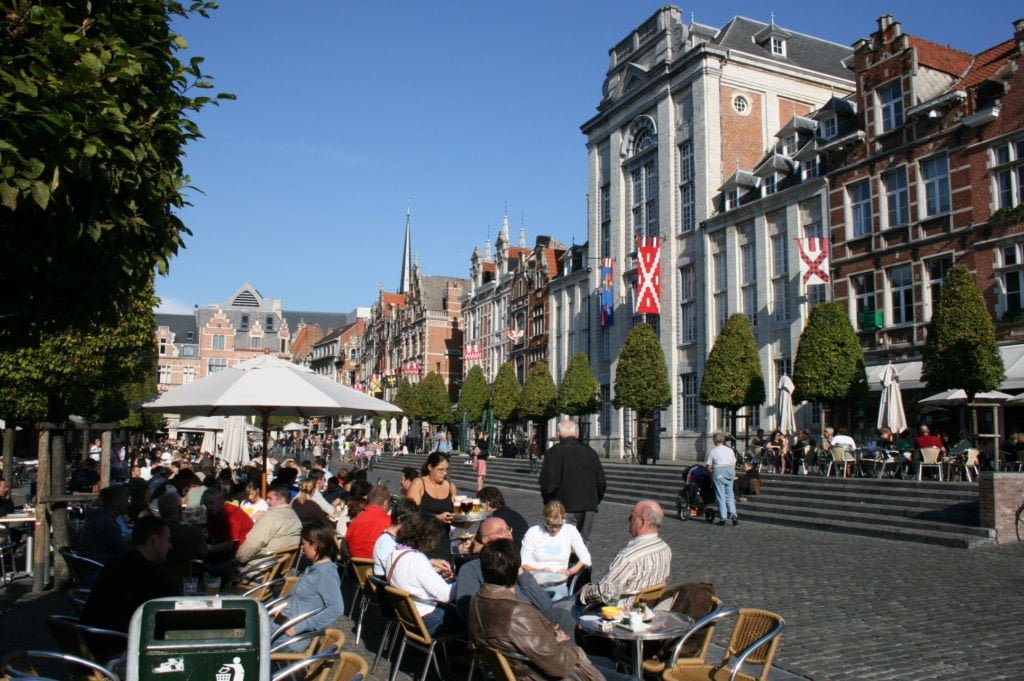
Emerging technologies are also being integrated pragmatically. In Leuven, an autonomous shuttle pilot is testing how driverless systems can complement, rather than replace, existing public transport networks. This reflects a broader principle: innovation should extend and strengthen public transport, not fragment it.
These examples illustrate that the transition away from oil dependency is already operational at the local level. What is missing is scale, coordination, and sustained investment.
'Our Power, Our Planet'
 This is where the connection to Earth Day transcends its symbolic meaning and becomes structurally and factually important. The 2026 theme, 'Our Power, Our Planet', emphasises that environmental progress is driven by distributed, everyday action across communities, institutions, and sectors. In mobility terms, public transport is one of the most immediate and scalable ways to translate that principle into measurable impact.
Transport-related actions linked to this framing are concrete. Supporting public transport investment by engaging with local and national representatives, participating in mobility planning processes or public consultations, and promoting evidence-based climate and transport data are all mechanisms through which individuals and organisations can influence system-level change. Attending local events focused on sustainable mobility and sharing verified climate and transport facts can also strengthen public awareness and political momentum.
Taken together, these interventions are not isolated civic gestures but components of a broader attempt to reduce systemic exposure and improve resilience.
From this perspective, the coalition’s message is ultimately about risk management as much as sustainability. EU private cars consume over 1.2 billion barrels of oil annually; this is not just an environmental concern: it is a strategic liability. Without credible alternatives, households remain exposed to external shocks, and public authorities are left reacting rather than shaping outcomes.
The current crisis, therefore, is a stress test of Europe’s mobility system. Public transport, as framed by the coalition and reinforced through World Public Transport Day and Earth Day, emerges as a central lever for resilience—one that simultaneously addresses energy security, affordability, inclusion, and climate objectives.
- Related Members
Manchester

South-Holland Province
