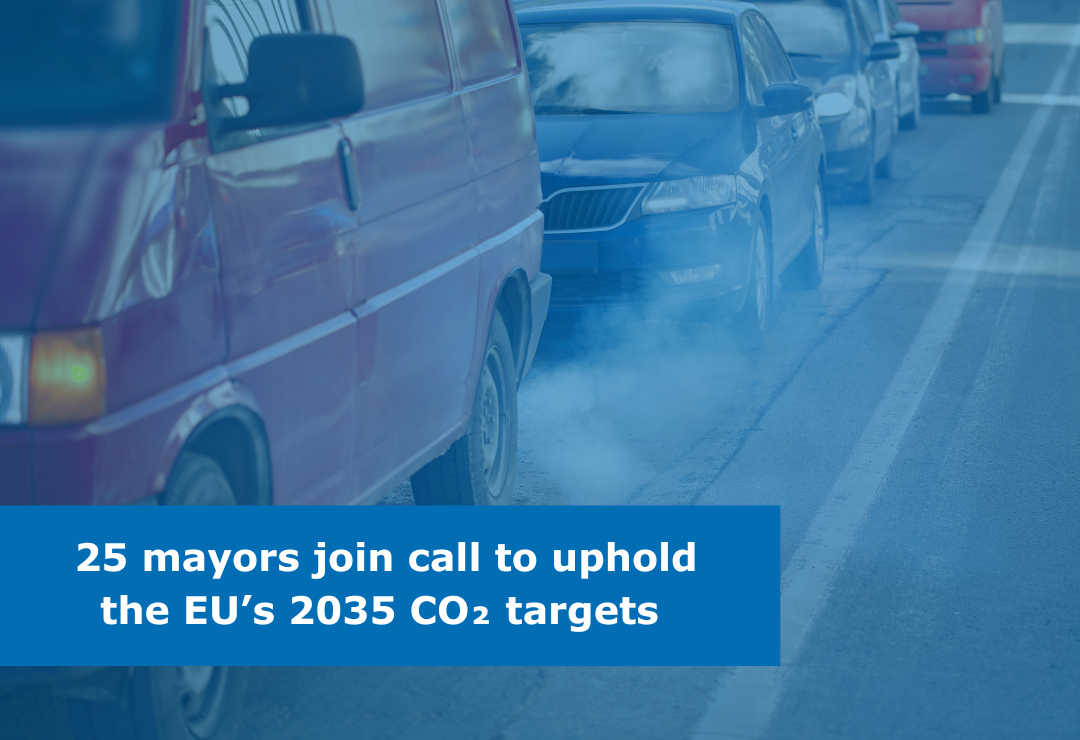
POLIS mayors join call to uphold the EU’s 2035 CO₂ targets
25 European mayors, represented through the C40, Eurocities, ICLEI Europe and POLIS networks, urge the European Commission to maintain the phase-out of new CO₂-emitting cars and vans by 2035.
The joint letter follows the Commission’s announcement to review existing CO₂ standards for road vehicles.
For cities and regions across Europe, this is not merely a regulatory debate: it is a question of public health, social equity, industrial competitiveness, and the credibility of Europe’s climate leadership.
A clear message from cities: Stay the course
The joint letter warns that weakening the 2035 target would reverse critical progress at a moment when 94% of urban residents remain exposed to harmful levels of pollution.
Cities on the frontline of Europe’s air-quality and climate efforts have shown that phasing out polluting vehicles is both feasible and socially beneficial, and the 2035 deadline has been crucial in giving them the certainty to invest, innovate and modernise, meaning any rollback now would jeopardise hard-won progress and stall the transition to cleaner, fairer mobility.
Predictability is critical, for cities and industry
POLIS members have consistently highlighted that electrification is already transforming local mobility systems, supporting the expansion of charging networks, the electrification of public fleets, and the creation of world-leading low- and zero-emission zones. These advances were made possible by a clear EU policy direction.
Weakening the 2035 target threatens to erode the predictability that cities, operators, and industry rely on to make long-term investments. It would also risk opening the door to synthetic fuels in urban environments, despite strong evidence that their tailpipe emissions remain as harmful as petrol and diesel for public health.
A united call for a healthy, competitive and just Europe
European mayors underline that this is not only a climate obligation: it is a social one. Disadvantaged communities, already disproportionately affected by air pollution and climate change, would be the first to suffer from any weakening of standards.
Cities and regions are moving ahead with the transition. They are electrifying fleets, redesigning streets, and driving innovation with public transport operators and local industries. But they cannot deliver alone. A strong and stable 2035 framework is essential to align public and private investments, guarantee a competitive European automotive sector, and ensure that the benefits of the transition—cleaner air, healthier communities, new jobs—are shared by all.
- Related Members


Dublin (NTA)
Gelderland