Paris reinforces mobility ambitions through new political mandate and measurable initiatives
In recent years, Paris has increasingly positioned itself as a global reference for rethinking urban mobility through a broad transformation that connects infrastructure redesign, environmental objectives, and political direction—a transformation visible in both policy results and in the political mandate behind them.
Two recent developments illustrate this shift particularly well: the early results of the périphérique apaisé initiative and the outcome of the 2026 municipal elections. Together, they point to a clear trajectory: one where technical experimentation and political commitment reinforce each other.
The périphérique apaisé initiative
Not without pushback from the transport ministry and some opposition parties, the city of Paris began lowering the speed limit on the 'Boulevard Périphérique', its 35‑kilometre outer ring road and one of Europe’s busiest urban motorways, from 70 km/h to 50 km/h on 1 October 2024. Then, in March 2025, as part of an experimental traffic‑calming and reallocation strategy, the city further introduced a reserved lane for vehicles with two or more occupants (VR2+).

The Boulevard Périphérique — Credits: HJBC, Shutterstock
Available monitoring data from reports by city authorities and analyses shared publicly suggest measurable shifts in traffic performance and environmental indicators following these changes. Between March and April 2025, overall vehicle flow on the ring road fell slightly (around 3–5%), but congestion dropped more sharply, with total traffic jams down approximately 27% and, during VR2+ operating hours, congestion on the reserved lane decreasing by as much as 46%. Average speeds declined in line with the new limit, with daytime speeds down roughly 6–8% and nighttime speeds by 15–18%, while the VR2+ lane allowed slightly higher speeds than other lanes. Accident counts showed modest reductions overall (between 2–14%, depending on measurement scope), and nighttime noise near sectors like Porte de Vincennes fell by around 3 dB(A), from 80.2 dB(A) to 77.2 dB(A).
These results are still preliminary and context‑dependent: air quality in Paris, for example, has been influenced by wider regional emission trends and weather variability. Municipal agencies have acknowledged that isolating the direct causal impact of the périphérique apaisé measures remains a work in progress, but the broad direction of the data suggests measurable shifts in traffic flow, ambient noise, and localised emissions patterns. This level of quantified evaluation is unprecedented for a road of this magnitude within a dense European metropolis.
2026 and the promise of political continuity
The 2026 Paris municipal election, held with a first round on 15 March 2026 and a runoff on 22 March 2026, reaffirmed left‑wing governance of the city at a moment when Paris’s mobility and environmental strategy were among the central axes of political debate. In the second round, Emmanuel Grégoire, the Socialist Party candidate, won the mayoralty with 50.52 % of the vote against the centre‑right candidate, who garnered 41.52 %, securing a majority on the Council of Paris. Grégoire’s list increased the Socialist and allied group’s seats from 96 to 103 out of 163 on the council.
Grégoire’s victory extends the governance continuity established under his predecessor, Anne Hidalgo, who served as mayor from 2014 until 2026 and pioneered many of the urban mobility and environmental reforms that have defined Paris’s transformation. Hidalgo’s administration expanded pedestrian zones along the Seine and in central districts, rolled out extensive cycling infrastructure, and advanced the '15‑minute city' planning model, all with an explicit goal of reducing car dependency and improving urban liveability. Parísian policy debates leading up to the 2026 election frequently framed mobility as a referendum on these broader environmental strategies, including access for vehicles, pedestrianisation, and bike infrastructure.
During the campaign, mobility policy (and especially pro‑cycling stances and public space redesigns) became emotive issues for voters. Grégoire’s platform placed sustainable transport at its core; he pledged to expand bike lanes, pedestrianise additional streets, and build on the city’s environmental commitments, signalling political continuity with the Hidalgo era rather than a reversal. His victory was celebrated with a symbolic bicycle ride to City Hall, underscoring the political and cultural significance of mobility in Parisian urban identity.
The electoral reinforcement of a government that champions these mobility reforms is significant. It signals wider public endorsement of the sustainability agenda—at least among the electorate that turned out—and reduces the risk of abrupt policy reversals that could derail long‑term investment and planning. That political backing is essential for scaling up short‑term experiments like périphérique apaisé and bike lane expansions into longer‑term structural commitments for urban transport and planning.
Paris’s broader vision
The périphérique apaisé measure and the municipal election outcome both sit within a broader trajectory of mobility policies that have reshaped Paris in recent years, moving from car‑centric infrastructure toward multi‑modal, low‑emission, and people‑oriented spaces.
For decades, the Boulevard Périphérique symbolised the contradictions of metropolitan mobility: with more than one million vehicle movements daily, it concentrated congestion, noise, and pollution at the edges of the city. Today, this corridor is being reimagined alongside other initiatives that collectively define Paris’s mobility agenda.

100% biomethane bus in Paris — Credits: Here Now, Shutterstock
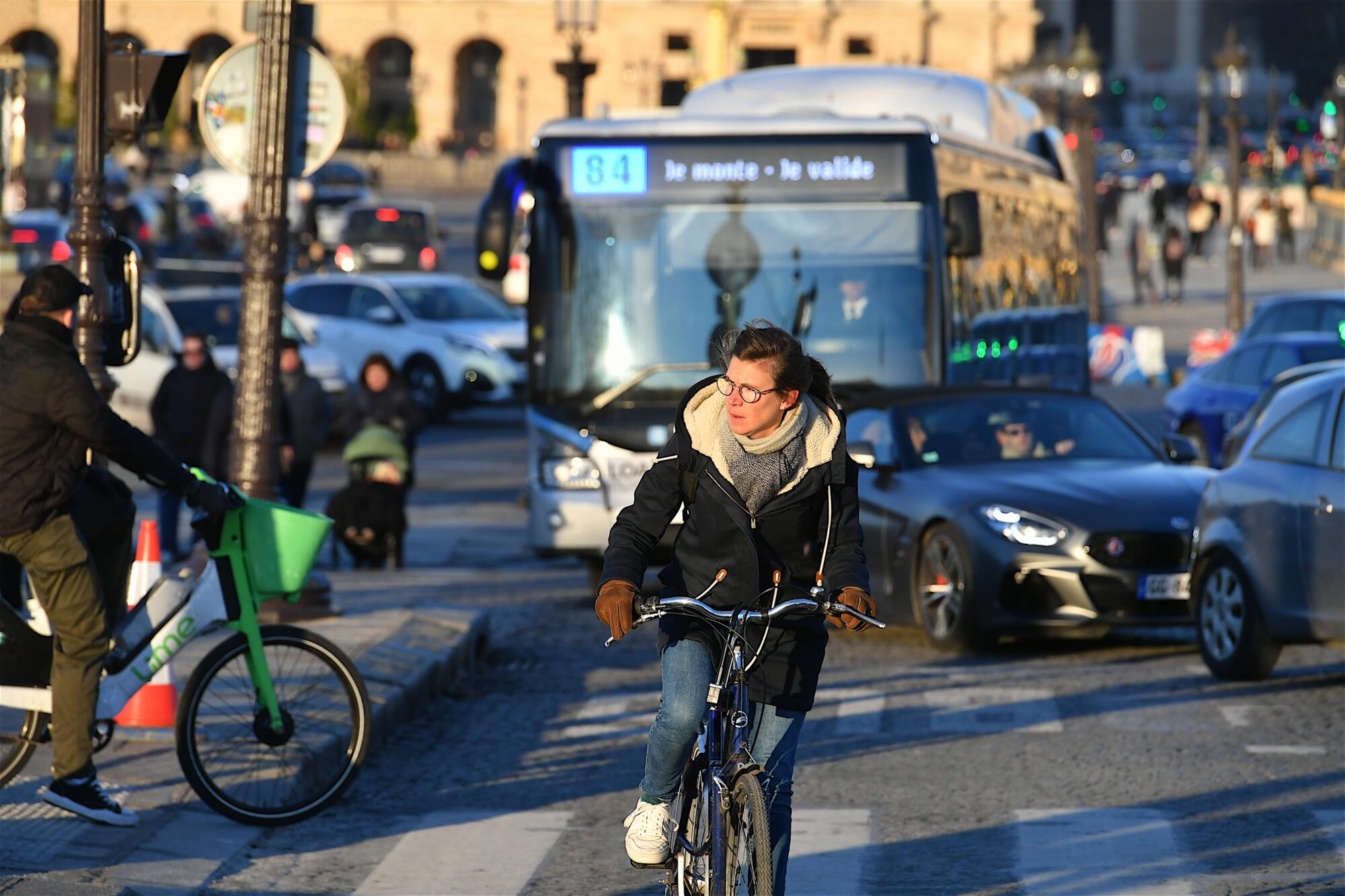
Paris has systematically reduced car dominance in urban space by expanding pedestrian zones in central districts, implementing car‑free Sundays and low‑emission zones (LEZs) that restrict older, more polluting vehicles, and reclaiming on‑street parking for cycling infrastructure and electric vehicle charging. The city has also pursued massive investment in cycling infrastructure, building well over 1,000 km of bike‑friendly routes, including permanent lanes born from temporary coronapistes installed during the pandemic. These routes, along with a modernised bike‑sharing system with thousands of e‑bikes, are central to the city’s strategy to shift mode share away from cars. Policies such as 'Paris Respire', which designates car‑free days or zones, explicitly promote cycling and walking in neighbourhoods across the city.
Public transport improvements—dedicated bus corridors, tram expansions, and metro enhancements—complement these shifts, providing reliable alternatives to private vehicle use. Environmental goals, including commitments to reduce transport‑related greenhouse gas emissions and improve air quality, are woven into planning frameworks that now consider noise reduction and liveability as quantifiable policy outcomes.
Throughout this period, political and civic alignment has played a pivotal role. Municipal leadership under Hidalgo and now Grégoire has consistently framed mobility as an intersectional issue of public health, climate action, and quality of life rather than merely transport logistics.
- Related Members