
ECA Audit 2026 reveals gaps in EU Sustainable Urban Mobility Plans
Urban mobility in the EU is facing growing pressures. Approximately 75% of the population lives in urban areas, which are economic hubs but also centres of congestion, pollution, and long commuter journeys.
The European Court of Auditors (ECA) Special report 05/2026 'Sustainable commuting around urban areas – Moving forward, with local action crucial to reach destination' highlights that local authorities play a critical role in translating EU sustainable urban mobility objectives into tangible improvements for residents.
Understanding the challenge

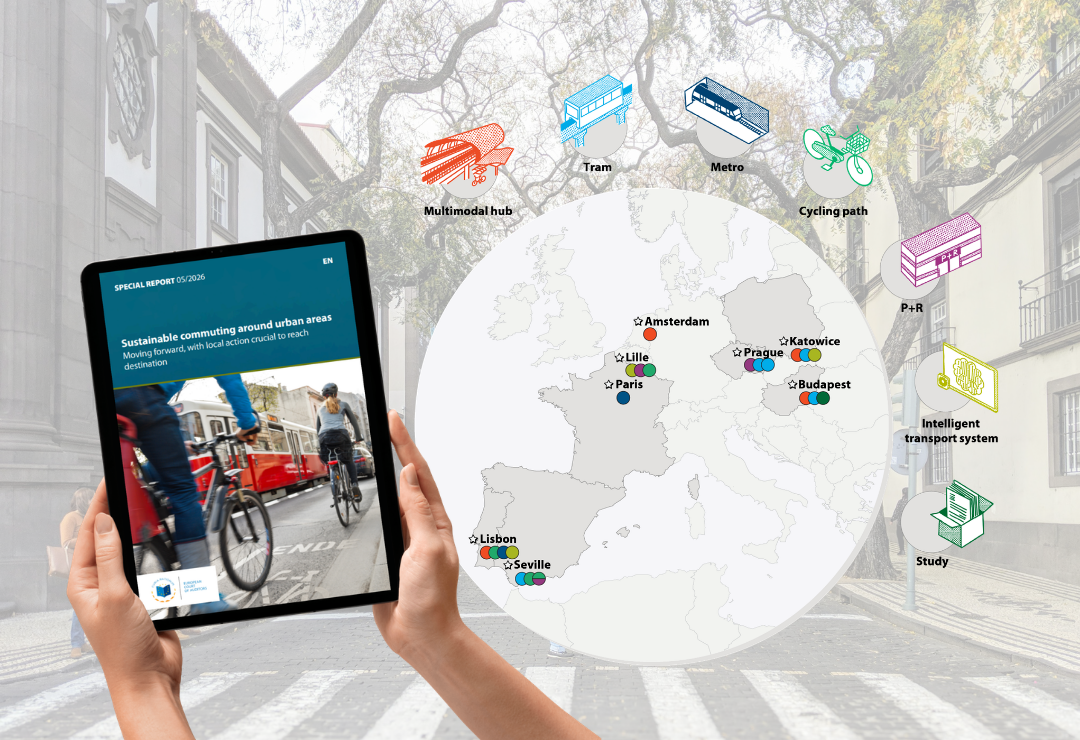
Location and type of audited projects — Credits: ECA
Population growth in suburban commuting zones is outpacing city centres, driving longer trips and increased reliance on private cars. In six audited cities—POLIS members Budapest, Lisbon, Lille, and Prague, as well as Seville and Katowice—public transport coverage in suburban areas often falls short, leaving commuters with limited options. Travel-time simulations show that in most cases, private cars remain faster than public transport during peak hours, while cycling can be viable only in specific cases, such as Seville.
Transport poverty is particularly pronounced in suburban areas, where a lack of public transport, limited multimodal options, and high travel costs reduce accessibility to jobs and services. Cities must recognise that improving accessibility is not just about extending lines but integrating services, offering on-demand transport, shared mobility, and seamless ticketing.
Effective SUMP implementation
Sustainable Urban Mobility Plans (SUMPs) are intended to guide cities in improving accessibility, reducing emissions, and promoting active and collective transport. Audit findings indicate that while SUMPs generally include measures for multimodal hubs, on-demand transport, and integrated ticketing, their effectiveness varies depending on:
- Geographical coverage: Most SUMPs are defined by administrative boundaries, excluding significant suburban commuter flows—up to 64% in Seville and 46% in Budapest.
-
Car-use reduction policies: Parking management is common, but land-use planning and employer mobility management measures are often limited or absent.
-
Monitoring and data: Only a few cities actively monitor implementation; indicators are often output-focused (eg, kilometres of cycle paths) rather than outcome-focused (eg, travel-time savings, modal shift).
Cities that integrate land-use planning with mobility policies, such as limiting parking near public transport hubs, can encourage a modal shift to sustainable options. Lille, for example, provides a model with coordinated frameworks linking public space planning, employer mobility schemes, and active transport infrastructure.
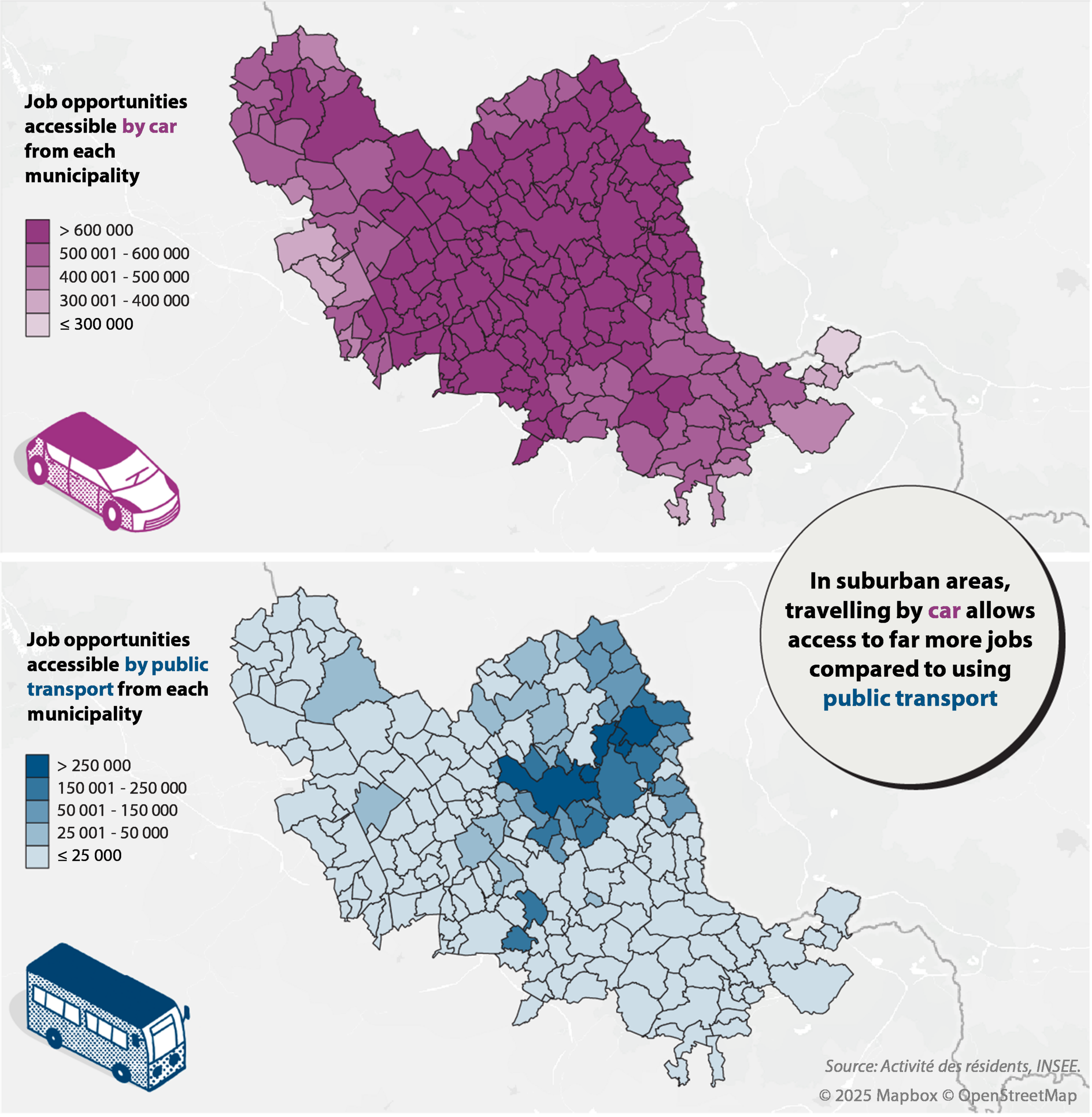
Functional urban area of Lille – accessibility of jobs by public transport (within 45 minutes) — Credits: ECA, based on data from INSEE
EU funding that matters (if used correctly)
Local authorities manage projects funded by EU programs like Cohesion Policy Funds, the Connecting Europe Facility, and the Recovery and Resilience Facility, which must align with local sustainable urban mobility plans (SUMPs) or comparable strategies to ensure value for money and effectiveness. The ECA audit found that while most projects delivered planned outputs, such as cycling paths, multimodal hubs, or upgraded public transport stops, their impact on commuter behaviour was often limited due to incomplete needs assessments, delayed implementation, or poor coordination between neighbouring municipalities. For instance, park-and-ride facilities in France and Hungary suffered from low usage because they lacked direct public transport links or proper demand analysis.
Effective evaluation depends on reliable indicators for modal shift, commuter satisfaction, and GHG emissions reduction. The audit highlighted wide inconsistencies, with some projects using overly simplistic or uniform emission reduction assumptions, while only a portion defined result indicators. Even where indicators existed, data quality and monitoring were uneven, making it difficult to assess whether projects genuinely advanced sustainable mobility objectives or EU climate targets.
A suburban focus is critical to reduce car dependency. The audit found that shared mobility and on-demand transport were often limited to city centres, leaving suburban commuters reliant on private cars. Extending multimodal connections, integrated ticketing, and flexible transport services into suburban areas would shorten commuting times, increase public transport attractiveness, and support modal shift. Without these measures, suburban populations continue to face transport poverty, with limited access to jobs and services, undermining the EU’s climate and mobility goals.
Lessons and recommendations
 City authorities play a central role in turning sustainable urban mobility plans into tangible improvements for commuters—if you do not believe us, hear it from the Mayor of Budapest Gergely Karácsony. Lessons from audited projects show that integrated, well-coordinated approaches, combining infrastructure, data-driven planning, and employer engagement, can significantly boost accessibility and promote modal shift. At the same time, gaps in suburban connectivity, cross-boundary coordination, and the use of robust indicators highlight areas where cities can strengthen their strategies.
Building on these lessons, the following recommendations aim to guide city authorities in expanding SUMP effectiveness, enhancing multimodal networks, integrating mobility with urban planning, and using EU funding efficiently to achieve measurable outcomes in accessibility, travel times, and emissions reduction.
Recommendations for city authorities
-
Expand SUMP coverage to entire functional areas: Include suburban commuter flows and cross-border movements where relevant.
-
Integrate mobility with urban planning: Limit parking near public transport nodes, prioritise pedestrian and cycling infrastructure, and link mobility to land-use policies.
-
Enhance multimodal connectivity: Develop hubs, integrated ticketing, on-demand services, and suburban shared mobility.
-
Implement monitoring and indicators: Focus on outcomes, such as travel-time reductions, modal shift, and GHG emission reductions, and not just outputs.
-
Leverage EU funding strategically: Align projects with SUMPs, ensure needs assessments and feasibility studies are complete, and coordinate across neighbouring authorities.
- Related Members