
Vehicle-to-Grid – not as futuristic as you might think!
The European Commission wants 30 million Electric Vehicles (EVs) by 2030 – something that will dramatically increase electricity demand. While some might ponder on whether this goal could be reached or not, some cities, regions and organisations are taking matters into their hands. Sabina Asanova tells us more about three POLIS members that are currently taking action in the Netherlands.
The European Commission wants 30 million Electric Vehicles (EVs) by 2030 – one of the sustainable mobility milestones in the European Green Deal to achieve a 55 % CO2 reduction and a pretty good reason to dramatically rise the demand for electricity. However, only by correctly balancing and integrating electric transport with the electricity grid and the renewable energy options it is possible to achieve a transport system that would (and could) match the Green Deal goals.
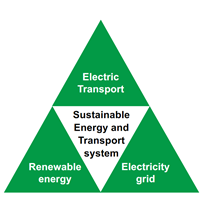
Components of Sustainable Energy and Transport System - Credits: SEEV4-City
In 2020, the Netherlands had already over 272,000 electric vehicles (Battery EV + Plug-in Hybrid). By 2030, the Dutch aim to reach two million EVs.
Fair questions – and ones that pop out of anyone’s mind when thinking about the deployment of electric vehicles in Europe – are: How are cities, regions, and provinces rolling out their sustainable energy and transport system? Are there clear, tangible examples?
Indeed, there are. Or at least, POLIS Network does know where to find them.
Amsterdam

Credits: SEEV4-City
Amsterdam is preparing for an expected increase of electric cars, as well as an increase of locally generated renewable energy. The city is aware of the limits to the existing distribution network in accommodating this increasing electrification, and, therefore, is open to host and support research and innovation pilots for smart charging and V2G solutions. Recently, two pilots were implemented and supported by the Interreg North Sea Region programme.
The first pilot focused on Vehicle2Business. The Amsterdam Arena is a large sports and event facility that presents a different order of magnitude for V2G experiences, with a consumption of energy comparable to a district of 2,700 households. Thanks to its photovoltaics (PV) installation, the Amsterdam Johan Cruijff (JC) Arena already produces around 8 % of the electric energy it consumes, the rest is foreseen by certified regional wind energy.
Within the Seev4-City project, the JC Arena has invested in a 3 MW/2,8 MWh battery energy storage system, 14 EV charging stations and one V2G charging unit. With 2,000 parking spaces at the Arena, many owned by the municipality, the potential for further optimization is large. In addition, the experience of the Amsterdam Arena serve as a development model for other stadiums worldwide.
The second pilot in Amsterdam dealt with Vehicle2City, defined as Flexpower I and II. The Flexpower pilot was used to test, improve, and scale up a smart charging solution that reduces the power available for charging EVs when the stress on the electricity network is already high and then allows faster charging when the available capacity is sufficient.
For this purpose, dynamic capacity profiles were created, and energy use of 432 charging stations throughout Amsterdam monitored. An important conclusion is that scaling up will significantly improve both impacts and business cases. The results of this pilot support the roll-out of V2G schemes in Amsterdam, and also serve to explore the possibilities of variable energy prices in combination with V2G.
Noord-Brabant province

Credits: DeeldeZon
The ERDF-funded Interreg Flanders-Netherlands project DeeldeZon 2018-2022, set up by Zonnova and partners and supported by the Province of Noord-Brabant, is looking for an integrated solution storing the generated renewable energy in EVs during the day and deliver it back in the evening.
DeeldeZon connects solar energy to a direct current 20 kW Vehicle to Grid (DC-V2G) charging station with shared EVs serving as a district battery. A DC-V2G charging station returns 5,5 times more energy than its alternating current (AC) equivalent (20 kW versus 3,6 kW). In Europe there are already 50,000 EVs that can be connected directly to a DC-V2G charging station. A single EV has a DC feed-in capacity of 55 solar panels, delivering 20 kW. The reservation system for the shared EVs supplies usage data for the individual cars and the users. This is the basis for the feed-in strategy.
The province of Noord-Brabant is helping to bring the project to the attention of larger players in the field, such as network operators and energy companies – this would allow it to be scaled up. In Noord-Brabant, the project is up and running at Hoogeind, in the municipality of Breda, and is under development in, among others, the Municipality of 's-Hertogenbosch, where the DeeldeZon system is based on neighbourhood centres.
To provide insight into the importance of the concept at the local level, ZenMo TU/e have developed an interactive simulation model on behalf of DeeldeZon that shows that with the right mix of smart charging stations, V2G charging stations and shared EVs in the neighbourhood the local network is not overloaded. Well balanced charging techniques make the EV a pleasure for the neighbourhood instead of a burden.
The City of Arnhem

Credits: CleanMobilEnergy
The CleanMobilEnergy project (CME) is made possible by Interreg North West Europe and focuses on implementing an interoperable energy management system (iEMS) in four city pilots to demonstrate how different local combinations of electric mobility, battery storage and renewable energy can be optimised to maximise local self-reliance and minimise impacts on the power grid. Partners from Germany, The Netherlands, UK, France, Luxembourg, and Belgium collaborate to realise this.
The City of Arnhem (NL) coordinates the project as Lead Partner as well as implementing its own ambitious city pilot, involving a river cruise ship harbour, a large battery storage system, a 14 MW solar farm located next to the harbour and all public electric vehicle (EV) chargers in the city. The harbour provides electricity to ships so they do not run their diesel generators while docked. All of these components are connected to the iEMS, which forecasts the supply of solar energy and the demand from the EVs and harbour. The iEMS then optimises the energy flows to make sure the most solar energy is consumed locally, and the grid is not congested by peak demand, by controlling the battery storage as well as recommending smart charging behaviours to the EVs.
To date, Arnhem has electrified the harbour, which can fit up to 18 large ships, installed the 1,5 MWh battery, connected 200+ EV chargers in the city to the iEMS system, and is currently building the solar farm. The main challenge so far has been in establishing a commercial/legal agreement between all parties involved to ensure that the iEMS can be operated in a fair, transparent manner with benefits shared to provide the business case for each party. As part of a shared energy system, all interests need to be represented in the control priorities of the iEMS, which is a unique challenge not seen in cases where such a system manages devices from a single owner.
Lead by example
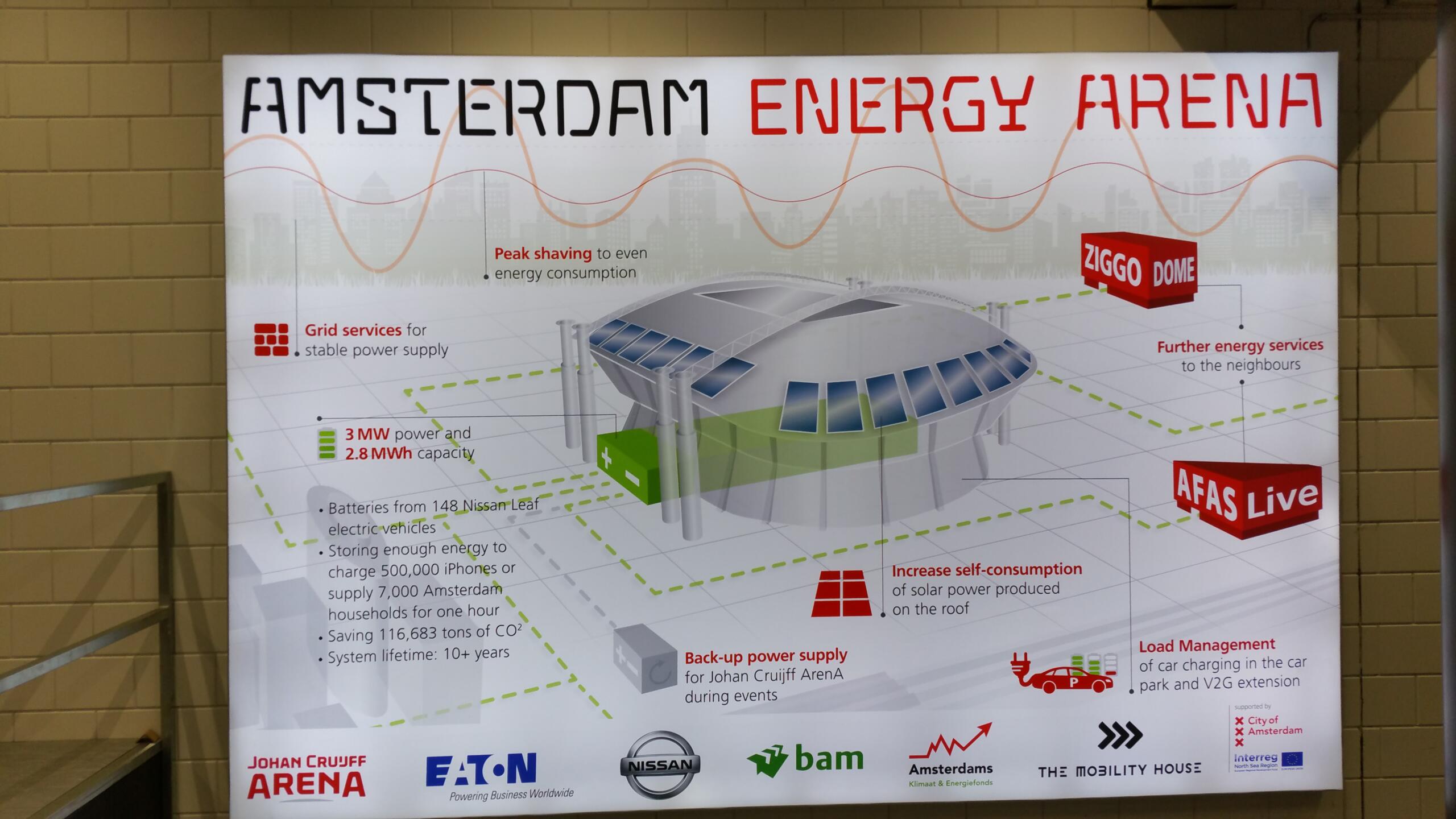
Arena scheme within SEEV4-City - Credits: SEEV4-City
No matter how futuristic the applications above sound, these technologies are developing rapidly and will be embedded in the decarbonisation strategies.
So, take the examples above as an inspiration and do not wait to start with exploring V2G in your city or region.
To help you in this task, POLIS together with Northumbria University and AVERE, has published a set of recommendations for different levels of public authorities: check it, and get it started.
____________________
About types of charging
Uncontrolled charging does not include any manipulation and does not consider high or low demand moments. It usually increases peak demand on the grid and may cause power flow and voltage control problems.
Smart Charging is time-controlled charging when electricity demand is low. This helps grid stability.
V2X (includes Vehicle-to-Grid (V2G), Vehicle-to-House (V2H), Vehicle-to-Business (V2B)) includes smart charging but in addition uses the EV as a mobile storage, thus car charges when the electricity is in low demand and car battery feeds electricity back to the grid when there is an electricity demand peak. This technology further improves the benefits to the grid and provides energy savings or revenues to the Photovoltaic/EV owner.
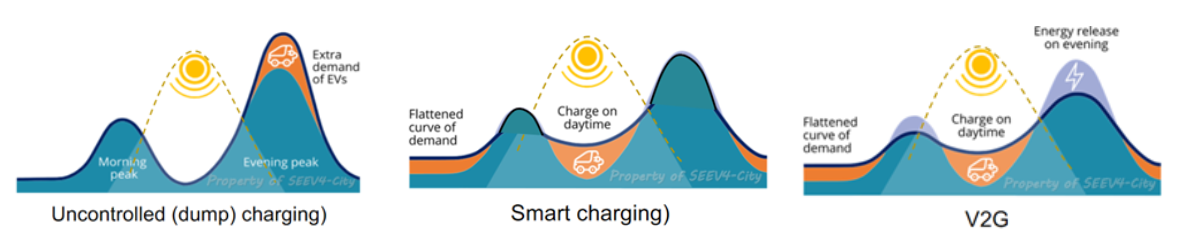
From left to right: Uncontrolled (dump) charging, smart charging concept, vehicle-to-Grid (V2G) - Credits: SEEV4-City
____________________
About the author
Sabina Asanova was Senior Project Manager and Coordinator Clean Vehicles & Air Quality at POLIS Network.
 Credits: CleanMobilEnergy