POLIS joins READJUST focus group to rethink mobility
Participants in the READJUST project focus groups, held across Europe in February and March 2025, have played a crucial role in shaping the project’s insights into a just and inclusive green transition. POLIS played a central role in these discussions, ensuring mobility was seen as more than a supporting factor and recognising it as a core driver of access, opportunity, and social inclusion.
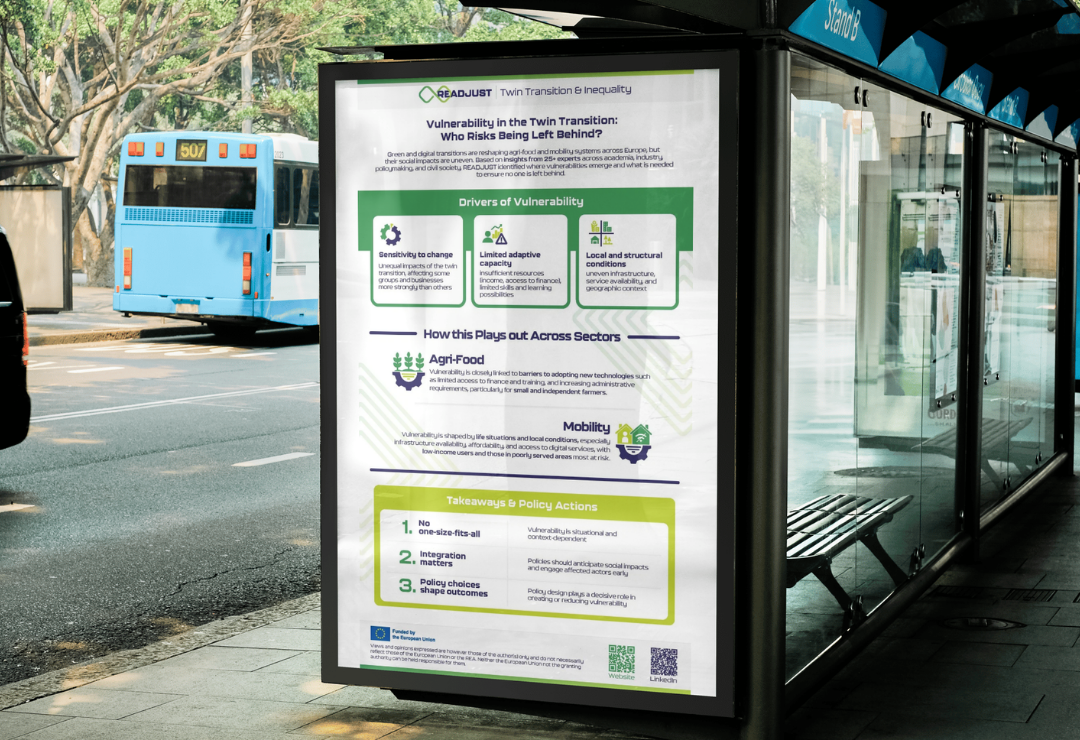
The READJUST project, funded by the EU, has now published its deliverable synthesising the findings and recommendations from these discussions, available on the READJUST website. This report highlights how climate policies intersect with social inequalities and demonstrates how participant contributions have guided the project’s outcomes.
Through a combination of research, stakeholder engagement, and policy analysis, the READJUST project has shown that mobility is a critical dimension of a fair transition. Focus groups and consultations brought together policymakers, researchers, civil society organisations, and practitioners to share experiences, identify challenges, and produce actionable insights for socially just climate action. A central finding is that climate policies affect people differently, with vulnerable groups—low-income households, women, older adults, and rural residents—facing the greatest barriers.
Affordability emerged as one of the most pressing issues. While public transport networks exist in many regions, ticket prices and subscription models are often misaligned with the realities of those most in need, limiting actual access. Other barriers include digital exclusion, lack of information, and safety concerns, all of which shape travel behaviour. Rural and low-density areas face additional challenges, with limited service provision forcing reliance on private vehicles or creating transport poverty. The transition to low-emission mobility can be particularly difficult in these contexts, as alternatives such as electric vehicles or shared mobility options are not always accessible or affordable.

Challenges, solutions, and POLIS’ contribution
Focus group discussions also explored potential solutions. Demand-responsive transport (DRT) systems, which adapt routes and schedules to actual demand, were highlighted as a promising way to serve dispersed communities. Fare integration and seamless multimodal networks were also recommended to make mobility more predictable and inclusive. At the same time, the project emphasised that technological innovation alone is not sufficient; new mobility solutions must be implemented with equity in mind to avoid reinforcing existing inequalities.
POLIS contributed significantly to the project by bringing a mobility-focused perspective to the discussions. This input helped shape the project’s recommendations for inclusive climate policies and demonstrated how local and regional experiences can inform broader EU-level strategies.
The READJUST findings, showcased in their report 'Vulnerability assessment and engagement strategy', underline that achieving a just transition in mobility requires a systemic approach. Policy measures must integrate affordability, accessibility, spatial planning, and social inclusion, with strong coordination across sectors such as transport, urban planning, and social policy. Mobility is not just a technical issue—it is a social one. Ensuring fair access to transport enables broader participation in society and supports wider climate objectives.