New POLIS policy paper links local and regional mobility to EU competitiveness goals
As competitiveness moves to the centre of European policymaking, a new POLIS policy paper argues that the debate risks overlooking one of its most important foundations: the regional transport systems that connect people, businesses, infrastructure, skills, and innovation
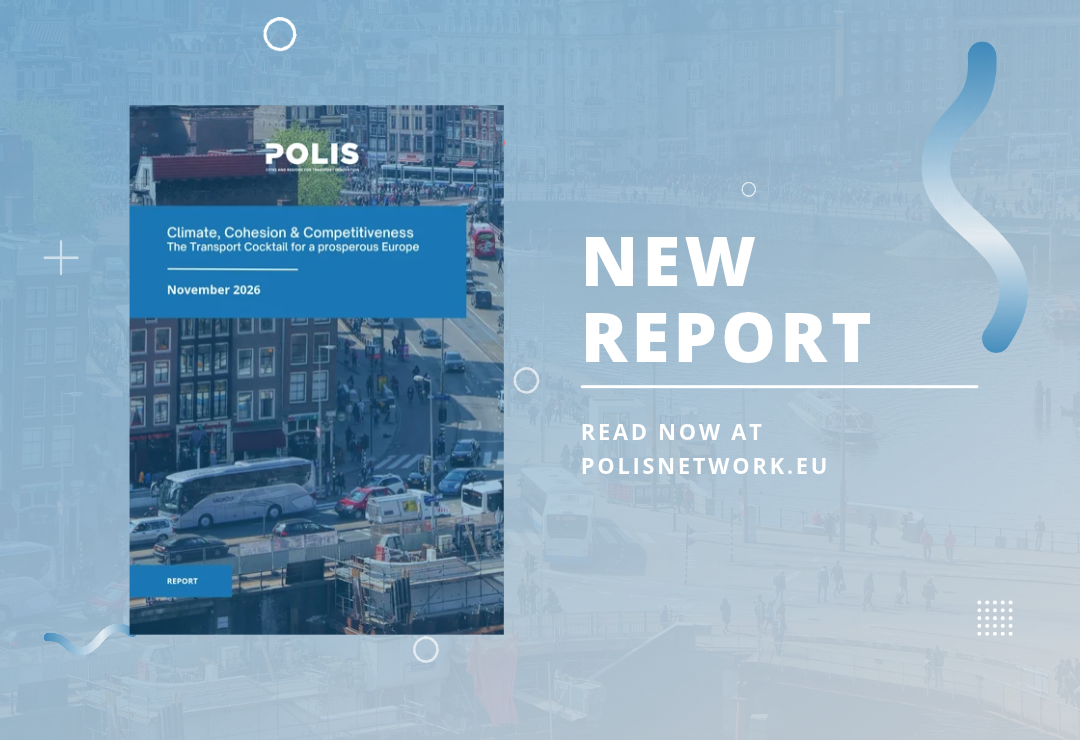
With 'competitiveness' becoming a central policy buzzword in Europe, POLIS' latest policy paper 'Climate, Cohesion & Competitiveness: The Transport Cocktail for a prosperous Europe' argues that the term is often misunderstood and too frequently separated from climate action and cohesion goals. Instead, it emphasises these objectives not as competing priorities, but as mutually reinforcing outcomes of well-functioning territorial and mobility systems.
Across Europe, competitiveness is increasingly framed in terms of industrial strength, technological leadership, and economic growth. While these elements do remain important, the paper argues that competitiveness is too often separated from climate action and cohesion goals, despite all three being deeply interconnected. As Europe navigates industrial transformation, demographic change, energy volatility, and growing climate risks, the paper argues that long-term prosperity depends on recognising these objectives as mutually reinforcing. Transport is central to this challenge: not simply as another economic sector, but as the infrastructure through which people, businesses, goods, skills, and innovation move across territories. A competitive European economy, therefore, requires a competitive regional transport market.
The transport system behind Europe's economy
Transport is not simply another economic sector. It enables the daily movement of people, goods, services, and knowledge, shaping how workers access jobs, how businesses connect to suppliers and customers, and how innovation reaches the market.
The paper argues that improving the efficiency of regional transport systems can generate benefits beyond transport itself. More efficient mobility can lower energy costs for households and businesses, strengthen resilience, improve accessibility, and create the conditions for innovation and investment to spread across territories. Conversely, congestion costs the European economy an estimated €180 billion annually, while poor connectivity and accessibility gaps continue to leave some regions at a competitive disadvantage.
The role of cities and regions
The paper places local and regional authorities as key enablers of Europe’s transformation, arguing that the green and digital transitions are also territorial transitions. Success depends on connecting these shifts rather than managing them in parallel.
Cities and regions play three reinforcing roles:
- Economic builders, creating the physical and operational conditions for access to jobs, services, and opportunities;
- Market shapers, using procurement and investment decisions to steer mobility markets towards decarbonisation and innovation;
- Innovation drivers, acting as real-world testbeds for new mobility solutions such as electric buses and autonomous shuttle services.
On this basis, the paper stresses that cities and regions should not be seen as passive implementers of EU policy, but as essential actors in delivering systemic transformation. It calls for stronger alignment between EU policy frameworks and local implementation capacity in the next Multiannual Financial Framework, alongside stable support for cross-border and place-based mobility investment.
Synergies, not trade-offs
Rather than framing climate action, cohesion, and competitiveness as competing objectives, the paper highlights the opportunities that emerge when they are addressed together.
Climate resilience protects Europe's long-term economic capacity. Cohesion supports participation in economic and social life while helping innovation and investment spread across territories. More efficient and accessible mobility systems can strengthen strategic autonomy by reducing energy demand and exposure to external shocks.
The paper identifies several areas where these synergies can be realised, including tackling transport poverty through affordable mobility alternatives, scaling up the deployment of European-made electric buses, supporting autonomous transport services where they meet genuine mobility needs, and strengthening Europe's cycling economy through investment in infrastructure and safer streets.
In each case, transport policy can support economic, social, and environmental objectives simultaneously, demonstrating that Europe's greatest opportunities lie not in matching trade-offs, but in building connections between policy goals.
Let local lead
Achieving Europe's ambitions on competitiveness, climate, and cohesion will require closer alignment between European objectives and local implementation.
To achieve this, the paper calls for policy and funding frameworks that recognise cities and regions as strategic partners in economic development, market creation, and innovation. It also advocates stronger cooperation across levels of government, support for local and regional capacity, cross-border collaborations, and stable investment frameworks that provide certainty for public and private actors alike.
The paper's message is clear: Europe's competitiveness cannot be built through industrial policy alone. It also depends on the strength of the transport systems and territorial ecosystems that connect people, places, businesses, and innovation across the continent. A competitive regional transport market is therefore not only a mobility objective, but a foundation for a more competitive, cohesive, and climate-resilient Europe.
Karen Vancluysen, POLIS Secretary General, emphasises:
Reality shows that competitiveness means teamwork, as all actors rely on an ecosystem, and that ecosystem does not exist in a vacuum: it is rooted in concrete territories, connected by transport and mobility systems. Good connections are therefore not simply an outcome of a competitive economy: they are one of its foundations.
Read the policy paper here, or download it from the side or the bottom of this page.
- Related Documents
- Related Members
Climate, Cohesion & Competitiveness: The Climate & Cohesion Competitive Transport Cocktail

Baden-Württemberg