Leuven, Prague, and Helsinki rethink (and innovate) last-mile delivery
The rapid expansion of e-commerce has intensified pressure on urban logistics systems, particularly in the 'last mile', widely recognised as the most expensive, least efficient, and most polluting segment of the delivery chain.
As cities grapple with congestion, emissions, and rising consumer expectations for speed and flexibility, incremental improvements are no longer sufficient. What is emerging instead is a structural transformation of last-mile logistics, one that integrates new vehicle types, digital optimisation, and collaborative delivery models.
A recent VTI study by Robert Klar and colleagues provides a rigorous analytical foundation for this transformation. Their work models a hybrid delivery system in which autonomous robots and vans operate in tandem, using optimisation techniques to allocate parcels based on cost, energy use, and operational constraints. At the same time, cities and companies across Europe, including POLIS members, are piloting real-world applications of similar concepts. Together, these developments point toward a new paradigm: a layered, multimodal last-mile system in which different delivery modes are strategically combined rather than substituted.
An intelligent system that allocates parcels
Autonomous delivery robots go beyond standalone innovation and deserve a prime position in the broader logistics architecture. While vans remain essential for long-distance routes and bulky goods, robots can now handle short-range, lightweight deliveries in dense urban areas, and this division of labour may be formalised through an integer programming model that minimises both operational costs and energy consumption.
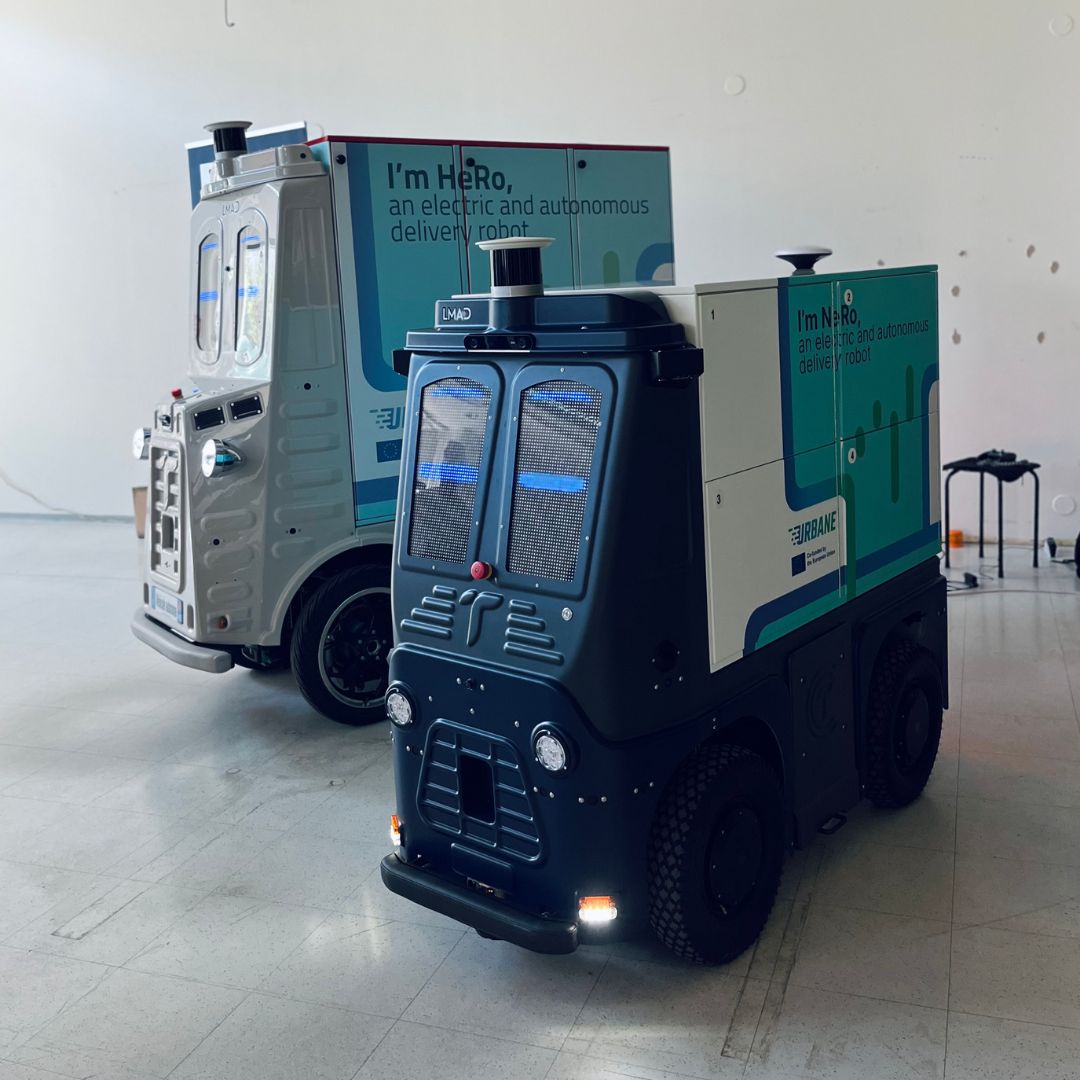
HeRo and NeRo robots inside the Helsinki microhub — Credit: Satu Reijonen
A key methodological innovation highlighted in the Klar study is the use of spatial clustering, specifically K-medoids, to define delivery zones based on building density and road network data. These zones effectively function as operational units where robots can be deployed efficiently, often supported by localised hubs or transfer points. Within this framework, the model dynamically assigns parcels to either robots or vans, taking into account constraints such as distance, payload, and vehicle capabilities.
The results are striking: depending on the configuration, the hybrid system may reduce costs by up to 57% and energy consumption by up to 42%. However, the study also highlights a critical nuance: these gains depend heavily on context, including urban density, infrastructure, and the configuration of the delivery network. In other words, the model provides an optimisation logic, but its real-world performance depends on how well it aligns with local conditions.
Real-world validation
Across Europe, cities and logistics operators are beginning to test precisely these kinds of hybrid and multimodal systems. The cases associated with POLIS members offer valuable empirical insights into how the theoretical model translates into practice.
In Leuven, the Colruyt Group has launched a pilot through its Collect&Go service using autonomous delivery vehicles developed by indiGOtech (technically, the delivery vehicle used is the Clevon 1 model from the Estonian startup Clevon, which was then acquired in 2025 by the US company indiGOtech). Unlike many sidewalk-based robots, these vehicles operate directly in urban traffic without predefined routes. This represents a notable shift in design philosophy. Rather than functioning as last-mile delivery tools, these robots act more like compact, fully autonomous delivery vehicles integrated into the broader traffic system.
From an analytical perspective, this expands the solution space envisioned in the Klar model. If robots can operate beyond sidewalks and interact with general traffic, they may take on a larger share of deliveries. However, this also introduces new constraints, particularly around safety, regulation, and public acceptance, areas that are only partially captured in optimisation frameworks.
A different operational model is visible in Prague, where foodora, in partnership with Starship Technologies, is piloting sidewalk-based delivery robots. These robots operate within a limited radius of around two kilometres and are primarily used for hot food and grocery deliveries. This configuration closely mirrors the assumptions of the Klar study: short distances, lightweight goods, and high delivery density.

Autonomous foodora delivery robot at pedestrian crossing in Karlin, Prague, Czech Republic — Credit: arazu, Shutterstock
The robots are fully electric and consume minimal energy per delivery, reportedly comparable to boiling a kettle. Moreover, by shifting short trips away from vans, they reduce congestion and free up human couriers for longer or more complex routes: this illustrates the complementary role of robots within a hybrid system, rather than a replacement for traditional delivery modes.
Further north, in Helsinki, autonomous delivery robots have been tested as a way to manage peak demand during the holiday season. Here, the emphasis is less on spatial optimisation and more on temporal flexibility. Robots act as scalable assets that can absorb fluctuations in demand without requiring a proportional increase in fleet size. This highlights another dimension of hybrid systems: their ability to adapt dynamically not only to geography but also to demand patterns.
The role of European projects
What distinguishes these cases is not only the technology itself but also the institutional context in which it is deployed. Through projects such as GREEN-LOG, URBANE, and UNCHAIN, POLIS facilitates collaboration between cities, logistics providers, and technology developers.
Cities like Ghent and Mechelen are experimenting with Logistics-as-a-Service platforms, while Berlin is developing tools to optimise the placement of micro-depots. Barcelona is exploring cargo-bike hubs linked to public transport, and Madrid is focusing on data-driven route optimisation and congestion forecasting.
These initiatives demonstrate that robot delivery is only one component of a broader transformation. The effectiveness of hybrid systems depends on supporting infrastructure, such as micro-hubs, as well as regulatory frameworks and data-sharing mechanisms. In this sense, POLIS and our projects play a critical role in aligning technological innovation with urban policy and planning.
A layered logistics architecture
The convergence of optimisation research and real-world experimentation points toward a clear conclusion: the future of last-mile delivery is not defined by a single technology, but by the integration of multiple modes within a coordinated system.
In this emerging architecture, vans handle long-distance and bulky deliveries, robots manage dense, short-range distribution, and micro-hubs act as coordination points. Digital platforms and data-sharing systems enable real-time optimisation, while cities provide the regulatory and infrastructural framework necessary for deployment.
The main challenge ahead is not technological feasibility, but systemic integration. Questions around land use for micro-depots, interoperability between logistics providers, and regulatory harmonisation across cities remain unresolved. Addressing these issues will determine whether the efficiencies identified in models like that of Klar et al. can be realised at scale.
What is already clear, however, is that the last mile is no longer a marginal segment of the logistics chain. It has become a central arena for innovation, where optimisation theory, urban policy, and technological experimentation intersect to reshape how goods move through cities.

- Related Projects
- Related Members





Forum Virium Helsinki