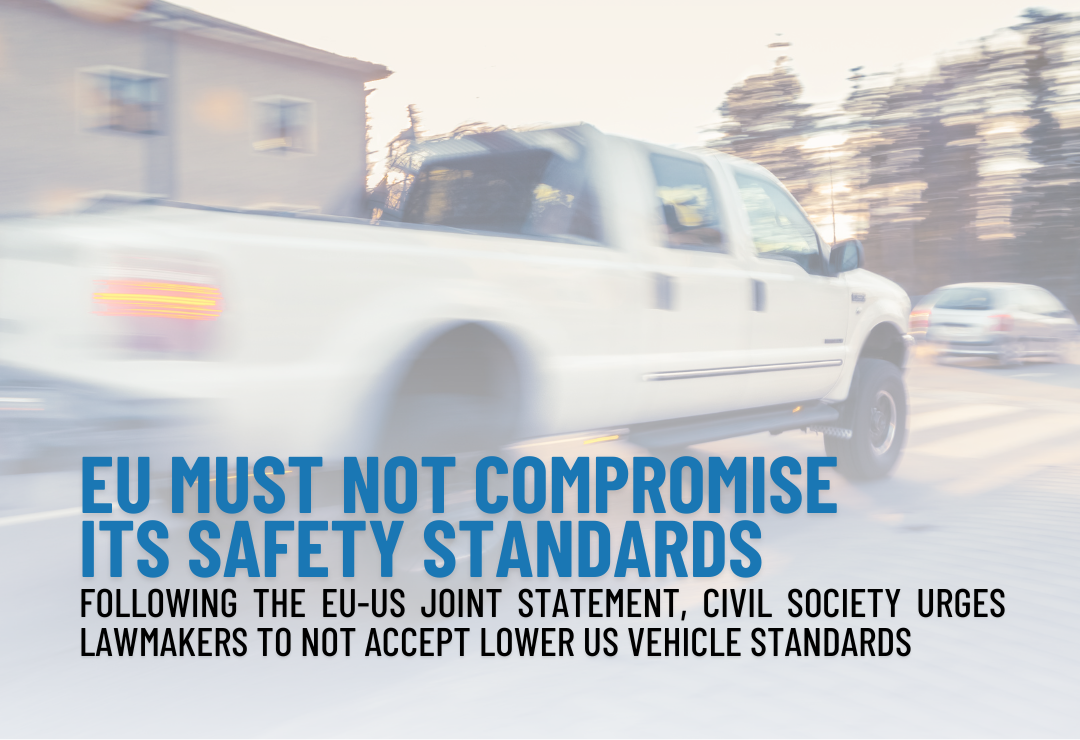
EU must not accept lower US vehicle standards
In August, the EU and the US issued a joint statement, suggesting that the EU has accepted the lower US vehicle standards. European cities and civil society organisations warn policymakers that this would undo decades of EU progress, with profound consequences on road safety.
Following the EU–US Joint Statement on trade, published on 21 August 2025, the European Union is once again putting road safety at risk. Vehicle safety standards have been under negotiation for months, and the latest statement signals the EU’s intention to accept weaker US car regulations.
In response, many European cities, including Paris, Brussels, and Amsterdam, along with more than 75 civil society organisations, have written to European lawmakers urging them not to accept and provide mutual recognition to US-made vehicles. POLIS has signed the letter, reaffirming its call to uphold its high standards in road safety, public health, climate policy, and competitiveness.
A threat to safety, the environment, and industry
Since 2010, EU vehicle safety regulations have helped reduce road deaths by 36%. Over the same period, fatalities in the US have increased by 30%, with pedestrian deaths up 80% and cyclist deaths 50% higher.
Europe’s strict and mandatory requirements for life-saving technologies - such as pedestrian protection, automated emergency braking, and lane-keeping assistance - have proven effective in saving lives. These measures are not guaranteed under current US rules.
Basic EU safety requirements, including deformation zones and the prohibition of sharp vehicle edges, have long made models such as the Tesla Cybertruck illegal to sell in Europe. Lowering EU standards would likely exacerbate the surge of oversized US pick-ups and SUVs on European roads. These tall, heavy, and emissions-intensive vehicles are more aggressive in collisions, making them more likely to cause fatal injuries to pedestrians, cyclists, and drivers of European-market cars, and ultimately undermining the EU’s commitment to reducing deaths among vulnerable road users.
Environmental concerns are also at stake. While the EU will introduce limits on brake and tyre wear emissions from 2026, the US is moving in the opposite direction, proposing to weaken its air pollution rules for vehicles.
Finally, accepting weaker standards could also harm Europe’s automotive industry. Major EU manufacturers such as BMW, Mercedes, and Stellantis already operate in the US. If the EU lowers its requirements, firms could shift more production across the Atlantic to take advantage of looser regulations, then re-import vehicles to Europe. This would mean a massive job loss and weakening the continent’s industrial base.
EU vehicle standards must remain non-negotiable
The European Commission is already working to close the loophole of the Individual Vehicle Approval (IVA), which currently allows thousands of oversized US pick-ups onto European roads without meeting EU safety and environmental standards. To accept lower US rules now would only worsen the problem. The EU must therefore insist that all vehicles sold in its market meet the standards in full, and the work to reform the IVA must continue.
Europe built its reputation on pioneering robust vehicle standards. The signatories of the joint letter urge European lawmakers to uphold these standards, which have saved countless lives and strengthened Europe’s global leadership in road safety, public health, climate action, and industry.
Read the full letter.