
Parking, the Steppingstone of Mobility Transition
As new mobility needs have emerged, the mobility sector is looking for ways to adapt to new demands and modes of transportation. The parking industry has proven its ability to reinvent itself and ensure effective coordination among mobility operators. In this article, Victoire Couëlle brings together representants of the parking sector to discuss ways it can support the integration of multimodality in our cities.
Urban mobility is constantly adapting to new needs: centred around growing car ownership and major road expansion, we are now experiencing a shift towards multimodality, sustainability, and usage flexibility. To achieve a successful mobility transition, it is necessary to start integrating new mobility alternative into urban planning.
The parking sector is the steppingstone to the successful adaptation and response to emerging demands, by providing a platform for mobility stakeholders and local authorities to coordinate. The parking industry is becoming an increasingly complex and connected ecosystem allowing for multimodal integration, playing a crucial role in achieving a new mobility model.
Evolution of the Mobility and Parking Sector
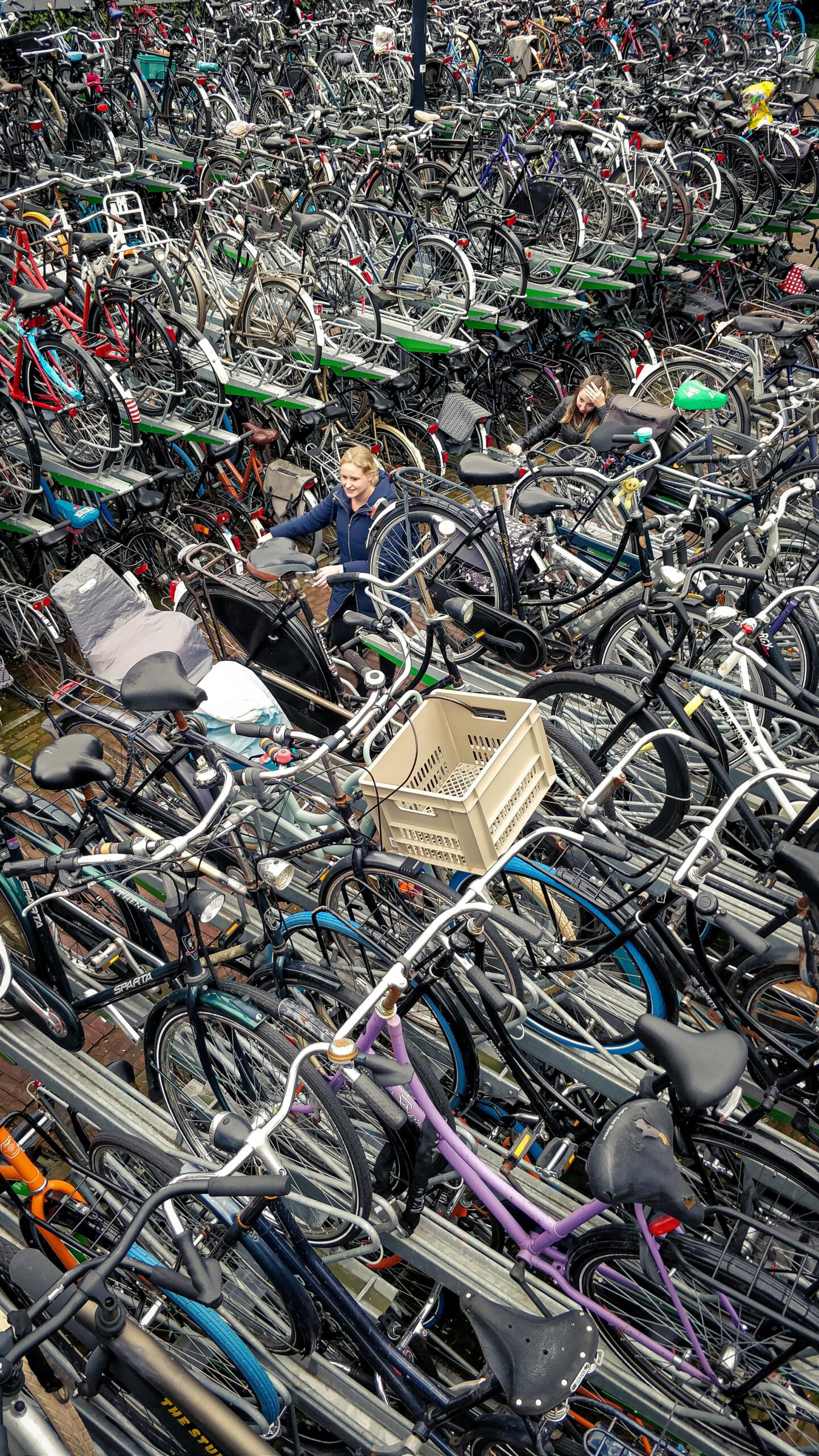
The Province of South Holland has started reducing parking norms to use the urban space more efficiently - the goal is to gradually reduce parking spots to gear the usage of urban space towards people rather than cars
- Credits: Greg Jeanneau and David Beneš, Unsplash
With the implementation of teleworking measures and strict travel limitations, covid-19 has noticeably impacted our mobility behaviours. Over the past year we have experienced a notable shift away from traditional car ownership, causing profound changes in the structure of urban mobility. Faced by the emergence of new mobility needs, it is necessary to provide solutions and integrate alternative mobility services into our urban ecosystem. The first step towards integration starts with the parking sector, one of the central determinants for modal choice.
If local authorities have started to seek management solutions, cooperation with the parking industry is necessary to achieve a successful mobility model. The parking sector is in fact crucial to develop new land strategies, reorganize surface urban parking and respond to mobility demands though approachable, efficient, and adaptive multimodal solutions.
For instance, the City of Barcelona has successfully adapted to the mobility shift away from car ownership by integrating curbside management and alternative mobility into its urban planning. Unfortunately, if “one-fit-for all” solutions do not exist due to unique urban and modal structures present in each city, parking provides a flexible tool to reorganize urban surface and efficiently respond to emerging mobility providers.
Providing a Platform for Multimodality
During this period of economic and social uncertainty, the parking industry has shown its ability to reinvent itself and adapt to new demands. The concept of parking itself has evolved from a physical infrastructure that interacts with one customer at a time, to a complex system of curbside management, parking locations and mobility services.
The parking sector has always played the unique role of bringing together all the different actors of the mobility ecosystem, from logistics to the electric vehicle sector, while constantly maintaining direct interaction with customers. As the parking industry is reinventing itself to offset losses from off-street parking revenue, it is now focusing the provision of an interactive space for mobility intermediaries and emerging actors.
Credits: Alliance for Parking Data Standards
As the mobility ecosystem has become increasingly complex, organizations such as the Alliance for Digital Parking Standards (APDS) are looking at ways to coordinate transportation actors. The parking sector, naturally located at the heart of the mobility chain, is able to provide a space of dialogue between all actors, helping to coordinate new standards that are being developed that will affect the ensemble of the mobility ecosystem.
The adoption of new digital management tools is helping the parking sector become more flexible, allowing to optimize surface urban parking and support an easier co-mobility linkage. For instance, the APDS Data Domains adopted by DATEX II, provides a unified interface bringing together parking platforms, parking operators, service providers as well as customers.
“If the future of innovative mobility will be driven by integration, it is necessary to ensure a systematic collaboration between all mobility stakeholders and develop truly an innovative, integrated and competitive business model.”
Nigel Williams, Vice President of the European Parking Association
Reorganizing the urban spaces, the role of parking in the built environment
When talking about parking we usually refer to the location itself, overlooking the complex network and behavioural elements attached to it. People organize themselves around cars as it allows them to navigate their personal networks (home, work, school, and other crucial locations). If we want to help people shift away from the predominantly car-oriented attitude, we need to develop infrastructures that make it easier to adopt multimodal behaviours.
“To achieve a vibrant multimodal city, we need to look at the direct interaction between land use and transportation, building compact cities that will support an evolution in people mobility behaviours.”
Paul van de Coevering, Professor Urban Intelligence at Breda University of Applied Sciences
To achieve this, we need to build environments that provide multimodal alternatives and make cities more compact. Parking is the first step in mobility transition, as it is a necessary precondition for modal shift. With limited open spaces in urban areas, parking can help optimize space management, which has been urban planning’s focal point.
The Province of South Holland has started reducing parking norms to use the urban space more efficiently. The Province has built over 200,000 new dwellings with limited parking requirements, developed temporary parking solutions as well as mobility hubs. The goal is to gradually reduce parking spots to gear the usage of urban space towards people rather than cars.
Housing projects themselves have focused on repurposing parking areas and integrating mobility services alternatives. Launched in 2019 in Gothenburg, EC2B proposes an infrastructure “built for the purpose of sustainable mobility”. With an integrated mobility platform and zero parking accommodation, this housing has experienced a behaviour shift with a notable increase of shared mobility usage.
"The implementation of parking requirements and land price systematics allows for 70 % more houses, improving land development, accelerating building time, more desired living-environments as well as healthier living environments.”
Raymond Linssen, Senior Project Leader of Spatial Development at the Province of South Holland
If car ownership and traditional mobility behaviours will not disappear from one day to the other, we need to start considering new mobility needs and behaviours shifts. The parking industry plays a central role in bringing together the entire mobility ecosystem, local authorities, and citizens. As we are looking for new solutions, the parking sector has an important role to play in achieving a new mobility model geared towards sustainability, flexibility, and multi-modality.
____________________
About Alliance for Parking Data Standards
The Alliance for Parking Data Standards (APDS), formed by the International Parking & Mobility Institute (IPMI), the British Parking Association (BPA), and the European Parking Association (EPA), is a not-for-profit organization with the mission to develop, promote, manage, and maintain a uniform global standard that will allow organizations to share parking data across platforms worldwide.
More here.
____________________
About ECTB: Easy To Be
EC2B is a sustainable mobility service. EC2B packages various mobility services (carpooling, bike-sharing, public transport, etc.,) and makes them easily accessible through its app. In addition, individual counseling for residents is included. The service is under constant development and will be expanded with more mobility services but also with new functions – for example, a user community where users can get advice and tips or plan a ride.
More here (Swedish only).
____________________
About Park4SUMP
The Horizon 2020 project Park4SUMP aims to show that good parking management can help freeing up public space, supporting local businesses, reducing search travel, generating revenues, and making our cities more attractive.
The project aims to help partner cities to:
- integrate parking management into their (future) SUMP;
- free an average of 10% of public space currently used for parking by means of participatory planning;
- invest at least 10% of parking revenues into sustainable transport;
- develop a more human-centred neighbourhoods with active modes such as walking and cycling.
Park4SUMP brings together 14 national governments to increase knowledge of how legislation on parking facilitates and hinders the use of effective parking management by cities in that state. The project is a partnership between organizations including POLIS, Edinburgh Napier University, Mobiel 21 and Isinnova; as well as cities and regions including Lisbon, Tallinn, Rotterdam, Trondheim, and Arnhem-Nijmegen.
____________________
About the authors
Victoire Couëlle was Communications Assistant at POLIS Network.
 Credits: Greg Jeanneau and David Beneš, Unsplash