
Healthy Living by Design
With its bold 10-minute city vision and citizen-driven mobility policies, Utrecht is redefining what sustainable, people-centred, and healthy urban living looks like. Alderman Senna Maatoug shares lessons from the city’s transformative journey as it wraps up its POLIS presidency.
Interview with Senna Maatoug, elaborated by Carlotta Inserra.
As Utrecht gets ready to host the 2025 Annual POLIS Conference and wrap up its POLIS presidency, we sat down with Senna Maatoug, Alderman for Mobility, Climate & Energy, to reflect on the city’s achievements and its journey within the network.
With a bold vision to become a 10‑minute city that prioritises walking, cycling, and shared mobility modes, Maatoug reveals Utrecht’s strategies for creating a healthier, accessible, and more liveable urban environment. From world-class cycling infrastructure to a new Walking Strategy and innovative citizen engagement initiatives, the city is taking practical yet innovative steps to advance its sustainable mobility transformation.
POLIS: As a host city, what would you like to tell all participants of the Annual POLIS Conference?
 Senna Maatoug: Welcome to Utrecht! It is an honour to have you. We live in interesting times in which we all have an important role to play.
For more than twenty years, Utrecht has been a member of POLIS, a uniquely diverse network that brings together cities, regions, transport authorities, public transport providers, mobility agencies, research centres, and universities. The expertise, knowledge, and willingness to learn from one another have been invaluable to us as a member, and we hope that this year’s Annual Conference continues this proud tradition of collaboration and exchange.
We invite all conference participants not only to observe, but to engage: ask questions, challenge assumptions, share your local context, and use this event to help shape solutions that reach far beyond a single city.
POLIS: Utrecht aims to become a ‘10-minute city,’ prioritising walking, cycling, and shared mobility. What guided this vision, and how does the city balance key elements such as accessibility, liveability, and economic vitality?
Maatoug: It is indeed a complex balance, creating a city that remains both vibrant and compact. The idea behind the 10-minute city is that people should be able to reach daily amenities within a short walk or bike ride.
We know that when people live closer together and streets are not dominated by car traffic, social connection increases. Cars take up valuable public space, so encouraging alternatives simply makes sense. At the same time, we are learning from other dense cities how to combine housing, amenities and economic activity in ways that strengthen rather than compete with each other.
POLIS: Utrecht is widely recognised as a European leader in active travel. Which recent measures have most effectively promoted everyday cycling and walking, and how have these initiatives contributed to improving public health?
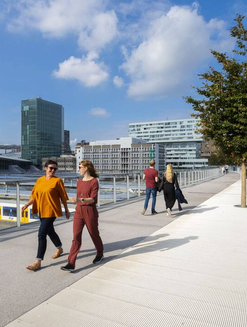
Utrecht wants to be a city in which health and quality of life are paramount, City of Utrecht
Maatoug: Healthy Urban Living is one of the key principles that drives our policies across the board, which means providing residents with an environment that enables healthy choices, supports physical and mental wellbeing, and offers equitable access to amenities, nature, and mobility.
We try to make active travel the easiest way to start or end your journey, and it encourages thousands of people to combine cycling and public transport every day. The entire station area around the railway station has been redesigned to prioritise pedestrians and create a welcoming, walkable environment. We had realised that our strong focus on cycling over the past decade sometimes meant less attention for walking. That is why we have now developed a dedicated Walking Strategy to give pedestrians the same priority.
We continue to invest in cycling by expanding networks, reducing car speeds to 30 km/h in most areas, and improving connections between neighbourhoods and public transport. These measures reinforce one another: the more people walk and cycle, the healthier, safer, and more social the city becomes. Ultimately, Healthy Urban Living is about that balance, and designing a city that keeps people moving and feeling connected.
One key lesson is that a city also keeps moving and governing requires looking at the facts and redirecting where needed.
POLIS: Utrecht’s 2040 vision also emphasises putting people and their needs at the centre. How has the city involved citizens, including those from underrepresented communities, in shaping its mobility and urban planning policies?
Maatoug: We do not design the city from behind our desks. We actively go out into the neighbourhoods to listen to residents. We organise city-wide conversations, but also smaller meetings with community and sports organizations to reach people who might not normally take part in consultations. For specific projects, our teams literally go into the streets with a cargo bike to talk to residents about their wishes and concerns. These local conversations help us make better, fairer decisions and build trust between residents and the municipality.
POLIS: Looking ahead, what are the main challenges you foresee in making healthy urban living a reality, both for Utrecht and for other European cities following your lead?
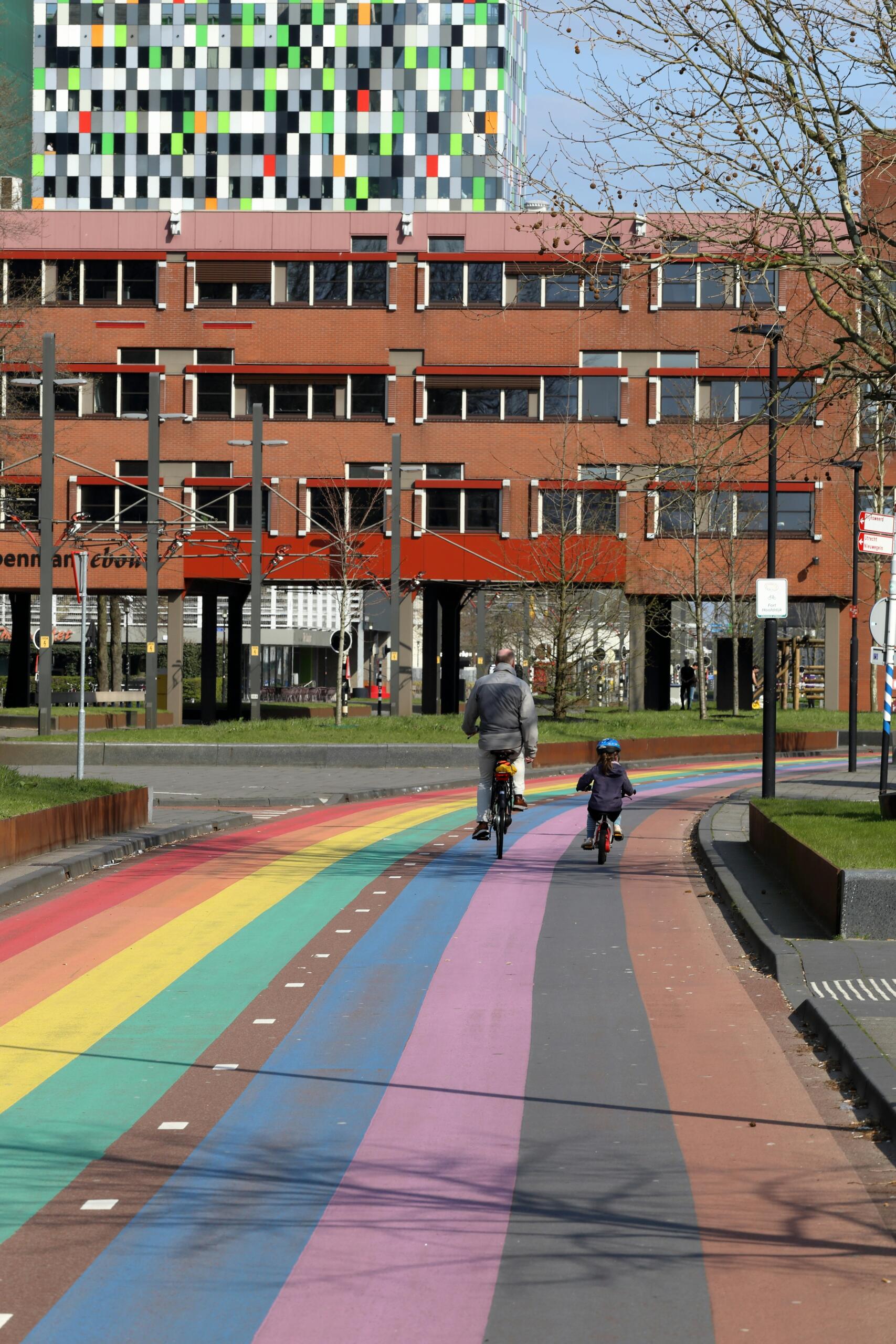
Father and child cycling on rainbow bike lane in Utrecht, Martin Woortman, Unsplash
Maatoug: We see two major challenges. The first is equity—ensuring that everyone can participate in the mobility transition. It is one thing to design a 10‑minute city for those living in dense central areas; it is quite another in peripheral neighbourhoods, or for residents with lower incomes, fewer mobility options, or less access to infrastructure.
The second challenge is to keep growing without losing the city’s character. Utrecht is projected to be one of the fastest-growing cities in the Netherlands: for this growth to be sustainable, we must invest in public transport, high-quality public space, and strong local communities, as these are the foundations of social, economic, and environmental resilience. At the same time, we must manage land use, mobility, and housing in such a way that the city’s identity and liveability remain intact. In uncertain times—due to the climate crisis, economic stress, and demographic change—strong communities make cities thrive. Our task, therefore, is to embed resilience into mobility and urban design.
For all European cities following a similar path, my advice would be to prioritise modes that use less space (walking, cycling, shared mobility), while also planning for growth, inclusion, and the preservation of local identity.
POLIS: As Utrecht’s term as POLIS President draws to a close, what reflections do you have on this period of collaboration, and what advice would you offer to the next city or region taking on the presidency?
Maatoug: During our presidency, we learned how crucial it is for cities to engage with the European Union and with each other, especially now that more aspects of transport, housing, and mobility are regulated at the EU level. The new requirement for Sustainable Urban Mobility Plans in designated urban nodes gives cities both responsibility and influence.
My advice to the next presidency would be to mobilise the collective knowledge, expertise, and energy of POLIS members. We were proud to welcome new members from Ukraine, for example, expanding the network’s reach. I hope the network will continue to grow, because it is increasingly through shared learning and peer exchange that cities can accelerate the sustainable mobility transition.
Click here to read the article in its original format.
About the contributors:
Interviewee: Senna Maatoug, Alderman for Mobility, Climate, & Energy City of Utrecht. Maatoug has been Utrecht’s alderman since December 2024, responsible for mobility, climate and energy, and the spatial projects Lunetten-Koningsweg and Overvecht. Previously, she was a Member of Parliament, a policy economist at the Ministry of Finance, and a lecturer in Economics. As alderman, she is committed to building a sustainable, fair, and welcoming Utrecht for all residents.
Interviewer: Carlotta Inserra, Membership & Communications Manager. Inserra is the main point of contact for the network’s expanding membership, where she oversees and supports members’ engagement and promotes POLIS’ Working Group activities. She also contributes to the Interreg SMALL project, where she channels her commitment to inclusive and accessible sustainable mobility for all.
 Christian Mueller, Shutterstock