
Designed To Deliver
The publication of the third edition of the Guidelines for developing and implementing a Sustainable Urban Mobility Plans marks an important milestone for urban mobility policy in Europe.
13 years after the first SUMP guidelines were introduced, the European Commission has once again updated its flagship methodology to reflect a rapidly changing policy landscape, new societal expectations, and the practical experience accumulated by hundreds of cities that have adopted and implemented Sustainable Urban Mobility Plans.
From writing plans to delivering change
The update comes at a particularly significant moment. Sustainable urban mobility planning has evolved from a voluntary planning approach into a central pillar of European transport policy. Under the revised Trans-European Transport Network (TEN-T) Regulation, 431 urban nodes will be required to adopt a Sustainable Urban Mobility Plan by the end of 2027. At the same time, cities are expected to contribute to climate neutrality objectives, address social inequalities, manage increasingly complex logistics flows and respond to technological change.
Although the familiar four phases and twelve steps remain unchanged, the third edition reflects a decade of practical experience. It is less concerned with helping cities write plans and more concerned with helping them deliver change. Governance, implementation, monitoring and political leadership feature far more prominently than in previous editions, reflecting a growing recognition that technical solutions alone are rarely the main barrier to smart and sustainable mobility.
Leadership as a game changer
One of the clearest messages running throughout the new guidelines is that successful mobility planning begins with strong political support and a clear sense of ownership among decision-makers. Earlier editions largely focused on planning processes, governance innovation, stakeholder engagement, and technical analysis, but the 2026 update, which incorporates older and newer good practices and examples, places greater emphasis on the institutions and political structures needed to turn ambitions into reality.
This shift mirrors developments seen across Europe. In cities such as London, Groningen, and Ljubljana, strong mayoral leadership has played a decisive role in advancing ambitious mobility agendas. Measures such as road space reallocation, parking reform, low-emission zones, and major public transport investments rarely emerge from technical planning alone, and require political ownership, a willingness to defend long-term objectives, and the capacity to build public support for change.
Budapest offers another perspective on this challenge. Rather than relying solely on individual political champions, the city established regular roundtable meetings that bring together decision-makers from different institutions and levels of government. The result is a more structured approach to cooperation, helping align priorities and resolve disagreements before they become obstacles to implementation. The example illustrates an increasingly important principle within the new guidelines: successful mobility planning depends on durable governance arrangements rather than isolated planning exercises.
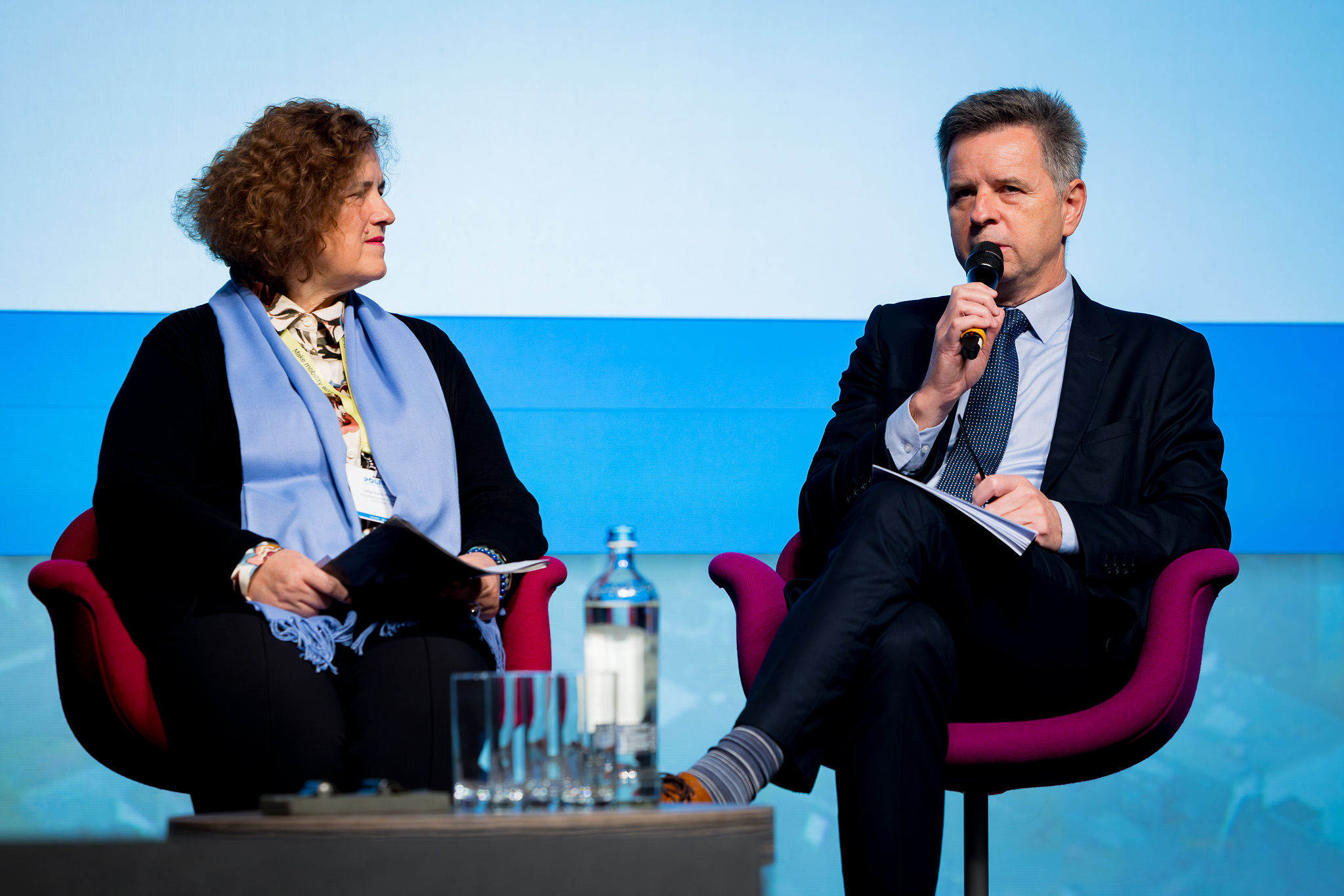
Lidija Pavić-Rogošić (ODRAZ) and Dejan Crnek (City of Ljubljana) at #POLIS25 — Credit: Michiel Ton
The rise of the Functional Urban Area
The stronger focus on governance is closely linked to another defining feature of the third edition, which is a move beyond municipal administrative boundaries. European cities increasingly operate as metropolitan regions, yet transport planning often remains fragmented between multiple authorities. The updated guidelines respond by placing greater emphasis on the Functional Urban Area (FUA) as the appropriate scale for mobility planning.
Bologna demonstrates what this looks like in practice. Its metropolitan SUMP connects mobility planning with territorial development and logistics, recognising that transport systems are inseparable from broader patterns of urban growth and economic activity. Rather than treating mobility as a standalone sector, Bologna has integrated it into a wider strategic framework for metropolitan development.
A similar philosophy underpins the cooperation models established within the transport regions of Flanders. By creating mechanisms for collaboration across municipal boundaries, these arrangements help coordinate policies that affect daily travel patterns far beyond the limits of individual cities. Together, these examples reflect a growing understanding that many mobility challenges can only be addressed through metropolitan governance.
Neighbourhoods as the building blocks of mobility
Another growing theme throughout the updated guidelines is the increasing attention given to neighbourhood-scale interventions. Rather than focusing exclusively on citywide transport networks, many cities are using circulation plans, superblocks, and low-traffic neighbourhoods to reshape mobility at the local level.
Ghent's circulation plan demonstrates how strategic traffic management can reduce through traffic while improving conditions for walking, cycling, and public transport. Barcelona's superblocks programme similarly reallocates street space from cars to people, creating quieter, safer public spaces while supporting wider mobility objectives. These approaches illustrate how Sustainable Urban Mobility Plans are increasingly translated into tangible changes that residents experience in their daily lives.
Alternative futures
This emphasis on long-term thinking is also visible in the stronger focus on scenario development and strategic foresight. Traditional transport planning often relied on forecasting future demand and responding to projected growth: the updated guidelines encourage cities to take a more proactive approach by exploring alternative futures and identifying pathways towards preferred outcomes.
Prague provides an instructive example. The city developed multiple future scenarios through extensive engagement with stakeholders and citizens, creating a framework for discussing different mobility futures rather than simply extrapolating existing trends. Antwerp adopted a similarly ambitious approach, bringing together citizens, policymakers, and experts in large-scale discussions about the future of the city and its transport system. Both experiences highlight a broader shift in planning philosophy. Rather than asking what is likely to happen, cities are increasingly asking what kind of future they want to create.
The Liveable SUMP™
The growing importance of quality of life represents another notable feature of the third edition. Mobility is no longer evaluated primarily through a set of indicators, such as traffic flow or network capacity. Instead, increasing attention is given to health, safety, accessibility and social inclusion.
This broader perspective can be seen in Gothenburg's Vision Zero approach, which treats road safety as a fundamental design principle rather than a specialist policy area. In Madrid, mobility objectives have been developed specifically for peripheral and peri-urban areas, recognising that transport disadvantages are often concentrated in neighbourhoods located far from city centres. London's Healthy Streets framework takes the discussion even further by linking mobility planning to public health, wellbeing, and the quality of urban space.
Collectively, these experiences reflect a significant change in how mobility success is defined. The central question is no longer how efficiently vehicles move through a city, but how effectively mobility systems contribute to safer, healthier, and more inclusive urban environments.
Implementation on the ground
The third edition also places greater emphasis on implementation. After more than a decade of SUMP practice, there is widespread recognition that developing and adopting a plan is only the beginning: the challenge lies in translating strategic ambitions into visible improvements on the ground.
Aarhus demonstrates how this can be achieved through its Active Mobility Hubs, which bring together different mobility services in accessible locations and encourage more sustainable travel behaviour.
In Vitoria-Gasteiz, mobility measures have become an integral part of the city's superblock model, helping reshape public space while reducing the dominance of private vehicles. In both cases, mobility planning functions as a catalyst for wider urban transformation rather than a collection of isolated transport projects.
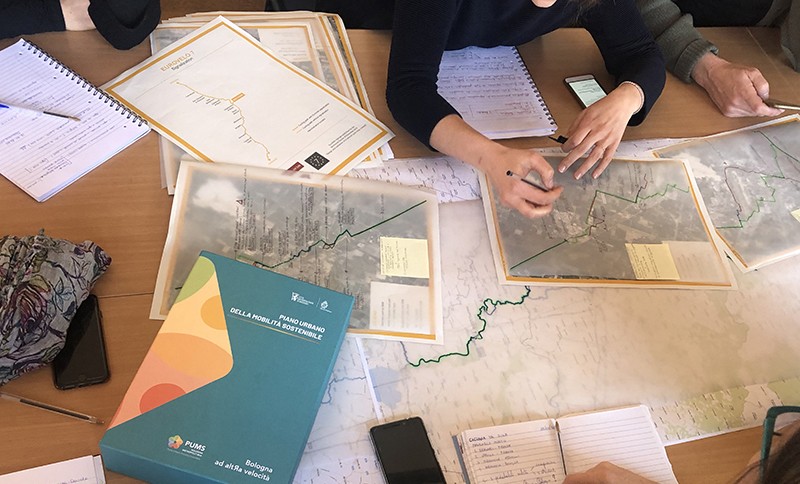
Engegament and exchange in Bologna — Credit: PUMS Bologna
It takes money to make a SUMP like this
The question of financing also receives greater attention in the updated guidance. Delivering ambitious mobility strategies requires stable and long-term funding sources, particularly at a time when many cities face growing investment needs.
Vienna's employer contribution model illustrates how dedicated local funding mechanisms can support the expansion of public transport infrastructure. Barcelona, meanwhile, demonstrates the role that European funding can play in accelerating investment and modernisation. Together, these examples underline a simple reality: implementation depends not only on good planning, but also on the ability to secure sustainable financial resources.
Not just a one-off consultation
The same applies to public engagement. The most successful mobility strategies increasingly rely on continuous dialogue rather than one-off consultation exercises.
In Ghent, public debate evenings, stakeholder meetings, and consultation activities have become part of an ongoing conversation about mobility. Bologna has experimented with innovative engagement formats designed to involve residents more actively in decision-making processes, while the Métropole Européenne de Lille has established regular political coordination mechanisms to steer mobility policies across a wider metropolitan area.
Matter of monitoring
Perhaps the most forward-looking aspect of the third edition is its stronger emphasis on monitoring, evaluation, and evidence-based decision-making. Mobility planning is increasingly presented as a continuous process rather than a document produced once every decade.
Madrid's evaluation of the Madrid 360 Sustainable Urban Mobility Plan demonstrates how cities can assess outcomes and adjust policies based on evidence. Greater Manchester has taken this principle even further through a continually updated online evidence base that supports strategic planning and policy development. Both examples point towards a future in which mobility plans become living frameworks capable of adapting to changing circumstances.
The Expert Corner
The publication of the new guidelines is also accompanied by a growing body of specialised knowledge. Through the Expert Corner and related resources, practitioners now have access to detailed guidance on subjects ranging from cycling and urban vehicle access regulations to climate resilience, logistics, public transport, social inclusion and shared mobility. This expanding knowledge ecosystem reflects the increasing maturity of Sustainable Urban Mobility Planning itself, in that cities are no longer simply seeking guidance on how to develop a plan—they are looking for practical tools to address increasingly complex urban challenges.
Click here to read the article in its original format.
About the author
Alessia Giorgiutti, Communications & Membership Lead & Co-Coordinator Just Transition, POLIS. Giorgiutti coordinates POLIS' corporate communications and magazine, has worked in several EU-funded projects, and supports the POLIS staff in all things communications (and has been doing so for the past 7 years!). Her work focuses on making accessible and inclusive content about transport, as well as highlighting the experiences of marginalised users.
 Credit: Mareks Perkons, Shutterstock