
Night Owl
Where does the city go when it shifts into lower gear? It moves differently, through fewer lines but higher stakes, and across Europe, night buses, rail, and shared services quietly sustain urban continuity after dark, until the sunrise comes.
Few urban experiences are more universal than waiting at a bus stop after a night out for what feels like hours, missing the last metro train of the evening, or sprinting to catch a late tram, only to squeeze inside at the very last second and cling to the handrails as if your life depended on it, every available inch of space already being claimed, as though the entire city decided to board at once with you.
Yet, night mobility is not only about nightlife nostalgia: it is about nurses and doctors finishing late shifts, hospitality workers returning home after midnight, students crossing the city after late cram sessions, and residents without access to private vehicles. While most urban transport systems are designed around daytime demand, cities continue to function well after sunset, their heartbeat going deep, life pulsing through fewer corridors and essential arteries, thinning out across the wider network; urban life continues at a slower pace, and transport quality reflects how inclusive, safe, and economically resilient the city is.
Across Europe, cities are increasingly experimenting with night mobility as part of modern urban transport strategy. Some metropolitan areas have expanded night bus systems, others have introduced shared taxi schemes, while several maintain overnight tram, rail, or metro operations during weekends. Transport systems, however, remain largely structured around daytime commuting patterns, creating gaps in accessibility and uneven outcomes for those reliant on public transit.
A German proof
Research conducted by the German automobile association ADAC assessed how reliably public transport connects 20 German cities with their surrounding commuter areas at night, focusing on weekend journeys from central urban hubs to nearby destinations. Results show mixed performance: half of the cities were rated ‘very good’ or ‘good’, several were assessed as limited or incomplete, and a few could not be fully evaluated due to shortcomings in electronic timetable information. Overall, most cities still offered broad late-evening connections, but reliability and coverage declined unevenly after midnight.
Across the 17 fully evaluated cities, most destinations remained reachable within the tested time windows, and nearly two-thirds of routes required no transfers. However, performance varied strongly by time slot: the window between 23:30 and 00:30 showed more restricted access than the later window between 23:30 and 02:30, where connections were more extensive. Travel times were often efficient where services existed, but consistency remained uneven across cities and corridors.
A key structural weakness identified in 13 of the 20 cities concerned electronic timetable systems, which in several cases failed to display night or replacement services or made post-midnight journey planning difficult. These digital gaps reduced transparency precisely when users depended most on accurate information.
In terms of system quality, larger metropolitan areas such as Stuttgart and Frankfurt, within the FrankfurtRhineMain region, generally performed better due to denser rail networks, higher frequency, and stronger multimodal integration. Smaller and medium-sized cities relied more heavily on fragmented night bus systems with limited suburban reach.
Where standard tickets remained valid on night services, accessibility and satisfaction were higher; where separate fares or restrictions applied, usage was more constrained. Combined with weaker digital systems and uneven interchange design, this disproportionately affected shift workers, young passengers, and residents without private transport options.

Woman on a night bus — Credit: l i g h t p o e t, Shutterstock
The Night-Time Economy
Night transport is tightly linked to cultural and service economies. Restaurants, bars, music venues, theatres, and cultural spaces depend on workers and visitors being able to travel safely and affordably after regular transit services end.
Tallinn illustrates this relationship clearly. Its night bus network operates on Friday and Saturday nights between 00:30 and 03:30. After a successful pilot phase, the city expanded the system to six routes connecting the city centre with suburban districts, strengthening access to nightlife while reinforcing links with peripheral neighbourhoods.
Ireland presents a more layered model. Dublin operates multiple twenty-four-hour bus routes, while smaller towns such as Sligo, Kilkenny, and Drogheda have expanded late services under the National Transport Authority’s Night-Time Economy programme. In rural areas such as Sligo, Buncrana, and Longford, the ‘One @ One’ pilot introduces scheduled 1am departures on selected weekends and cultural events, addressing gaps in safe late-night return travel and testing demand in lower-density contexts. Together, these initiatives frame night mobility as infrastructure linked to accessibility, safety, and economic activity rather than a supplementary service.
‘Cities After Dark’
Night mobility also shapes cultural access and tourism distribution. Central districts often concentrate visitors, while peripheral neighbourhoods remain disconnected after dark. Extending transport beyond the core redistributes activity and broadens access to cultural life.
The URBACT ‘Cities After Dark’ network examined how mobility interventions can improve access to evening activity by strengthening links between centres and outskirts and reducing reliance on private vehicles.
In Genoa, improved night connections enabled the historic Villa Bombrini to host evening events such as guided tours, concerts, and community gatherings, demonstrating how transport infrastructure can activate cultural spaces otherwise difficult to access at night.
In Zadar, a circular night bus line was introduced as a weekend pilot during the Advent period, operating late-night departures to connect peripheral neighbourhoods with central areas. The measure tested demand for after-hours services, improved accessibility during peak night-time activity, and reduced reliance on private cars for late returns.
This is about inclusion
A central rationale for nocturnal transport lies in employment access. Many essential workers operate outside standard daytime schedules, including healthcare staff, cleaners, maintenance workers, emergency responders, and hospitality employees. Night mobility therefore functions as a structural condition of labour market participation, particularly for those in peripheral or suburban areas with limited alternatives. Across night-time economies, availability and reliability of late services directly shape access to jobs, income stability, and spatial distribution of opportunity.
In Sofia, the introduction of a night bus system in 2018 improved access between residential districts and central employment zones, where much of the city’s night-time hospitality and service work is concentrated. However, its radial structure and centralised interchange system meant connectivity was strongest for centre-oriented journeys, while cross-peripheral travel remained limited. This produced uneven accessibility outcomes, improving access to some employment locations while leaving others harder to reach, particularly for workers outside central transfer patterns.
A related dimension of inclusion emerges through gendered patterns of night mobility. Rather than being defined solely by individual behaviour, nocturnal mobility reflects broader social relations that structure movement and access. Safety concerns, including poorly lit stops, long waiting times, and isolated walking routes, remain central. However, gendered mobility extends beyond vulnerability alone: care responsibilities, household organisation, and unequal access to daytime opportunities can increase night travel for some women while simultaneously constraining autonomy and modal choice.
In Bologna, these questions are addressed through the Nottambula initiative, which organises escorted group walks led by trained street hosts accompanying participants to transport hubs. Rather than altering the transport network itself, the intervention targets social conditions of mobility, reducing perceived risk and expanding the conditions under which night travel becomes viable. This highlights how inclusion is shaped not only by service coverage, but also by relational and environmental factors.
In Sofia, by contrast, these gendered dimensions were not explicitly integrated into system design or evaluation, which remained focused on operational and financial criteria. As a result, differentiated access, including how network structure affects women’s access to night-time employment and safe return journeys, remained largely implicit. The outcome is a service that improves aggregate connectivity while producing uneven effects across user groups depending on location, timing, and access to alternatives.
Overcoming the car
When public options are infrequent or absent, private vehicles become the default mode after dark, contributing to congestion, emissions, noise, and risks associated with driving under the influence. Across Europe, cities are testing alternatives that extend shared mobility into nocturnal hours. In Treviso, the MOM+ on-demand bus system enables passengers to book rides between 20:30 and midnight via app or phone, responding flexibly to dispersed demand patterns.
In Brussels, the Collecto shared taxi service operates nightly between 23:00 and 06:00, allowing passengers to share rides along similar routes at a lower cost. Rather than replacing fixed-route transit, these systems complement night buses and reflect a broader shift toward hybrid mobility models combining flexibility, affordability, and reduced car reliance.
Alongside these demand-responsive models, many cities continue to rely on structured overnight networks. Berlin operates continuous MetroBus and MetroTram services throughout the week, with U-Bahn and S-Bahn running through the night on weekends, creating near-continuous coverage. London maintains an extensive night bus network alongside the Night Tube on key lines. In Prague, night tram routes are organised around coordinated interchange hubs, ensuring predictable transfers across the network, a model echoed in Warsaw and Bratislava, where centralised night nodes structure mobility flows.
In Budapest, the night transport system is being restructured to function more explicitly as a metropolitan network, with stronger alignment between night buses, extended metro operations, and regional Volán services. The redesign prioritises direct cross-city links from central hubs such as Deák Ferenc Square to outer districts and surrounding towns, alongside higher frequencies on key suburban corridors. Rather than adding new modes, the approach focuses on reconfiguring existing services to reduce transfers and better reflect the city’s expanded residential geography across the wider metropolitan area. Taken together, these examples show that even limited night services can produce measurable social and economic benefits.
Where the city’s heart beats
Night mobility should be treated as a distinct planning field rather than a residual extension of daytime systems. It determines access to work, safety, and opportunity, while exposing how strongly mobility depends on network design, proximity, and alternatives when standard services recede.
As urban life becomes more flexible and less tied to fixed schedules, pressure on cities to provide reliable twenty-four-hour mobility will increase. A contemporary city is ultimately judged not by how it performs at peak hours, but by whether it remains genuinely connected throughout the day. Night-time transport is one of the clearest expressions of that continuity, revealing how inclusive and functional urban life remains once the daytime system steps back.
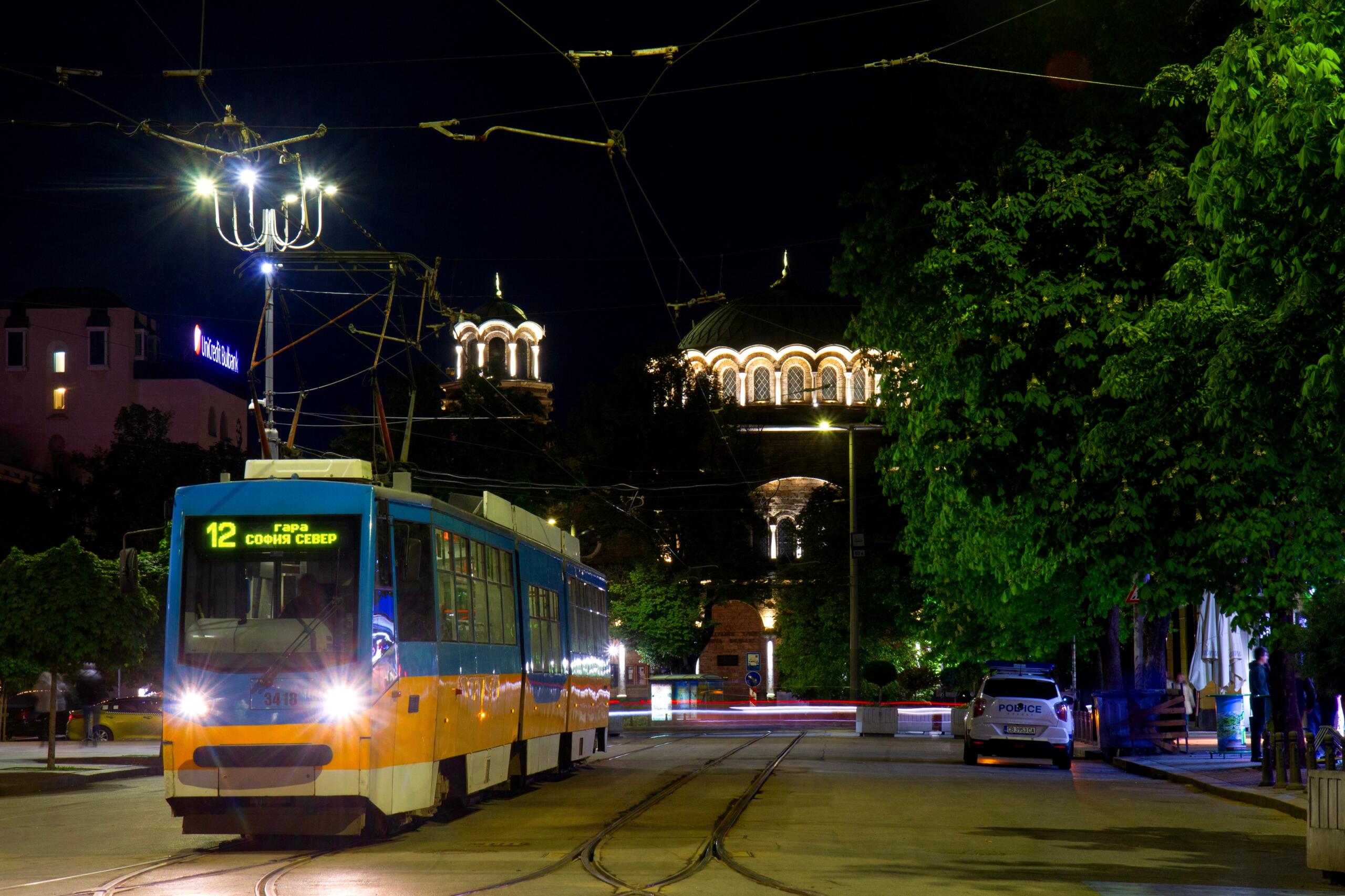
Night tram in Sofia, Bulgaria — Credit: Dina Rogatnykh, Shutterstock
Click here to read the article in its original format.
About the author:
Alessia Giorgiutti, Communications & Membership Lead & Co-Coordinator Just Transition. Giorgiutti coordinates POLIS' corporate communications and magazine, has worked in several EU-funded projects, and supports the POLIS staff in all things communications (and has been doing so for the past 7 years!). Her work focuses on making accessible and inclusive content about transport, as well as highlighting the experiences of marginalised users.
 Credit: a__da, Shutterstock