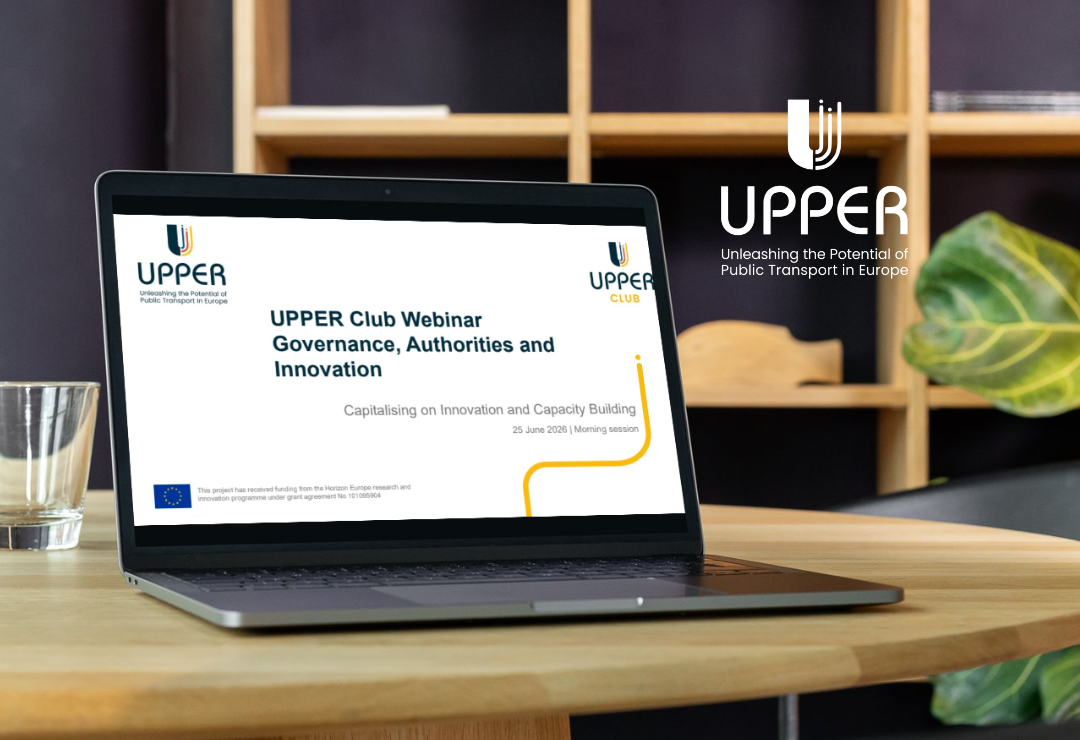
UPPER Club webinar explores governance practices for public transport innovation
What does it take to provide better public transport? What can we learn from other PTAs? How can innovation travel, adapt, and respond to different local governance contexts? These and other questions were answered in the latest UPPER Club Webinar.
The EU-funded UPPER project gathers ten cities and multiple horizontal partners to develop tools and implement local measures with the objective of growing public transport ridership and increasing passenger satisfaction. As part of this process, a study was conducted across international Public Transport Authorities (PTAs) to identify specific innovative measures recently implemented in their public transport network, and the governance and funding conditions that enabled this process. Last week, the UPPER project organised a full-day webinar for the PTAs involved in the study to share best practices among each other and to a wider audience of transport authorities and relevant stakeholders.
Barriers and enablers in public transport innovation: a recap from the UPPER Club Webinar
Not just one, but two sessions took place on the 25th of June, looking at the role of governance and PTAs in deploying innovative mobility solutions to support public transport operations.
The implementation and scaling of innovative mobility services within complex governance environments was explored, using insights from different local contexts provided by the speakers. Particular attention was placed on highlighting the key enablers and barriers PTAs face when developing and implementing innovations.
After an introduction by Emmanuel Dommergues (UITP) on the work done in the framework of the specific task of the UPPER project focusing on governance, the speakers took the floor to present their innovative measures and the governance structure they operate in.
Morning session - Capitalising on Innovation and Capacity Building
In the morning session, four PTAs were invited to share their views on how to capitalise on innovation and build capacity within the organisation. The insights provided by the cities of Braga (TUB), Auckland (AT), Budapest (BKK), and Seoul (SMG) laid the basis for a fruitful discussion led by Mario Alves, Secretary General of the International Federation of Pedestrians (IFP).
Simplicity and accessibility: Braga’s check-in/check-out system
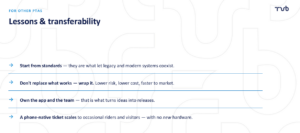
Transferability of TUB's innovation — TUB
Rui Martins (TUB) explained that their innovation aimed at letting anyone ride and pay with a device they already carry with them: their phone – but without replacing systems that already work. Capitalising on existing technology and building on previous improvements to the system made throughout the network’s history allowed them to keep the costs low and to utilise existing resources more effectively.
Reorganising for changing user needs: Auckland’s network reform
Pete Moth (AT) demonstrated how public consultations, phased delivery, and fare integration allowed Auckland Transport to double its ridership since 2012, adding 30% in-service Kms for only 7% of additional cost. Thanks to their long-term vision for transport in the region and efficient use of existing stock, users now have access to a faster and further-reaching transport network that did not severely impact public finances.
Centralized data collection: Budapest’s Unified Traffic Model
Miklós Gábor Bánfi, (BKK) introduced the city’s Unified Traffic Model, a system that enables data-driven transport decisions and automatic data collection across the wider Budapest region. Investing in IT resources and internal training made it possible to drastically reduce dependency on external consultants and grow stronger as an authority, collecting a staggering amount of data.
Unlimited transport access: Seoul’s Climate Card
Lastly, Chaeyeon Lee (SMG) presented Seoul’s Climate Card, a unified ticket for multiple metropolitan areas surrounding the capital city. Leveraging on previous integration efforts, SMG was able to deliver simplified transfers, unified fares, and reduced costs for passengers to provide a better connected and more accessible transport system.
Key learnings from the webinar
The presentations and the discussion highlighted how elements such as a user-centric approach, lower dependence on external providers, and efficient communication with the public are key in the acceptance and scalability of innovation. Moreover, these projects should not be seen as standalone policies, but rather as practices that were built on strong foundations, continuously building on internal capacity and working with what is already there, rather than against it.
Afternoon session – Transferability and Best Practices
The afternoon session focused on transferability and best practices, involving representatives from the Barcelona metropolitan area (AMB), Lisbon (TML), Bucharest (TPBI), and Los Angeles (LA Metro). The insights shared helped build a conversation led by Pedro Homem de Gouveia (POLIS) on how to best integrate existing innovative practices in one’s own area of competence.
E-micromobility for all: Barcelona Metropolitan Area’s shared system
Mariona Conill de Azpiazu (AMB) introduced the metropolitan area-wide shared e-moped and e-motorbike system, provided to cover for the lack of regulation of these services and of a long-term vision for Mobility as a Service in the wider region. The strong and continuous participatory process, as well as the flexibility of the regulatory framework that was developed, made the progressive fleet deployment possible, and supported a constant increase in demand, ensuring both market and public acceptance of the measure.
Navigating in complex interfaces: Lisbon’s WayFinding GO
An issue common to many PTAs is the very limited competence over certain complex transport interfaces, reducing the impact and possibilities of interventions. To solve this issue, Pedro Machado (TML) presented WayFinding GO: a series of five measures, co-produced and tested with blind users’ associations, with minimal impact on the built environment, to improve wayfinding for visually impaired people at Lisboa Oriente, a station with limited accessibility. Focusing on the independence of users and relying on technology, TML was able to produce a measure of great impact with few changes to the station itself.
A region-wide approach: Bucharest-Ilfov Traffic Management System
Geanina Suditu (TPBI) explained the challenges faced in modernizing and expanding Romania’s capital city traffic management system in a fragmented administrative context with changing mobility needs. Thanks to a focus on IT system improvement and phased measure implementation, TPBI was able to maximize the use of the limited available funds and progressively test and improve their system, making it increasingly foolproof through time.
Equalising transport accessibility: LA Metro’s Mobility Wallet
By introducing a bank card, based on existing banking and transport infrastructure, Avital Shavit (LA Metro) presented the Mobility Wallet, a $1.800 allowance for low-income individuals which can be used on any transportation mode available in Los Angeles and beyond. Thanks to strong partnerships with local universities, LA Metro was able to continuously study the effects of their measure and improve it in the various implementation phases, increasing overall access to opportunities and social networks.
Key learnings from the webinar
The discussion led to the conclusion that PTAs worldwide have taken upon themselves the task of acting as an integrator, not only within their area of competence, but also around them. This vision of mobility allows them to have an impact on the functional area of the city, actively shaping the transport landscape beyond the city limits. Going the extra step and responding directly to community needs has helped these PTAs promote a seamless and accessible travel experience, for all their users.
The UPPER measures are now in the final phase of implementation, and results and lessons learnt will be shared in the coming months, starting with the POLIS conference session co-organised with the EU-funded eBRT2030 project. Stay tuned for more!
- Related Projects
- Related Members