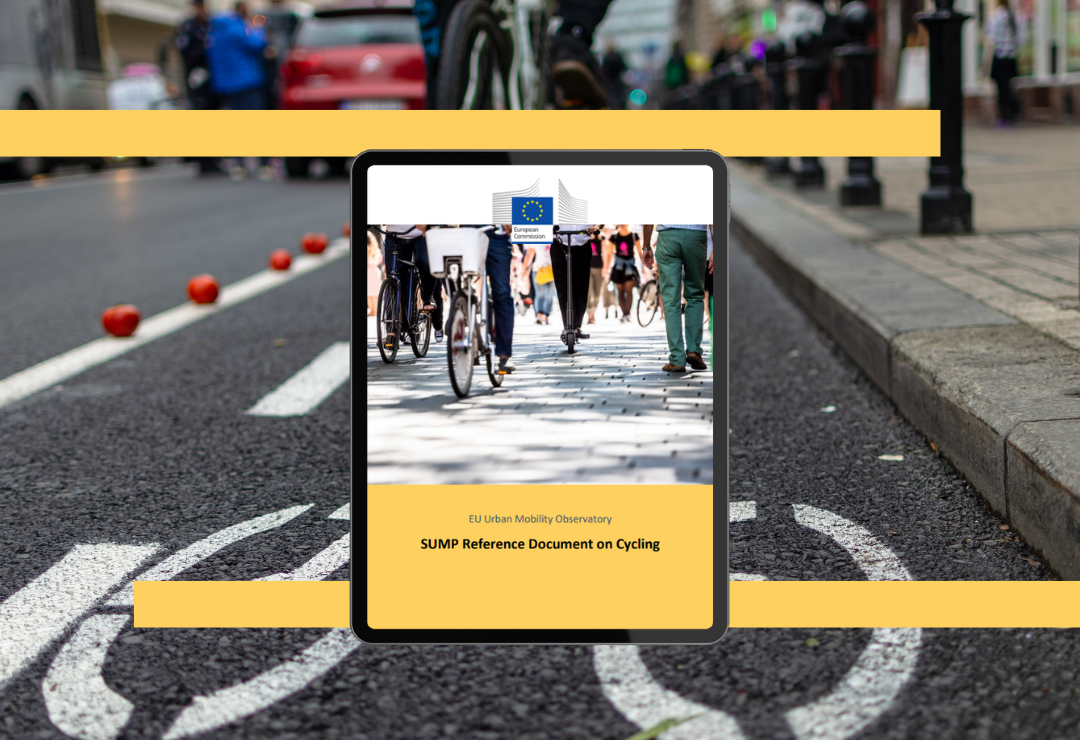
Navigating the SUMP guidelines 3.0: Implications for cycling
Alongside the new Sustainable Urban Mobility Planning (SUMP) Guidelines 3.0, the EU Urban Mobility Observatory has released a series of revised reference materials to help local authorities address specific mobility challenges and opportunities. Find out more below on what this means for cycling.
Cycling has long been recognised as an important component of sustainable urban mobility. However, the role it plays in cities has evolved significantly in recent years. Today, cycling is increasingly viewed not only as a transport mode, but also as a tool for achieving wider objectives related to decarbonisation, public health, social inclusion, and urban liveability.
The updated SUMP Guidelines 3.0 reflect this broader understanding: as cities face growing pressure to decarbonise transport systems, improve public spaces, and provide accessible mobility options, cycling is becoming an increasingly important element of integrated urban planning. To support cities and functional urban areas in this context, the EU Urban Mobility Observatory has published a dedicated new SUMP Reference Document on Cycling.
Together with other thematic SUMP publications, such as the guide on Urban Vehicle Access Regulations (UVARs), the document contributes to a growing European knowledge base supporting cities in the development and implementation of sustainable urban mobility strategies.
Key updates
While the previous cycling guidance, published in 2019, focused primarily on supporting and encouraging cycling through infrastructure, safety measures and behavioural change, the new document reflects how both cycling and urban mobility planning have evolved over the past five years.
In the years since the first document's release, cities have faced increasing pressure to reduce emissions and improve public spaces. At the same time, cycling itself has changed. E-bikes have become mainstream, cargo bikes are increasingly used for urban logistics, and many cities have accelerated investments in active mobility following the COVID-19 pandemic. The adoption of the European Declaration on Cycling has further reinforced the role of cycling as a strategic component of sustainable mobility policy.
The result is a new approach that goes beyond promoting cycling as an alternative mode of transport.
A broader vision for cycling
One of the most important shifts in the updated guidance is the way cycling is framed within the planning process.
The 2019 guidance already recognised that cycling policies should be embedded within a wider mobility vision and integrated into SUMPs. However, cycling was often treated as a dedicated policy area, alongside topics such as parking, logistics or road safety.

(C) Jack Lucas Smith on Unsplash.com
The new reference document takes a broader perspective. Cycling is not just a transport solution anymore: it is a contributor to air quality improvement, public health, energy efficiency, economic resilience and social inclusion, and it cannot exist as a separate silo.
This has important implications for cities developing or updating their SUMPs. Local authorities are encouraged to integrate cycling objectives throughout the planning cycle: from vision-building and scenario development to target setting, investment prioritisation and monitoring.
In practice, this means asking not only how cycling can be increased, but also how cycling can contribute to achieving wider city objectives.
Cycling as a tool for inclusive, sustainable urban planning
The most important change introduced by the new Reference Document on Cycling is the shift in perspective.
Cycling is no longer presented simply as one sustainable transport option among many. Instead, it is increasingly recognised as a strategic tool for delivering broader urban goals, which sets an important precedent for further SUMP developments.
Another notable development is the greater emphasis placed on equity and accessibility. Traditional cycling policies have often focused on increasing the overall number of cycling trips. While this remains important, the updated guidance encourages cities to consider who is cycling and who is not.
The earlier guidance already acknowledged that women, children and older people are often discouraged from cycling because of safety concerns. The new document expands this discussion considerably by highlighting the importance of inclusive planning and equitable access to cycling opportunities.
The shift is subtle but significant. The objective is no longer simply to create more cyclists. Instead, cities are encouraged to create conditions that allow everyone to cycle if they choose to do so.
Delivering cycling through stronger governance

(C) Bruce Barrow on Unsplash.com
A recurring challenge for many cities is effective implementation.
The 2019 guidance already highlighted themes that remain relevant, such as political leadership, stakeholder engagement, cycling officers and cross-departmental coordination. The updated reference material builds on this foundation by placing greater emphasis on governance, institutional capacity and implementation.
As cycling policies become more ambitious and more closely connected to climate, health and urban development objectives, coordination across departments becomes increasingly important. Transport planners, public health teams, environmental departments, urban designers and economic development agencies all have a role to play.
The new guidance also reflects growing interest in monitoring and evaluation. Advances in data collection, digital tools and performance measurement are providing cities with new opportunities to assess the effectiveness of cycling investments and adapt policies over time.
In many respects, this shift reflects the maturity of cycling policy across Europe. The question is no longer whether cycling should be promoted, but rather how cities can deliver meaningful change at scale.
What should cities do next?
For local authorities currently developing or updating their SUMPs, the new cycling guidance provides an opportunity to review existing approaches and identify areas for improvement.
Five practical actions stand out:
- Review existing cycling strategies against the updated guidance and identify potential gaps.
- Ensure cycling contributes directly to broader objectives related to climate, health, accessibility and quality of life.
- Reassess infrastructure standards to account for growing use of e-bikes, cargo bikes and shared mobility services.
- Strengthen governance arrangements, including cross-departmental coordination and stakeholder engagement.
- Develop robust monitoring frameworks that allow progress to be tracked and policies adjusted over time.
Looking ahead
The updated Reference Document on Cycling reflects the continuing evolution of sustainable urban mobility planning across Europe. While the previous guidance focused primarily on supporting cycling as a transport mode, the revised document positions cycling within a much broader policy context.
For cities, the document provides a valuable resource for strengthening cycling policies, improving implementation and ensuring that cycling plays a central role in the transition towards cleaner, healthier, and more liveable urban environments.