Girona-Salt Rapid Bus Corridor redefines Catalonia's urban mobility
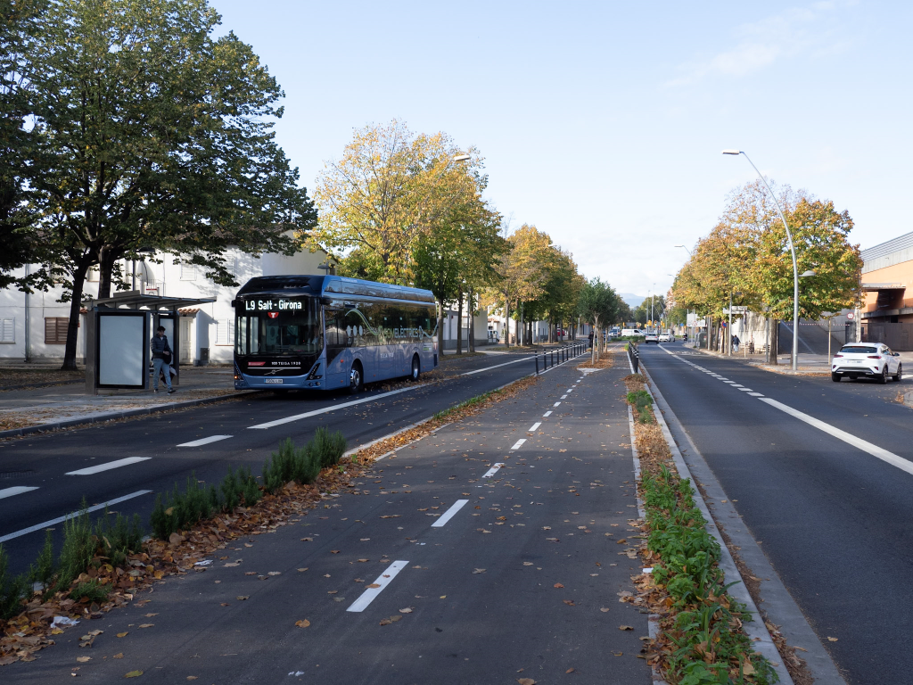
The construction of the Rapid Bus Corridor (BRCAT) between Girona and Salt has been completed, marking a major step forward in sustainable mobility and urban transformation in the metropolitan area.
Beyond transport infrastructure, the Rapid Bus Corridor represents a comprehensive transformation, combining active mobility, improved road safety, high-quality public transport, and a redistribution of urban space. The intervention rebalances the street in favour of people, prioritising walking, cycling, and shared transport while creating a safer and more inclusive urban space.
'This action is part of the Government of the Generalitat’s policies to decarbonise mobility and encourage the use of public transport', said Minister Sílvia Paneque. 'It promotes more competitive bus services while facilitating safe and attractive mobility on foot and by bicycle'.
From Girona to Salt, all the way back
The €5.5 million project, financed through European Mechanism for Recovery and Resilience (MRR) funds, spans 3.5 kilometres and connects Plaça Mercè Rodoreda in Salt with the Pont del Dimoni roundabout in Girona. It includes a dedicated bus lane in each direction and a continuous bidirectional bike lane, alongside a comprehensive redesign of public space to improve safety, accessibility, and traffic flow.

Map with the distribution of the actions implemented — Credits: Generalitat de Catalunya
The works have focused on three main areas and include the reconfiguration of Passeig dels Països Catalans and Passeig d’Olot, the installation of two new signal-controlled roundabouts in Salt, the removal of left-turn conflicts, and the simplification of traffic-light phases along the corridor. Improvements were also carried out on Avinguda de Sant Narcís to facilitate bus movement through a complex curved section, and Plaça Joan Brossa was fully renovated as the new terminal for lines L3 and L4, improving connections to Girona city centre and the railway station.
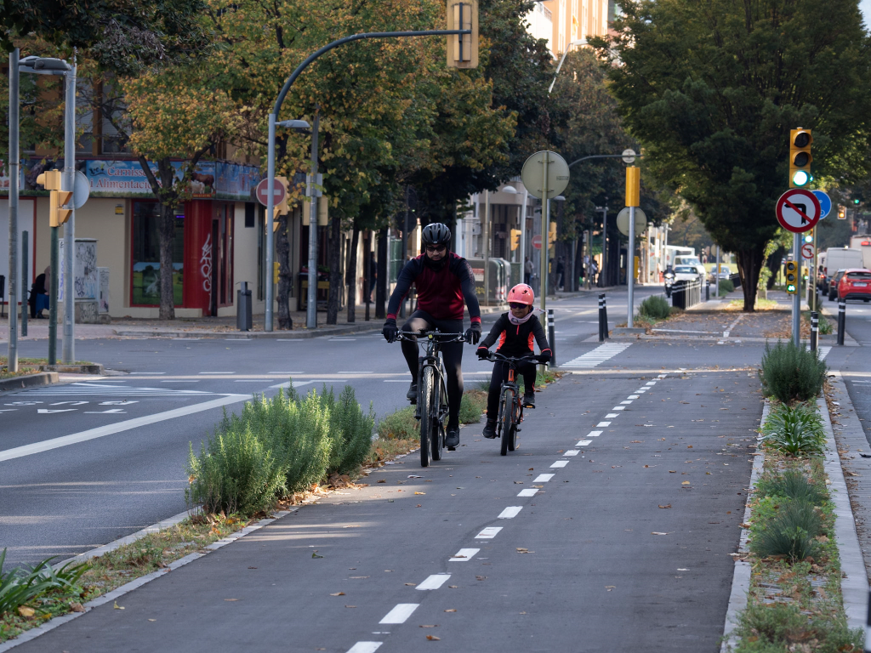
Bidirectional bike lane — Credits: Generalitat de Catalunya
Pedestrian infrastructure has been upgraded through wider sidewalks, new crossings, and expanded pedestrian areas, particularly around Espai Jove in Salt and Plaça Joan Brossa in Girona. A bidirectional bike lane now runs along the entire corridor, encouraging everyday cycling between the two municipalities.
Rethinking (and redoing) bus services
The new infrastructure has enabled a major upgrade to bus services, which came into operation in November 2025. Along the corridor, passengers now benefit from a bus every 3.5 minutes when combining lines L3, L4, and L9-BRCAT. Line L9-BRCAT operates every 15 minutes per direction on weekdays, doubling its previous frequency, and every 30 minutes on Saturdays. Average travel times have been reduced by six minutes, while service reliability has improved across the network.
Line L9-BRCAT has become the main trunk service connecting Salt with the University of Girona, while routes on lines L3 and L4 have been optimised to improve safety, efficiency, and access to key destinations such as the hospital, university campus, commercial areas, and cultural sites. Intermodality has also been strengthened, with seamless transfers at Plaça Joan Brossa, located just 100 metres from the high-speed and regional rail station, as well as interurban bus services.

New routes of L3, L4 and L9-BRCAT — Credits: Generalitat de Catalunya
Clean and inclusive
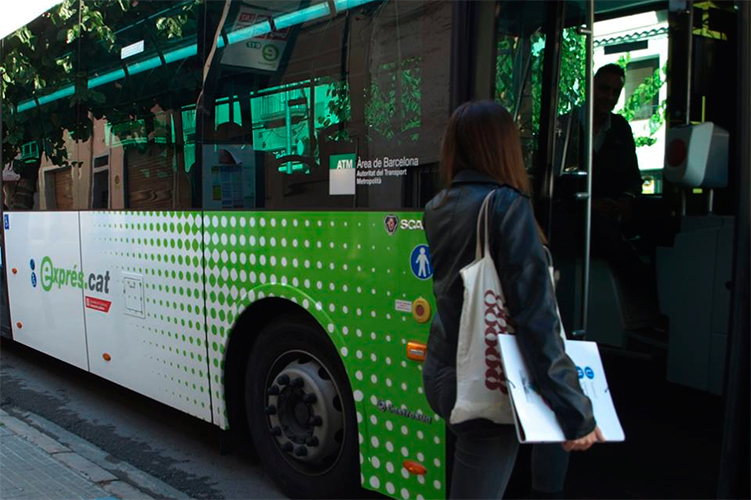
All services operating on the corridor now use 100% electric, zero-emission buses. The new fleet includes six electric vehicles with capacity for 84 passengers, wheelchair spaces, USB charging ports, real-time information screens, and acoustic announcements for visually impaired users. The result is a quieter, cleaner, and more comfortable travel experience.
The environmental impact is significant. A conventional urban bus emits nearly 80 tonnes of CO₂ per year. With four electric buses operating on L9-BRCAT alone, the project saves an estimated 84,000 litres of diesel annually, avoiding almost 319 tonnes of CO₂ emissions, as well as substantial reductions in nitrogen oxides and particulate matter.
A new wave of happy public transport users
Early demand figures confirm a strong public response. Since launch, weekday ridership on L9-BRCAT has effectively doubled, rising to more than 3,000 passengers per day. Line L4 has seen demand growth of over 8% following its route adjustment, while line L3 has maintained stable ridership. Overall corridor demand is growing by around 7% per week, with projections pointing to an additional 400,000 passengers per year on a corridor that already carries more than 3 million trips annually.
These results reinforce a key conclusion of the project: better frequency, speed, and reliability generate new public transport users rather than simply redistributing existing demand.
Catalonia's strategic approach
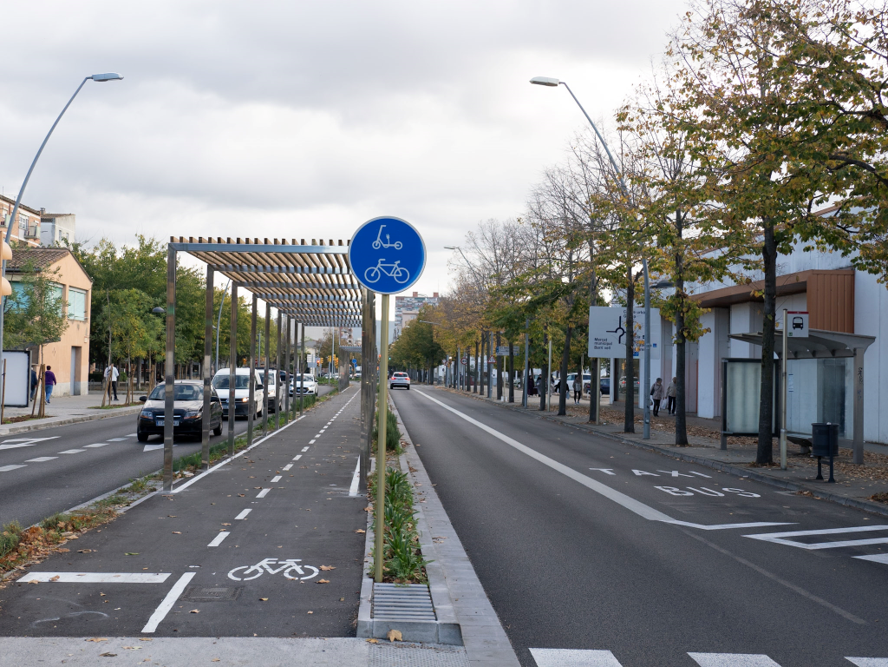
The comprehensive transformation of the Girona-Salt corridor is only one piece of the puzzle of Catalonia's strategy — Credits: Generalitat de Catalunya
The Girona–Salt corridor is one of six BRCAT projects forming the first phase of a wider rapid bus network being deployed in highly congested metropolitan areas across Catalonia. Beyond its local impact, it exemplifies the strategic approach now being applied across the territory, combining infrastructure, service improvements, and electrification to reduce reliance on private vehicles, cut emissions, and strengthen public transport through integrated solutions ranging from urban corridors to regional electric bus services, demand-responsive transport, and bus–train integration in both rural and metropolitan contexts.