
Public Transport, Reimagined
From rural demand-responsive services to zero-emission bus–train integration, Catalonia’s interurban transport initiatives show how smart planning and coordination can strengthen efficiency, sustainability, and regional connectivity, reflecting a clear commitment to improving mobility for both people and the environment. Together, they illustrate how existing resources and innovation are shaping an accessible and eco-friendly mobility model for the region.
Thoughtful planning and innovative thinking can reshape public transport, even in rural areas or protected natural spaces. Catalonia definitely knows something about it.
Indeed, by integrating services, using existing resources more efficiently, and embracing sustainability, the region is building a stronger, more accessible network that meets the needs of both residents and visitors.
Digital on-demand transport in rural areas
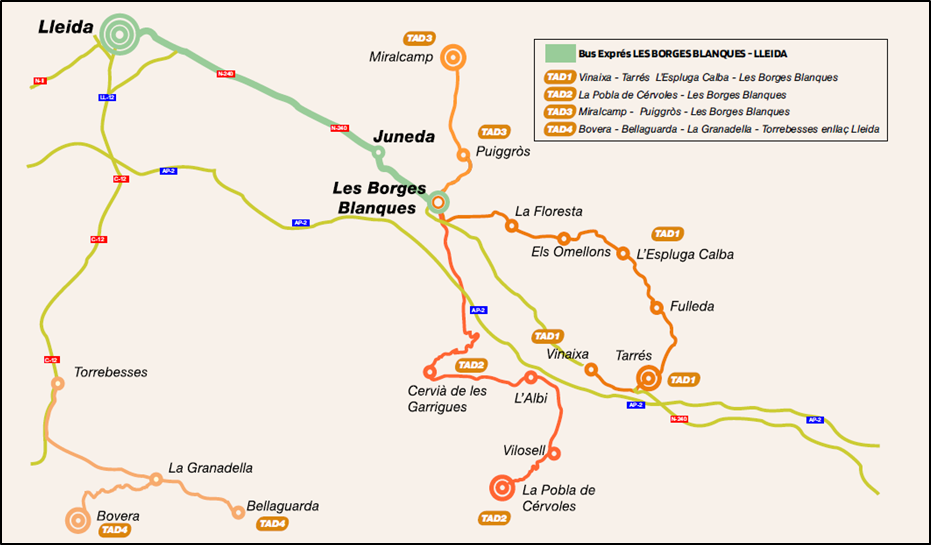
Bus routes from Les Garrigues, Catalonia, Generalitat de Catalunya
In rural areas, such as the comarca (county) of Les Garrigues, the Clic.cat digital on-demand service connects several small towns to the capital, Les Borges Blanques, significantly improving accessibility. To maximise resources, Clic.cat routes are strategically coordinated with the Exprés.cat bus line, which links Les Borges Blanques to Lleida, the capital and largest town in Segrià county, the Ponent region, and the province of Lleida. This integration ensures smooth transitions between different modes of transport, providing more efficient and reliable journeys. The results speak for themselves: Clic.cat demand increased by 21.95% between 2022 and 2024, while the Exprés.cat line saw an impressive 60.1% demand increase, demonstrating the success of this integrated approach. By combining local and express bus resources and aligning timetables, the network reduces travel time and increases overall efficiency.
Electric bus feeders to train stations
Catalonia is also integrating different transport modes using electric buses as feeders to trains, creating a zero-emissions, fully integrated network. Four lines of electric buses are designed to connect passengers seamlessly with train services, further reducing private car use. One of the most notable innovations is the use of energy from regenerative braking on the Ferrocarrils de la Generalitat de Catalunya (FGC trains), which is transferred to electrically power the buses, creating a circular energy system. Recently, this initiative has proven highly effective: between 2022 and 2024, demand for the bus services rose by 37%. This approach not only improves energy efficiency but also reduces the environmental impact of both bus and rail, advancing Catalonia’s goal of net-zero emissions.
Connectivity from different cities to the university campuses
The Universitat Autònoma de Barcelona (UAB) benefits from 20 bus lines connecting over 30 towns and cities across Catalonia—an extensive, robust service that ensures accessibility for students and staff from both metropolitan and more rural areas. Between 2023 and 2024, demand for campus bus services grew by 20%, highlighting the increasing reliance on public transport as a sustainable alternative to private cars.
Key aspects of this successful network include:
- Well-coordinated routes connecting diverse municipalities;
- Timetables synchronised to align with university hours for convenience;
- Seamless integration with surrounding transport networks, allowing smooth and efficient journeys from a wide range of locations to the campus.
Access to national and natural parks
Public transport also supports sustainable tourism in Catalonia’s natural parks. Services connect visitors with
prominent natural parks, such as the Montseny and Garrotxa regions, helping reduce car congestion. The Parc Natural de Aigüestortes i Estany de Sant Maurici—one of the most iconic natural parks in the Catalan Pyrenees—is also accessible by public transport.
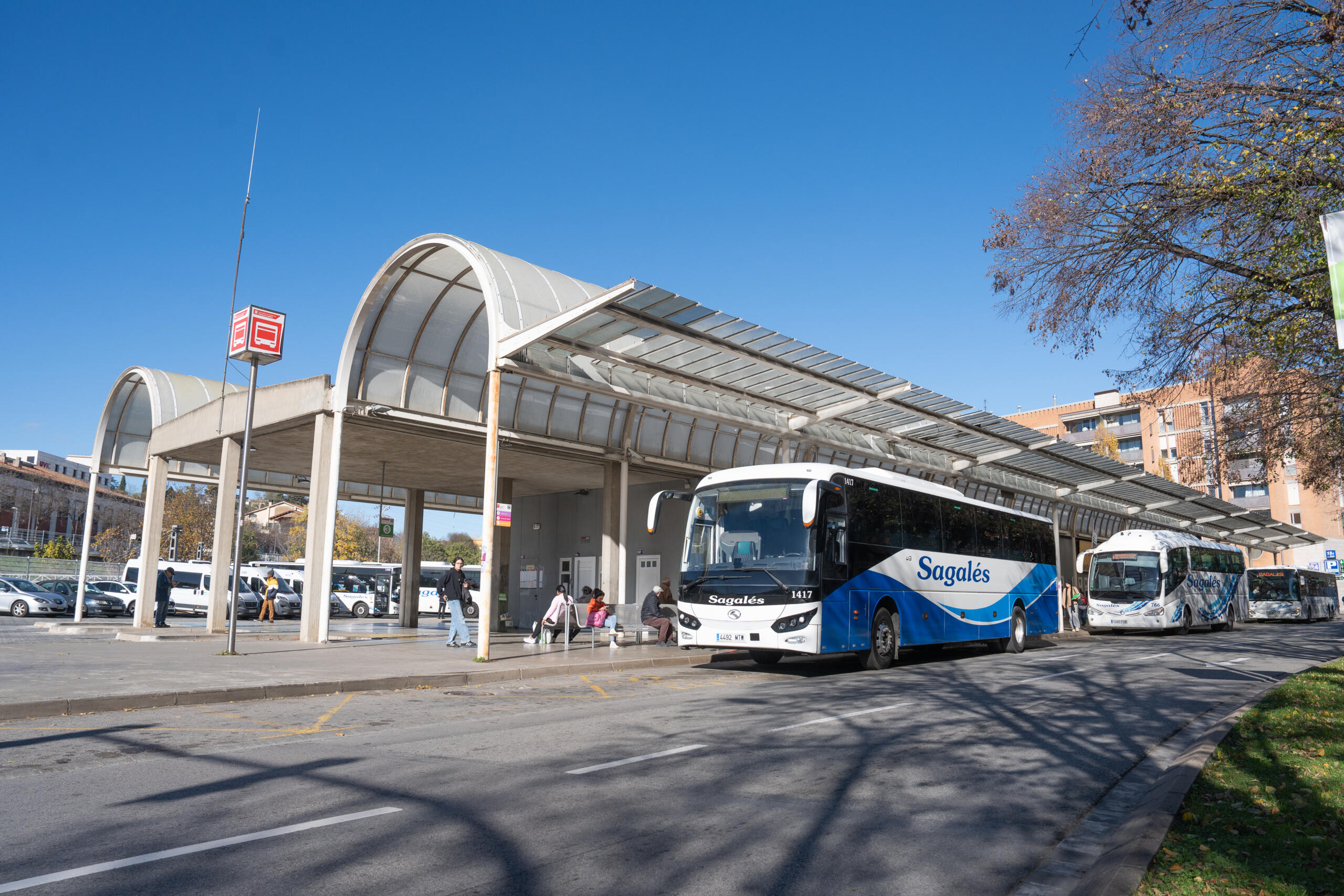
Bus that provides service to the university, near the bus station, Mobility and Transport Direction, Generalitat de Catalunya
The Aigüestortes bus service connects the town of Espot to the park, offering a sustainable travel option for visitors. This service is especially popular in the summer months, when demand increases significantly: it not only reduces the environmental impact of private vehicles, but also facilitates easy access to hiking trails and stunning viewpoints, making the park more accessible while promoting its conservation.
Additionally, integrated train-and-bus services make two major Catalan natural parks—the Montseny and the Sant Llorenç del Munt i l'Obac—accessible year-round.
Visitors can reach Montseny Natural Park with a convenient combined ticket that includes a train from Barcelona and a connecting bus ride to the park. Sant Llorenç del Munt i l'Obac Natural Park is equally easy to access, thanks to a coordinated train and bus service on the FGC lines running every weekend and public holiday. These initiatives reduce traffic congestion, promote environmentally friendly travel, and support the conservation of these protected areas.
Optimising school buses for public transport
In many rural areas, school buses are the primary form of public transport: Catalonia has embraced this as an opportunity to extend their use beyond school hours. In the Segarra region, with a population of just 22,000, school buses—which traditionally only ran during school hours— now serve passengers on available seats during non-school hours, providing a proper demand-responsive transport system, with additional bus services scheduled when vehicles and drivers are free. Between 2021 and 2024, demand increased by 30.2%.
Click here to read the article in its original format.
About the authors:
Cristina Pou, Head of Road Public Transport, Mobility and Transport Direction, Generalitat de Catalunya. A civil engineer with two Master’s degrees in Mobility Planning and E-logistics, Pou has 25 years of experience in transport, including roles at TMB, Barcelona’s Transport Authority, and the Catalan Traffic Service. She also taught in a Postgraduate Program on Smart Mobility for 12 years. She now leads the Road Public Transport Service for the Government of Catalonia.
Albert Guillaumes, Senior Engineer, Mobility and Transport Direction, Generalitat de Catalunya. Civil Engineer and Master in Supply Chain, Transport and Mobility, Guillames works in the Road Public Transport Service at the Government of Catalonia, focusing on planning improvements for the regional bus network, including demand-responsive transport (DRT) services.
Oriol Font, Junior Consultant, Mobility and Transport Direction, Generalitat de Catalunya. Consultant in the Road Public Transport Service at the Government of Catalonia, Font supports planning improvements for the regional bus network, including demand-responsive transport (DRT) services.
 Steve West, Unsplash