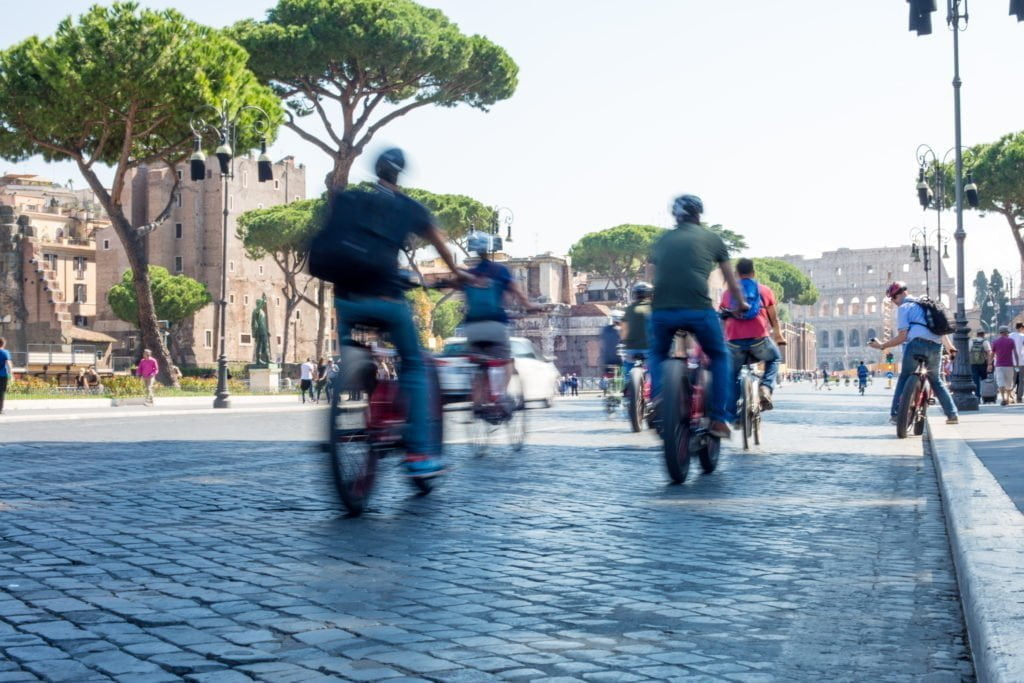
Rome tightens vehicle restrictions in its Low-Emission Zone
POLIS member Rome goes one step further in reducing air pollution levels! A new measure now bans the circulation of vehicles with diesel engines up to Euro 5 and petrol engines up to Euro 2 within Rome’s Low-Emission Zone (LEZ), known as the Green Zone.
The driving restriction will be enforced annually from 1 November to 31 March, on weekdays from 08:30 to 18:30. The winter period usually corresponds with high pollution levels due to increased heating and more intensive use of transport services. The measure does not affect emergency and essential services, such as police and ambulances.
Rome’s Green Zone is one of Europe’s largest LEZs. It plays a key role in the city’s broader efforts to improve air quality for its citizens, and it covers both central areas and surrounding districts.
The measure adopted by the Lazio Regional Council is part of an updated air quality improvement plan. The City of Rome will be responsible for defining any exemptions, provided they are balanced by appropriate compensatory measures. In addition, the Ministry for the Environment and Energy Security (MASE) has allocated €25 million for pollution-reducing initiatives such as the replacement of old commercial vehicles, the promotion of sustainable transport modes, and the modernisation of heating systems.
Pushing forward pays off
Accelerated after the COVID pandemic, the city of Rome has acknowledged the changes in mobility patterns and recognised the role of transport in achieving environmental targets. Since then, the administration has welcomed and encouraged the shift to sustainable mobility, raising awareness on public transportation and sustainable modes.
The creation of the Green Zone is part of these efforts. By targeting high-polluting vehicles, low-emission zones reduce the levels of harmful pollutants associated with road traffic, such as nitrogen dioxide (NO₂) and particulate matter (PM2.5), which are responsible for a range of diseases.
Last year at the Annual POLIS Conference 2024, Rome shared more about the Green Zone and the city's evolution of urban vehicle access regulations. First introduced in 2022, the Green Zone is an access regulation scheme that covers the entire city with restrictions for cars and motorcycles with certain EURO emission levels. The standards are progressively being tightened, and as of 1 July 2023 they include Euro 3 for petrol cars and Euro 4 for diesel ones.
Despite being part of the city's efforts to deliver equitable and sustainable mobility solutions, the introduction of the Green Zone has been met with backlash. However, the measure has been paired with investments in public transport services and supply, encouraging conversations with the citizens. As highlighted in the latest Leadership Summit, held in Rome on 14 May 2025, the city demonstrates how political courage means pushing forward and maintaining an open dialogue with communities.
In fact, Rome is at the forefront of the urban mobility transformation. In recent years, it has taken ambitious decisions to reduce car dependency, expand active and shared mobility, and improve road safety, such as the GRAB, an extensive cycle route encircling the capital, or the pedestrianisation of Piazza Pia.
‘Our aim is to redistribute urban space in a way that prioritises pedestrians and sustainable modes of transport, while gradually reducing the dominance of cars in the cityscape. This is not just about infrastructure—it is about reimagining the city to make it safer, greener, and more liveable for all our citizens.’
Eugenio Patanè, Deputy Mayor for Mobility of the City of Rome

- Related Members