POLIS co-signs manifesto leveraging cycling to achieve energy independence
In response to the European Commission's communication on affordable energy, European civil society organisations dedicated to sustainable urban mobility launch a manifesto on achieving energy independence and affordable transport by leveraging cycling.
Only four years after Russia's invasion of Ukraine and the consequent fossil fuel energy crisis, the EU faces another crisis due to its dependence on imported oil. The US-Israel war on Iran is causing oil and gas prices to skyrocket, leading the International Energy Agency (IEA) to describe this situation as the 'biggest energy crisis in history'.
This latest shock to the energy market is another reminder that the European transport sector remains overly reliant on imported oil. Despite the growing electrification, the EU must take more ambitious steps to reduce fossil fuel consumption. To achieve this, the EU and its Member States need to invest in sustainable transport solutions, which will address both energy dependence and affordability issues.
The Communication AccelerateEU, presented by the Commission on 22 April, addresses the rising energy costs by introducing both short-term and structural measures to reduce dependency on volatile fossil fuel markets. Proposed actions include improving coordination, protecting consumers, accelerating the shift to homegrown clean energy, upgrading the current grid system, and boosting investments to support the clean energy transition.
The coalition of European mobility advocates—including POLIS, European Cyclists' Federation, European Cycling Industries, European Transport Safety Council, Eurocities, and Clean Cities Campaign—welcomes the initiative by the Commission. With the cycling manifesto 'Achieving energy independence and affordable transport for all: ten measures to leverage cycling', they encourage policy leaders to be more ambitious by prioritising cycling and active mobility as immediate, cost-effective solutions to reduce transport-related energy demand.
Car is out, bike is in
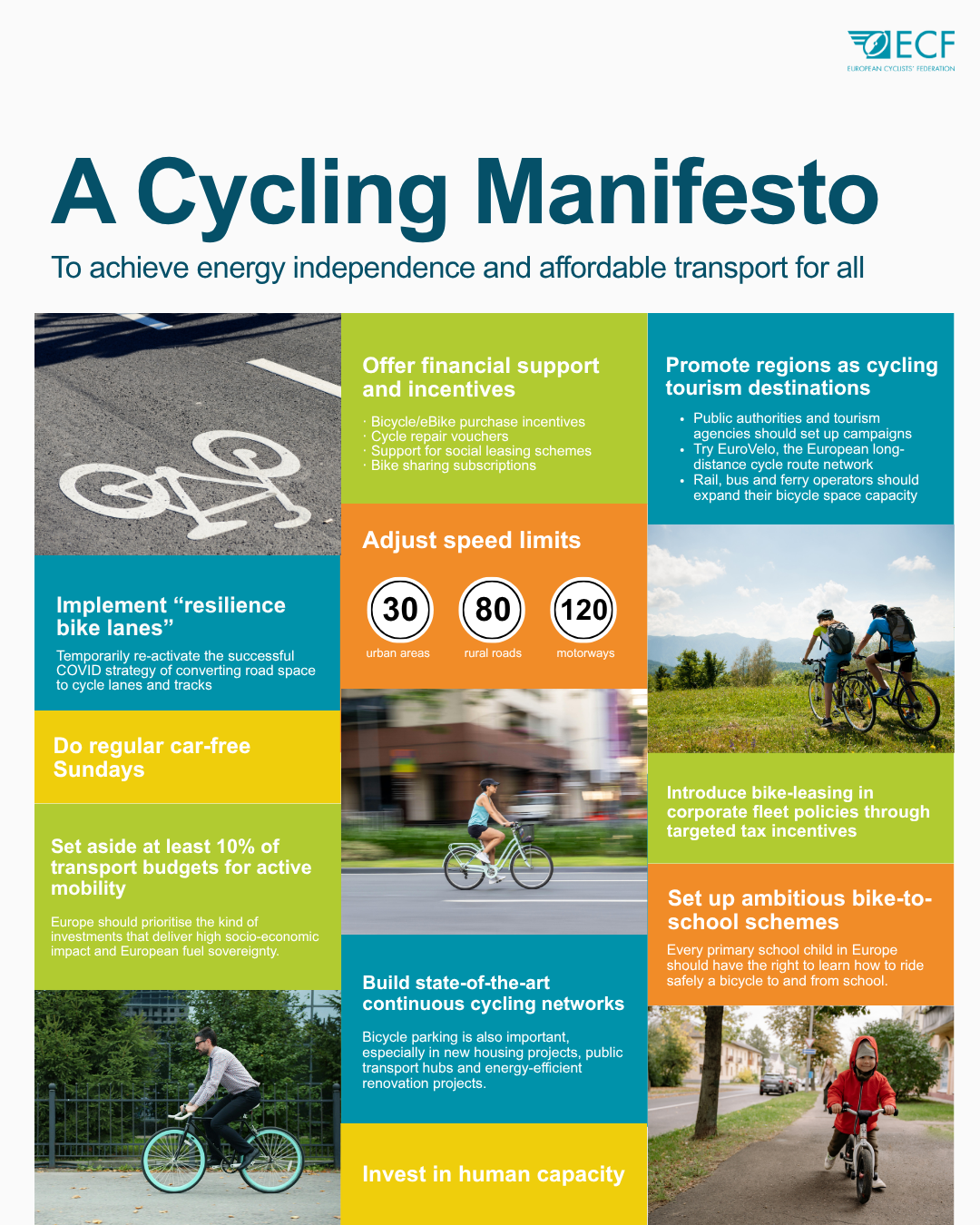
The cycling manifesto outlines ten concrete short- and long-term actions to support the shift from private cars and towards active mobility — Credits: ECF
Among all modes of transportation, the bicycle is by far the most energy-efficient. One kilometre travelled by bicycle consumes up to 27 times less energy than by car. Considering that in Europe, approximately 100 million urban car trips occur daily within a 10 km range, if even a small fraction of these trips were replaced by walking, cycling, or public transport, the savings in fuel consumption would be huge.
To support cycling, the co-signatories of the new manifesto present ten achievable measures that can be implemented at all levels of governance.
The short-term actions include:
- Implementing 'resilience bike lanes', by temporarily re-introducing the successful COVID strategy of converting road space to cycling lanes;
- Adjusting speed limits to 30 km/h in urban areas, following successful examples from cities like Bologna, which have seen positive effects in terms of reduced road deaths and injuries, as well as benefits for the environment and public health. Speed limits should also be lowered to 80 km/h on rural roads and 120 km/h on motorways;
- Offering financial support such as incentives for bicycle and e-bike purchases, cycling repairs vouchers, support for social leasing schemes, and bike sharing subscriptions;
- Implementing regular car-free Sundays in cities and neighbourhoods, following the model of the EUROPEANMOBILITYWEEK;
- Promoting regions as cycling tourism destinations by advertising cycling networks such as EuroVelo, the European long-distance cycle route network.
Structural reforms with medium and long-term benefits are:
- Building state-of-the-art continuous cycling networks at local, regional, national, and European levels, as well as planning for bicycle parking in new housing projects, public transport hubs, and energy-efficient renovation projects;
- Dedicating at least 10% of transport budgets to active mobility, prioritising investments that deliver high socio-economic impact and support European fuel sovereignty;
- Investing in human capacity by including more sustainable mobility experts in urban planning across all government levels;
- Mainstream bike-to-school schemes to ensure that every primary school child in Europe learns to bike and can do so safely to and from school.
Two birds with one stone
The EU needs to change course and invest in solutions that reduce fossil fuel use at the source. Cycling is one of the fastest and most cost-effective tools for achieving this goal. By prioritising cycling as part of a sustainable modal shift, it can become a strategic asset for Europe’s energy security, competitiveness, and resilience.
The coalition welcomes the inclusion of measures promoting cycling in the Annex of the Commission’s communication on affordable energy, such as enhancing cycling infrastructure, incentives for bike purchases, support for bike-sharing programs, and encouraging cargo bike deliveries. However, just like the Commission’s recent proposal on clean corporate vehicles, it neglects to include company bike leasing in its tax benefit recommendations for company cars, missing the chance for significant fuel savings through improved employee mobility.
The signatories of the manifesto stand ready to support policymakers in implementing the measures outlined.