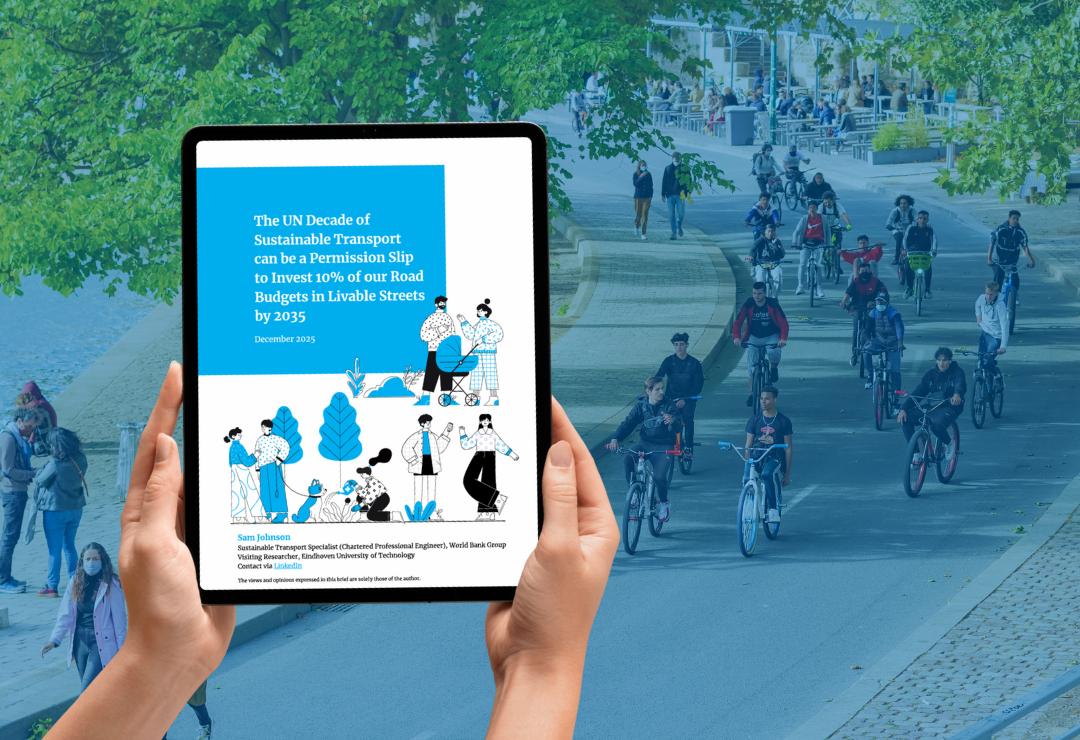
New briefing advocates investment in 'Livable Streets' for sustainable transport
Sam Johnson, Sustainable Transport Specialist at the World Bank, has issued a briefing paper calling on national and subnational authorities to create dedicated 'Livable Streets Investment Programmes' to co-fund projects throughout the UN Decade of Sustainable Transport (2026–2035).
On 10 December 2025, the United Nations launched the Decade of Sustainable Transport 2026-2035, establishing a global framework to coordinate action, mobilise resources, and monitor progress towards more sustainable mobility worldwide. This is a rare change to place sustainable mobility at the top of the political agenda.
According to Johnson, this opportunity to shift global priorities cannot be missed. The Decade can be a ‘permission slip’ to accelerate and enable active mobility.
Time to invest in Livable Streets
During his speech at the Annual POLIS Conference 2025 Opening Plenary, he called on governments to commit to a transformative yet achievable pledge: to invest up to 10% of road budgets in active mobility by 2035. His briefing paper expands on this proposal, recommending authorities to establish 'Livable Streets Investment Programmes' to systematically co-fund local improvements in towns and cities throughout the Decade.
Johnson highlights a long-standing imbalance in public investment. While governments spend trillions on road infrastructure, active mobility is often an afterthought, receiving only a fraction of the budget. Across Europe, 22 central governments currently invest less than ten euros per capita in such initiatives.
Investing in happier and healthier communities
Livable streets and active travel are among the most resilient, cost-effective investments available to public authorities. Their health, social, environmental, and economic benefits are well-documented, and the return on investment is notably high.
Under Johnson’s proposal, Livable Streets Investment Programmes would receive a gradually increasing share of the capital road budget over the Decade, starting small and increasing slowly.
Each programme would adopt a people-first approach and support a broad range of interventions, including:
- Capacity building for government and industry
- Livable Streets strategies and network development plans
- Feasibility, concept, and detailed design studies for both temporary and permanent projects
- 'Open Streets' events that temporarily close streets to cars and other motorised vehicles, re-purposing the space for community activities
- Construction of core active mobility infrastructure, such as footpaths, protected cycle lanes, and school streets
Johnson concludes that continuing with business-as-usual in road spending will not deliver the livable future societies want and need. Mobility is not just about moving efficiently, but how people feel when navigating urban spaces. Cities where people can walk, cycle, and interact freely are healthier, more cohesive, and more economically attractive. Governments, therefore, should reassess their budgets and priorities to ensure that mobility contributes to urban wellbeing and collective joy.
Read the full briefing paper here.