New EU Framework for Climate Resilience establishes a proactive approach to managing climate risks
On 27 October 2026, the European Commission released the Communication on the EU Framework for Climate Resilience, putting forward a common European approach for managing growing climate risks and integrating resilience into policymaking and economic and investment decisions.
The EU Framework for Climate Resilience sets out the Commission's strategy for strengthening climate resilience across Europe, in response to increasingly severe and frequent heatwaves, droughts, wildfires, and floods that have occurred in recent years. Climate change has devastating impacts on citizens, infrastructure, and businesses, as the economic losses due to climate damage are estimated at €50 billion per year.
The Framework Communication proposes a systemic change: Europe must move from a reactive to a proactive approach to disaster response in order to anticipate, prepare for, and manage climate risks, preventing avoidable damage. This means integrating 'climate resilience by design' across all levels of decision-making, including local and regional authorities, and all major policy areas, both domestic and international.
Climate resilience by design
A core element of the Framework is the proposed European Climate Resilience Law, which seeks to establish a common reference for climate risk management across the EU. Key elements include:
- reference global warming trajectory, establishing a shared baseline for risk assessments against which Member States can assess future climate risks based on the global warming scenario of 1.5°C by 2030, 2°C by 2050, and 3°C by 2100;
- regular and consistent identification of policy risk owners, mandating Member States to assign and determine public actors responsible for managing climate risks,
- improved and more regular climate risk assessments, to ensure that Member States’ assessments and the European Climate Risk Assessment would be comparable, synchronised, and coherent;
- simplifying national strategic plans, requiring Member States to develop only one plan instead of the four planning instruments required today that integrates climate resilience;
- simpler and more effective monitoring of progress, both for each Member State and the European Union, which the European Environment Agency periodically carries out.
The Framework provides practical tools to support public authorities, businesses, and communities in estimating and addressing climate risks. These will be gathered in a European online platform for climate resilience, and include tools such as:
- the European Climate Viewer, an interactive map of projected climate hazards across the continent;
- the Navigator of Climate Resilience Tools, supporting users in finding relevant climate resilience tools based on their location, sector, and the specific risks they face;
- the Solutions Explorer, showcasing practical adaptation solutions developed and tested through the EU Mission on Adaptation to Climate Change.
The Commission also mentioned that it will identify 100 of the most vulnerable EU territories, strengthening the EU Mission on Adaptation to Climate Change, a funding programme to support regions, cities, and communities, and the related Climate City Capital Hub and National Adaptation Hubs, as well as strengthening the New European Bauhaus policy and funding initiative. Lastly, the EU will put forward an Implementation Plan for the European Climate Resilience Law within six months of the law's adoption.
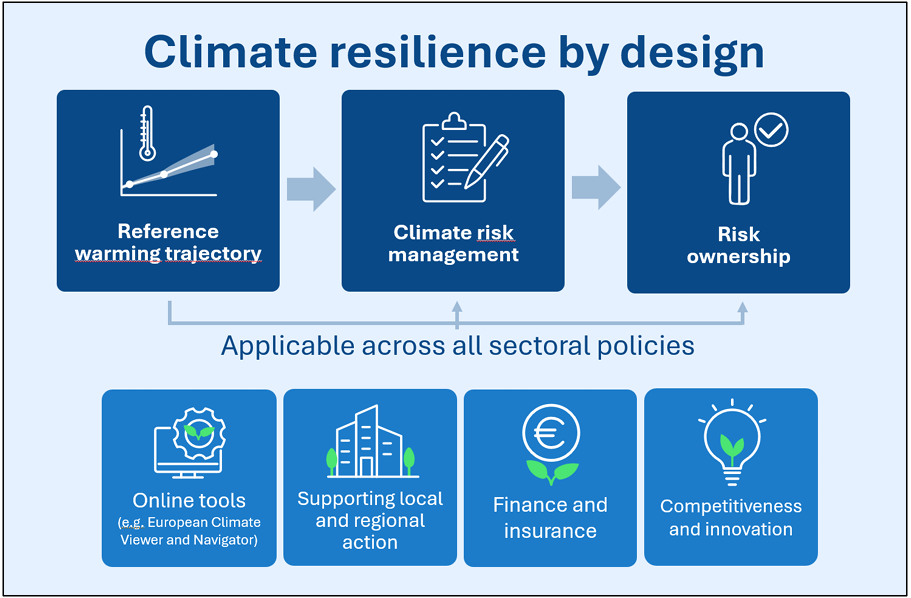
Overview of the EU Framework for Climate Resilience — Credit: European Commission
Implications for local and regional authorities
The transport sector is identified as one of the key policy areas of Union-wide relevance for climate resilience. The Framework builds on existing EU regulations, namely the TEN-T Regulation and the EU Adaptation Strategy. Since the TEN-T Regulation already requires climate-proofing and risk assessments for infrastructure projects, the Commission has started to implement lifecycle-based methodologies to assess environmental impacts and climate resilience of transport infrastructure. Moreover, new tools are being developed to identify structural vulnerabilities in rail and road bridges and tunnels on the TEN-T network.
ICLEI Europe welcomed the framework in a press response but argued that the proposed consultation of subnational authorities in national strategic plans should be strengthened through a formal multilevel coordination mechanism. Before the publication of the Framework, the Local Alliance had called for a stronger role of local and regional governments as key partners and not merely implementers, and for more robust financial and institutional support.