
Modal shift from short-haul flights to rail reduces emissions in European intercity and cross-border mobility
Air travel within Europe remains one of the fastest-growing sources of transport emissions (right after road transport!), despite the fact that many of these journeys already have viable rail alternatives.
The ONTRACK report by The Shifters Belgium demonstrates that a targeted modal shift from air to rail could deliver substantial and near-term climate benefits, particularly for urban-to-urban and cross-border travel corridors.
A significant but often overlooked emissions source
In 2024, nearly 27.9 million passengers departed from Belgian airports. Focusing on intra-European routes with equivalent train travel times under 15 hours reveals a striking picture: these journeys alone accounted for approximately 11.9 million passengers and 1.8 million tonnes of CO₂ equivalent emissions, including non-CO₂ climate effects.
 These trips are not marginal: they represent almost half of all flights departing Belgium and cover key European urban corridors linking cities such as Paris, Amsterdam, Frankfurt, Berlin, Zurich, and Barcelona. In other words, this is not only an aviation issue, but a core urban and regional mobility challenge.
Rail as a technically viable alternative for city networks
Rail already provides a competitive alternative for many of these connections, particularly when viewed through a door-to-door urban mobility lens. High-speed rail links major metropolitan areas in a way that integrates naturally with city-centre access, reduces airport transfer burdens, and improves overall travel time reliability.
The ONTRACK analysis quantitatively confirms this potential. If all eligible intra-European journeys were made by train, emissions would be reduced by approximately 132,000 tonnes of CO₂ equivalent annually.
The scale of achievable impact
The study goes further by applying realistic behavioural and infrastructural constraints, showing that even under conservative assumptions, a partial modal shift still yields major benefits.
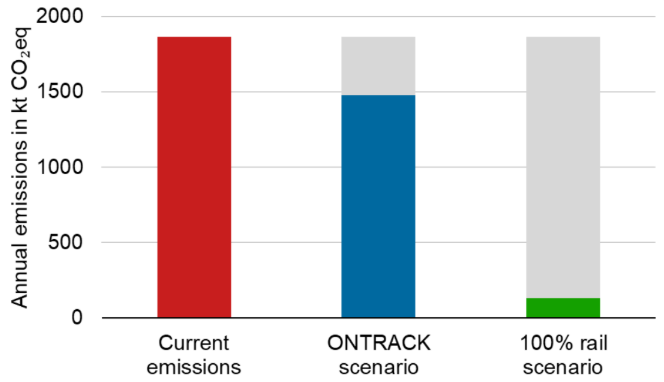
Emissions from flights with equivalent train journey times of less than 15 hours with no modal shift, ONTRACK modal shift, and 100% modal shift — Credits: Shifters Belgium
Using differentiated modal shift rates (100% for journeys under 4 hours, 40% for 4-8 hours, and 10% for 8-15 hours), the estimated annual reduction is approximately 389,000 tonnes of CO₂ equivalent—equivalent to the average annual carbon footprint of nearly 30,000 Belgian residents.
From a transport planning perspective, this is particularly important: the majority of emissions savings come from medium- and long-distance intra-European routes where rail already exists but is underutilised or insufficiently competitive.
Cross-border mobility problem
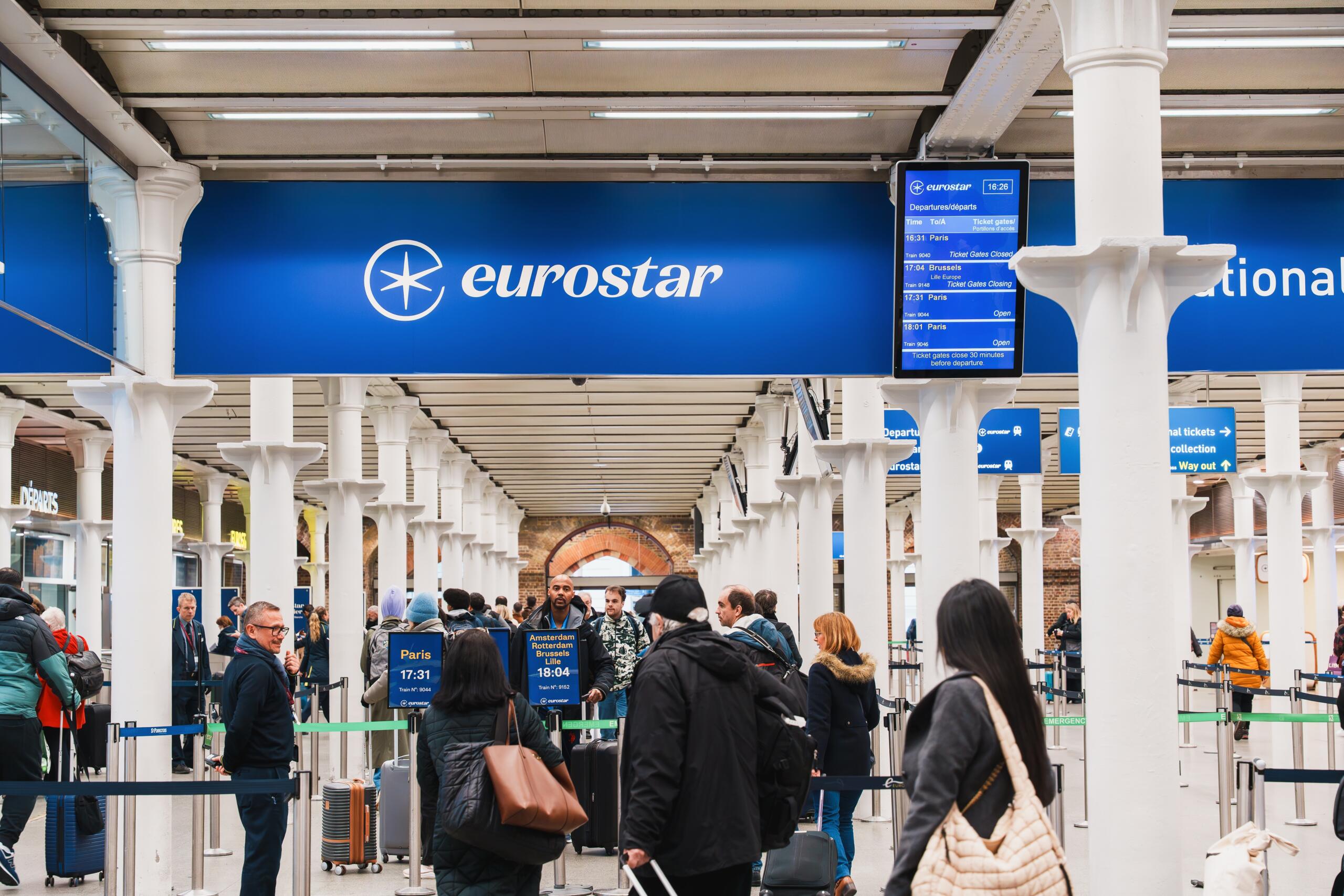
Eurostar departure hall inside St Pancras International station in London — Credits: Jannissimo, Shutterstock
This analysis reframes aviation not as a separate long-distance sector, but as an extension of urban mobility systems across Europe. Many short-haul flights effectively function as intercity connections between large metropolitan regions. When viewed this way, the problem becomes one of cross-border mobility integration rather than aviation alone.
Three categories of routes emerge:
- Short urban hops under 4 hours by train equivalent (connections between Brussels and Amsterdam, Paris, London, Lyon, and Frankfurt), where rail is already clearly superior in time, comfort, and emissions;
- Medium-distance corridors (4-8 hours, for connections between Brussels and Geneva, Berlin, Munich, and Zurich), where rail is competitive but limited by frequency, pricing, or lack of direct connections;
- Longer European links (8-15 hours, for connections between Brussels and Madrid, Barcelona, and Budapest), where night trains or improved high-speed networks could realistically capture demand.
Each of these categories corresponds to different policy and infrastructure levers, but together they form a coherent European urban mobility network that currently remains fragmented.
Policy directions emerging from the analysis
The report identifies three priority interventions that directly affect urban and cross-border mobility systems.
First, short-haul flights with viable rail alternatives should be progressively eliminated. This includes the most direct urban-airport-urban connections, particularly those under one hour of flight time, where rail already offers comparable or better door-to-door performance. Strengthening airport-rail integration, including seamless baggage transfer and automated rebooking systems, is essential to avoid creating accessibility gaps.
Second, medium-distance European rail corridors require targeted reinforcement. Cities such as Berlin, Munich, Geneva, Zurich, and Barcelona already attract significant passenger flows, but rail services remain inconsistent, indirect, or insufficiently frequent. These corridors are central to Europe’s urban network structure and should be treated as backbone infrastructure rather than niche alternatives.
The rail connection between Brussels and Barcelona could be strengthened, in light of the number of passengers travelling this route each year — Credits: Toni. M, Shutterstock
Third, rail must become structurally competitive at European level. Current fiscal asymmetries, including the absence of fuel taxation for aviation and VAT differences, distort modal choice. Without correcting these imbalances, even well-developed rail infrastructure will struggle to compete on price.
Beyond climate policy
While the climate case is strong, the implications extend further. Strengthening rail as the default mode for intra-European urban connectivity improves resilience, reduces dependency on imported fossil fuels, and enhances accessibility between major cities without relying on congested airports.
It also aligns more closely with how people actually travel in practice. A large share of aviation demand is discretionary and concentrated in a small proportion of frequent travellers. Redirecting even part of this demand toward rail creates disproportionate benefits relative to the scale of intervention required.
The ONTRACK findings demonstrate that shifting a meaningful share of short and medium-haul flights to rail is not a long-term aspiration but a near-term opportunity. For urban and regional mobility systems across Europe, this represents one of the most effective levers for rapid decarbonisation and more efficient cross-border travel.
- Related Members