EMW focuses on designing mobility across generations
The 2026 theme for EUROPEANMOBILITYWEEK is ‘Mobility for Everyone’, focusing on making sure that all people can access sustainable transport, no matter their income, location, gender, or abilities. The campaign has published a factsheet to illustrate how intergenerational fairness is central to that.
For the 2026 edition, EUROPEANMOBILITYWEEK is keeping the same theme of the previous edition: ‘Mobility for Everyone’. The 2025 theme was not only a big success, but it has sparked many reflections on what designing mobility systems truly for all means. This year’s edition of the EMW campaign will therefore follow up on these discussions and place the spotlight on intergenerational fairness.
Caring for current and future generations
Decisions taken today—or their lack—have important consequences on current and succeeding generations. To ensure that choices are equitable and fair to all, we need to change how we think about the future.
Intergenerational fairness means ensuring that decisions do not compromise the opportunities of future generations, and that benefits and burdens are shared fairly across generations. This requires an intergenerational approach that highlights our shared responsibility to protect, sustain, and regenerate the basic environment and societal conditions for all living things and nature, shifting from an individualistic view to a relational one.
Achieving intergenerational fairness demands collective reflection and action, in particular from global leaders. However, there are three main challenges to bringing more intergenerational fairness in policies and lawmaking:
- Short-termism, which dominates the political and economic agendas;
- Lack of sufficient collaboration across generations, where weak connections and the lack of opportunities for engagement and collaboration reduce social cohesion;
- Exclusion and inequalities, which constrain young and older people from fully participating in society.
To overcome these, we must combine long-term thinking, intergenerational collaboration, and protection of the vulnerable.
Intergenerational fairness on the global agenda
In September 2024, at the Summit of the Future, the United Nations adopted the Pact for the Future, a landmark agreement which calls all countries to cooperate to ‘deliver a better future for people and planet’. As part of this, the UN also adopted the Declaration on Future Generations. The Declaration is a pivotal moment in international diplomacy, as it affirms current generations’ responsibility to protect future generations’ needs and interests. It mainstreams long-term thinking in decision-making, promoting long-term sustainable development and multilateral collaboration.
This global momentum, paired with an increasing awareness of the cost of non-action and of how inequalities across generations are changing, has paved the way for the European Union to also act on the topic. The EU Strategy on Intergenerational Fairness aims to ensure that today's choices enhance tomorrow's opportunities and that benefits and responsibilities are shared fairly across all ages. This document is the result of a wide-scale citizens and stakeholders consultation supported by the EU Policy Lab, which brought together 150 randomly selected EU Citizens to form the European Citizens’ Panel.
The Strategy is shaped around the concept of ‘intergenerational contract’, which provides a common framework for aligning foresight, fairness, and responsibility. It is built on three dimensions:
- Fair policymaking that embeds a long-term and systemic perspective into decision-making;
- Fair opportunities uniting generations around shared goals for a better future;
- Fair places that ensure that different generations are not disadvantaged by geography.
By introducing this long-term perspective in complex challenges such as climate change, demographic change, geopolitical shifts, the overburdened pension system, and labour market changes, current generations can leave a legacy of choice and not a burden of debt to younger and future generations.
Mobility systems designed for today and tomorrow
Mobility is a basic service that everyone relies on daily, with diverse needs across all ages. However, many face barriers such as high costs or a lack of available transport options, which limit their access to job and educational opportunities, as well as basic services such as healthcare. This issue is known as transport poverty, and it is estimated that up to 125 million EU citizens experience some form of it.
As the decarbonisation of transport is underway, it risks exacerbating transport poverty and bringing new challenges, even though it has long-term benefits. In fact, on one hand, the sustainable mobility shift will help mitigate the climate crisis, which is one of the most worrying challenges for younger and future generations. On the other hand, the impacts of the transition are not distributed equally and unfairly affect groups that face systemic inequalities and marginalisation. For instance, factors like higher fossil fuel taxes, the upfront costs of electric vehicles (EVs), and congestion charges can affect affordability. Rural and peri-urban areas face challenges with limited public transport and EV charging access. Additionally, older adults and individuals with disabilities often struggle to switch to public or active transport, relying more on private cars and flexible options.
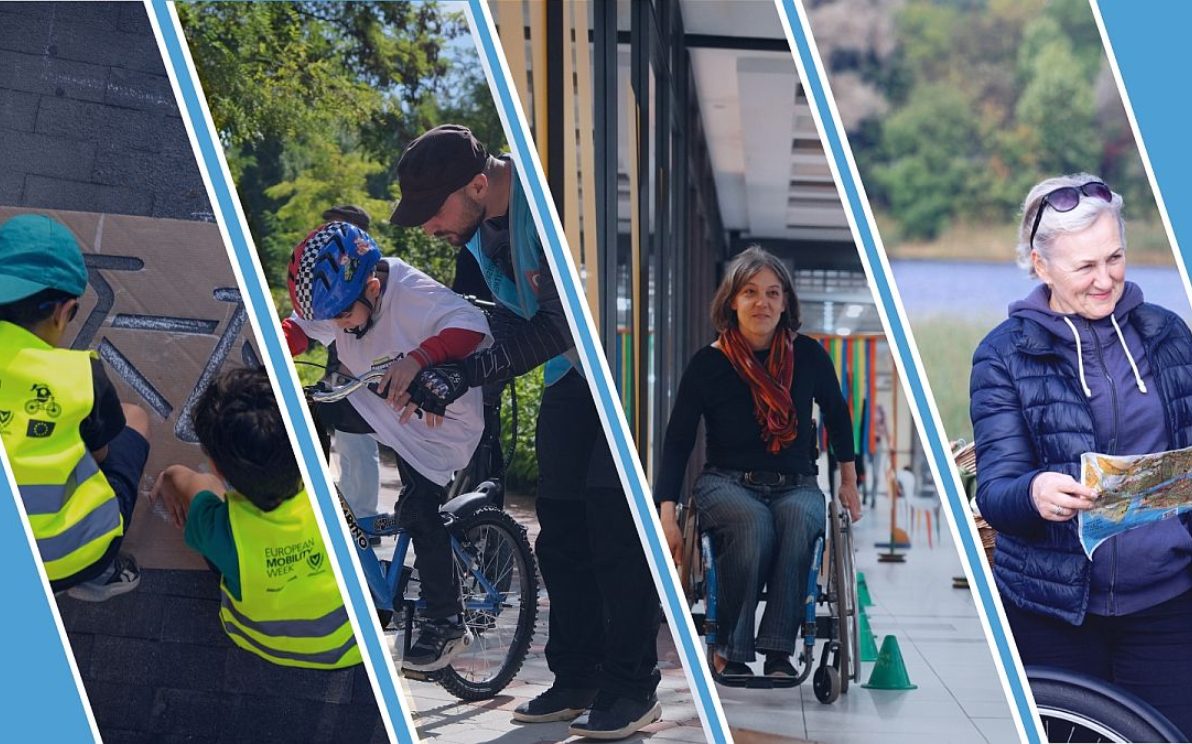
'Mobility for Everyone' comes as a principle to ensure equity and tackle transport poverty across Europe, and the intergenerational long-term thinking will only strengthen mobility systems in cities and regions. So in 2026, EUROPEANMOBILITYWEEK invites us to reflect on how mobility for everyone can support intergenerational fairness and collaboration, through four principles:
- Facilitating encounters across generations by considering transport as a collective good that sustains everyday life;
- Facilitating exchange across generations with mobility systems built by and for communities;
- Empowering generations to move safely and comfortably by ensuring safe and reliable services with no physical or digital barriers;
- Supporting a fair and lasting legacy by integrating a foresight mindset in all phases of planning.
Intergenerational fairness means creating transport systems that are affordable, sustainable, and accessible to today and tomorrow’s generations. EUROPEANMOBILITYWEEK encourages cities, regions, companies, institutions, NGOs, and citizens to develop and plan mobility activities, services, and actions from 16 to 22 September and beyond that consider all age groups and fulfil the needs of current and future generations.
Consult the EUROPEANMOBILITYWEEK factsheet on 'Mobility for Everyone' here.
- Related Projects