Amsterdam redefines mobility planning by integrating care and gender perspectives
Amsterdam is increasingly rethinking how mobility and urban space are understood by incorporating a gender perspective into planning, with implications for transport policy, public space design, and accessibility standards.
Recent mobility research in the city shows that when travel is analysed beyond traditional commuting categories, care-related trips represent a major share of daily movement. Based on Amsterdam’s 2025 'Mobilities of care' study (around 600 respondents) and reclassified data from the Dutch National Travel Survey (ODiN), care-related travel accounts for approximately 28% of all trips, compared with about 32% for work-related commuting. Care-related mobility includes grocery shopping, school and childcare drop-offs, escorting others, healthcare visits, and household errands. In this framework, 83% of grocery trips are classified as care-related, while escort trips are fully included because they are dependent.

Nesciobrug Bicycle Bridge in Amsterdam — Credit: Dutchmen Photography
This reclassification shifts how mobility demand is interpreted. Rather than being dispersed across fragmented categories, care becomes the second-largest trip purpose in the city. These journeys are also structurally different from commuting: they are often chained, time-constrained, and involve multiple stops, making them less compatible with standard origin–destination transport models designed around linear work trips.
Space for everyone
Building on this evidence, the exploratory study 'Space for Everyone', commissioned by the Municipality of Amsterdam and conducted by Sanne Kruyff, Zosia Nowakowska, and Yuki Tol, examines how planning assumptions shape infrastructure outcomes. It highlights that many transport systems are still implicitly designed around a 'standard user' moving directly between home and work. This model reflects historical prioritisation of employment-based mobility and peak-hour efficiency.
The study argues that this framing underrepresents care-related mobility in both policy and infrastructure design. While Dutch transport planning has produced highly efficient cycling and public transport networks, it has traditionally prioritised radial commuter flows. As a result, everyday local travel, including care-related trips, receives comparatively less structural attention.

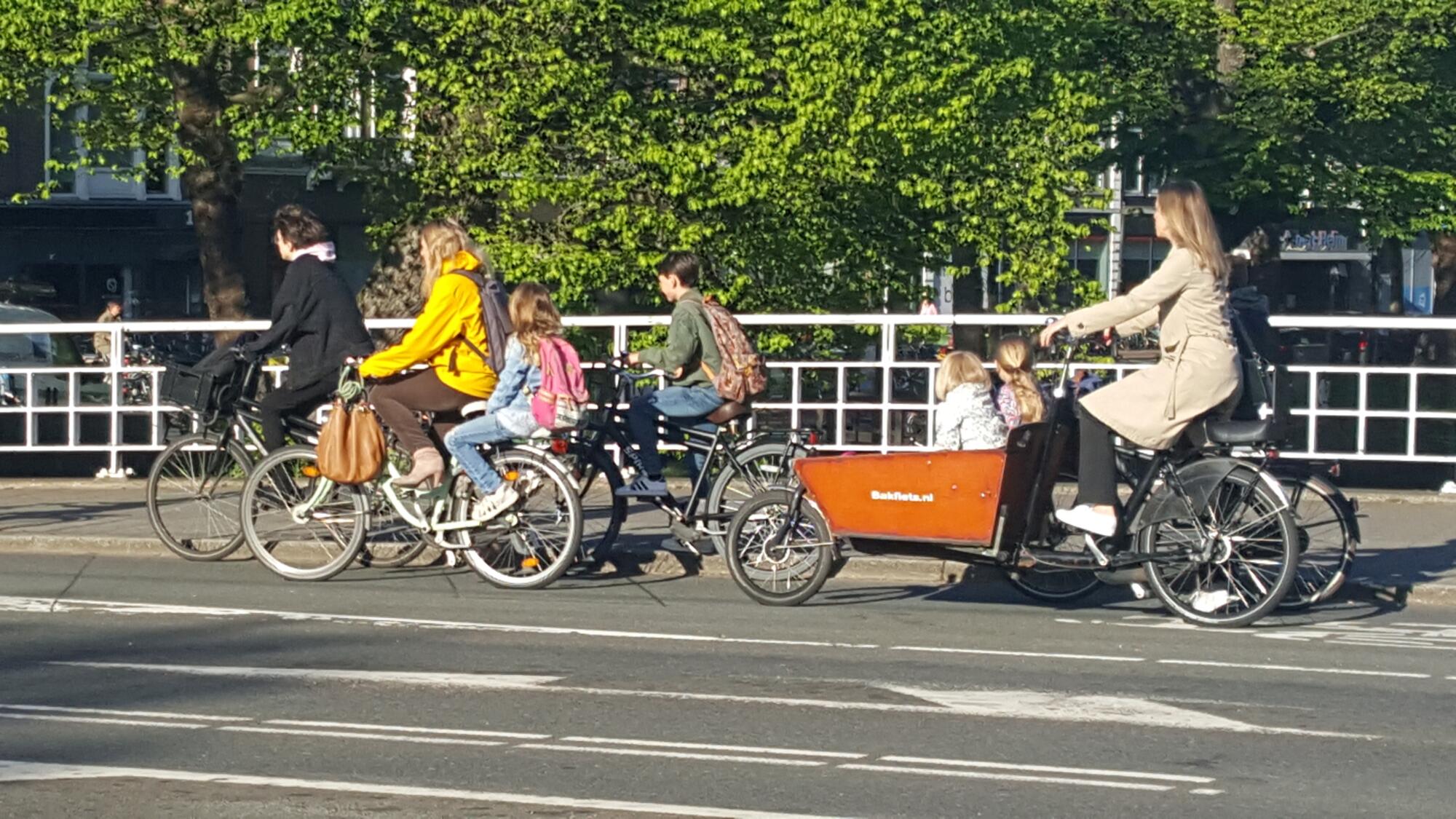
Mothers with children in Amsterdam — Credit: Nick_Nick
The findings suggest that incorporating gender perspectives is not about categorising users, but about identifying systematic bias in how mobility needs are defined. Care-related travel patterns, more common among women though not exclusive to them, reveal a broader mismatch between lived mobility and planning assumptions, particularly regarding access to local services, timing constraints, and network connectivity.
Amsterdam’s approach is also assessed in a wider European context. Cities such as Vienna, Barcelona, and Umeå have embedded gender mainstreaming more systematically into planning frameworks, through tools such as mandatory gender impact assessments or institutionalised equality governance. In comparison, the Dutch context is described as technically advanced but less consistent in formalising gender-sensitive planning, partly due to uneven gender-disaggregated data and a prevailing assumption that 'neutral' planning produces equitable outcomes.
Commuting as a gateway to inclusive mobility
The research points to several practical implications. Mobility systems that better reflect care-related travel would prioritise improved local accessibility, more flexible fare structures that accommodate multi-stop journeys, and stronger connections between residential areas and everyday destinations such as schools, shops, and healthcare services. Public space design is also identified as a key factor, as environments that support multiple simultaneous uses tend to accommodate diverse mobility patterns better.
Safety is addressed within this broader framework, not only in terms of lighting or surveillance, but as a function of spatial legibility, activity levels, and perceived autonomy in movement. Well-connected and multifunctional urban environments are associated with higher usability across different user groups because they support both visibility and flexibility in daily travel.
Overall, the combined research reframes mobility in Amsterdam as a system shaped not only by commuting, but by a substantial share of care-related movement that has historically been underrepresented in planning models.
- Related Members