Reclaiming Space
For years, queer activism has been advocating for more inclusive societies and cities. With its expansion, the movement has started reclaiming public spaces and transport systems within the modern cis-heteronormative world to make them safer and more sustainable, as well as more representative of society as a whole. Alessia Giorgiutti explores how a queer lens can support a new approach for the future of urban design.
Creating sustainable and safe mobility systems which cater for all, requires a complete transformation in the ways we think about urban space. This is a shift long advocated by 'queer theory' – so how can it help cities, regions and our mobility sector make the changes needed to achieve a truly inclusive city?
‘Queer’ is an umbrella term for people who are not heterosexual or are not cisgender (more in Infobox 1). While once a derogatory term used against the LGBTQ+ community, the term ‘queer’ is now being reclaimed as a celebration of difference and diversity. The queer community is disparate, including gay, lesbian, bisexual, transgender, non-binary and others LGBTQ+ identities. Critically, not everyone from these groups may self-identify as queer.
‘Queer’ is not just an axis of identity but a means of rethinking how we design space, power, and citizenship. Urban design institutions across the globe are adopting a queer lens to reconsider how public spaces could be designed for all bodies, genders and sexualities to create safe, sustainable and inclusive environments – something that can create a long-term, strategic and often radical vision, like in the case of Monash University’s XYX Lab and their project HyperSext City, which uses stories, statistics and data on urban life and mobility to amplify the experiences of underrepresented communities in urban space and planning.
Queer urbanism offers a lens to look at how we cannot just adapt but transform the city for all citizens. A queer critique calls for a complete reworking of accepted cis-heteronormative urban orders, by shifting the ways citizenship and politics are conceived and practiced. The term has been integrated into environmental discourses, international relations and more, to provide a model of non-normative relational ethics between humanity and the natural environment.
Carving a place in the urban space
At its origins, the queer urban space – not simply a place used or appropriated by non-heterosexual people, but a performative strategy to challenge the behaviours, rules, expectations and situations framed by the built environment – was a place of both escape and belonging – or, as historian Aaron Betsky describes it in his book Queer Space: Architecture and Same-Sex Desire, '[…] a useless, amoral and sensual space that lives only in and for experience, […] not built, only implied, and usually invisible.'

A sign near the entrance to Manchester’s gaybourhood, the Gay Village - Credits: Mikey via Flickr
Betsky is echoed by Gabrielle Esperdy, Associate Professor of Architecture at the New Jersey Institute of Technology, who describes the definition of interior, concealed and ephemeral queer urban spaces over the course of the 20th century as a desperate necessity – to hide and create an underground safe community, and as a brilliant opportunity – to occupy marginal, interstitial and derelict space, to patronise late-night commercial activities, and to revitalise local neighbourhoods.
For decades, clubs, ballrooms, and bathhouses, but also cafeterias, bookshops, dark city alleys and parks were reclaimed as queer spaces: while this initially took place covertly, with fear of reprisal from law enforcement and the public, from the 1950s, queer people began to revitalise urban spaces more publicly by gathering, living and thriving in distinctly queer enclaves – the so-called gaybourhoods, which were initially characterised by low rents, good transport links and queer-friendly bars.
Even in what have been ostensibly queer friendly neighbourhoods, these soon started to show their flaws. For example, landscaping and propriety flipping led to increases in rent, favouring relatively wealthy gay white males over their other queer and less-privileged counterparts. And now, contrarily to the positive trend of becoming central areas for culture, arts and social activism where locals and tourists flock alike, police statistics and news (e.g., on Liverpool’s hate crimes here and here; on Birmingham’s here; on Berlin’s here; on Madrid’s here) have shown how these supposedly safe havens have been increasingly marked by raising homophobic crime levels.
This shows that, while we may be eager to celebrate and experience these spaces, this must be done in tandem with understanding the concerns, fears, and aspirations of the queer communities themselves. Indeed, one cannot celebrate queer culture without supporting their safety and wellbeing. This demands addressing how urban spaces and mobility networks marginalise queer groups, putting in place tangible actions to combat this.
Understanding marginalisation in mobility
The localised discrimination in gaybourhoods is only a reflection of the modern and broader societal contradiction in which 1 in 4 Gen Z’s identifies as queer and 1 in 20 as transgender, but a lesbian couple gets brutally beaten on a bus on their way home, a man crosses train tracks to physically assault two men holding hands and kissing, and a transgender woman gets stabbed with a screwdriver at a subway station – a contradiction where the more visible queer people are, the more their discrimination in public spaces (especially the transport system) is exacerbated.
Despite the lack and specificity of local and international data showing how queer people are abused, discriminated, or harassed on public transport, experts say that, amongst queer people, queer women, transgender women, transgender men, and gender non-conforming people are being overwhelmingly targeted. In particular, compared to transgender men and cis-gender queer women, transgender women, trans-feminine, and visibly gender non-conforming riders report a higher incidence of violence overall, with transgender Black and Brown riders and disabled individuals being especially vulnerable to harassment from other riders and, occasionally, from public transport staff – see this study on transmobilities focused on Portland.

Queer Gen Z’s at the Capital Pride Walk and Rally - Credits: Miki Jourdan via Flickr
However, open harassment and hate crimes are just the tip of the iceberg.
Indeed, the fear of discrimination, violence and lack of safety on public transport alone is already dangerous: just as for women’s fear of urban transport networks, the fear experienced by queer people often forces them to restrict their mobility options and choices and to take identity and visibility compromises, proving that even though they might not necessarily be physically excluded from mobility opportunities or explicitly attacked on public transport at all times, queer people still pay hidden costs to travel safely.
As mentioned in 'Queer Mobilities: Critical LGBTQ Perspectives of Public Transport Spaces', queer people also tend to choose more expensive travel alternatives, such as taxis and ride-hailing or take less direct routes to overcome their experiences of unsafe and inaccessible public transport alternatives – a slippery-slope of money- and time-spending that, in normal circumstances, could be redirected to something more positive for queer individuals and their communities.
If we are to truly make urban mobility inclusive – this needs to be confronted.
Fighting the fear with planning and educating
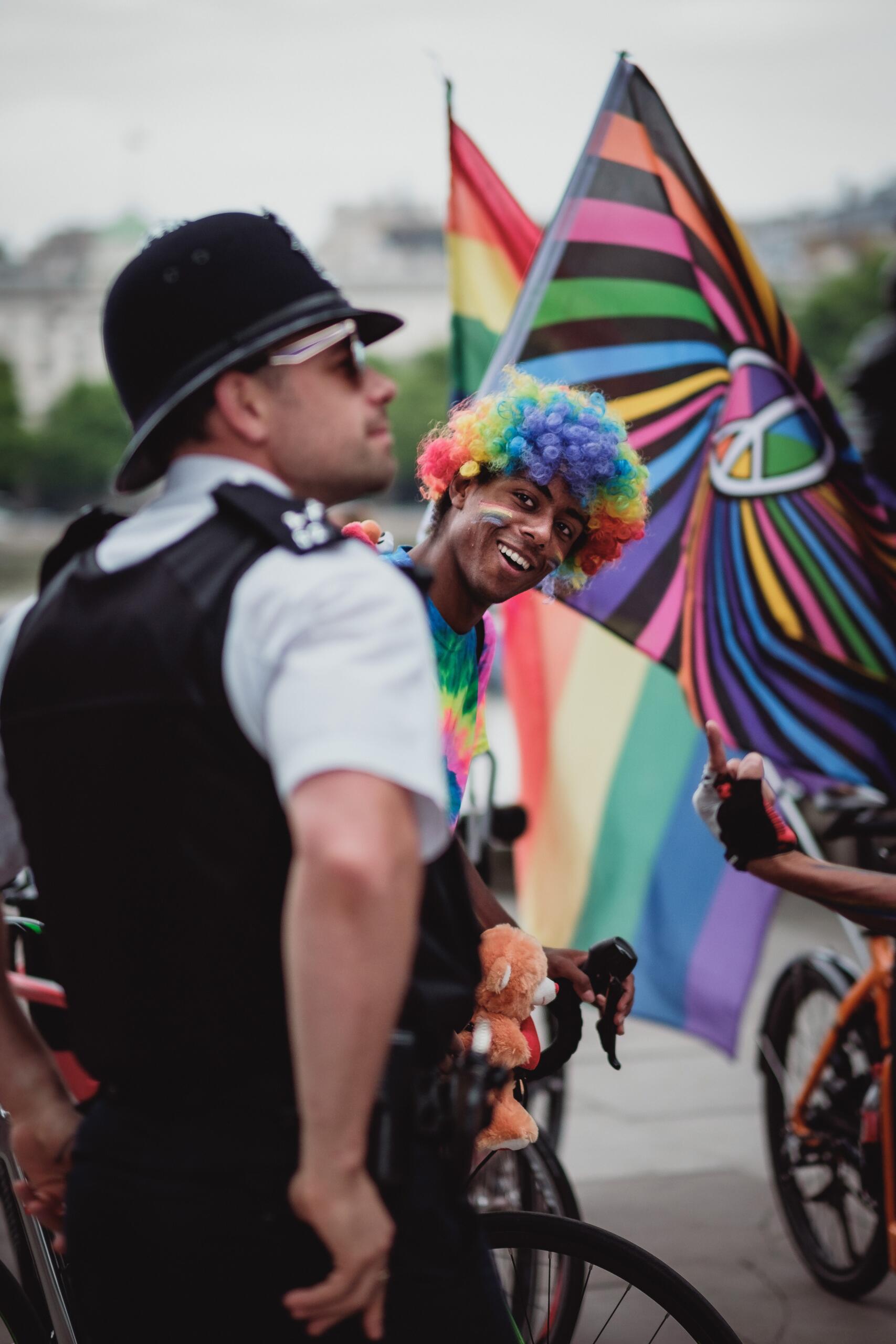
Pride in South Bank, London, United Kingdom - Credits: Clem Onojeghuo, Unsplash
Combatting this requires change at planning – prioritising queer safety and inclusiveness, and education – such as about (straight, but also wealthy, white, and gay male) privilege, and the increased risk of harassment and violence queer citizens and riders face. Indeed, change is already afoot!
When it comes to open public spaces, for example, queer people need more privacy, because common activities that most people take for granted – like kissing or holding hands with a partner, can draw negative attention. Warmer lighting to encourage footfall and semi-enclosed pockets in parks and streets that are visible but still offer a reasonable level of privacy could be a solution to make these spaces safer and more comfortable on an individual level.
In public transport, providing training for transit operators and other staff to educate them about appropriate and inappropriate language related to transgender and gender-nonconforming identities can already go a long way in creating a more inclusive environment. Implementing nondiscrimination policies supported by signage indicating the prohibition of harassment and discrimination while on transit or in transit facilities could also facilitate staff interventions like the removal of individuals who harass or physically attack queer vulnerable users while travelling.
Queer and here to lead

Inclusive traffic lights in Vienna, Austria - Credits: Viviana Couto Sayalero, Unsplash
Beyond making spaces visibly inclusive with signage, rainbow crossings and artistic lighting and fostering a more inclusive relation between transport users and providers, city planners have the vital job to cater to the specific needs of all queer people – to foster, in a way, a queer urbanist agenda. Needless to say, diversity within these organisations is critical, too – with queer urban planners, especially Black, Brown, transgender, and gender non-conforming ones, guiding those who are new to the topic or may not have the situated knowledge required.
When it comes to urbanism, amplifying queer voices – and especially marginalised ones – is, in brief, essential: not only because queer people experience urban space differently from others, for they have developed an understanding of the heteronormative world and carved a place for themselves in it, but because many of their basic needs and values are crucial for the future of urban planning and design, too.
For many local authorities, addressing this issue may appear complex. However, as foretold by Aaron Greiner, CultureHouse Founder and Director, if we do not look at queer urbanism through the lenses of these identities, we are setting up structures that are no better than the ones we are inheriting from the social and physical cis-heteronormative world.
This is where our queer approach comes into play – questioning a world based on a built environment that 'makes assumptions about the relationships people are supposed to have and the lives people are supposed to lead', as Dan Reed, an urban planner in Silver Spring, Maryland, said.
Inclusion, equity, gender safety, accessibility, comfort, and sustainability have been all critical themes of the queer urban experience: operating outside traditional structures and forces by valuing open communication and different perspectives, or better, by queering public space, might make cities better places to live and prosper for everyone – not just queer people.
____________________
Queer Vocabulary
LGBTQ+: an acronym for lesbian, gay, bisexual, transgender and queer – the plus identifies additional queer identities, such as intersex, asexual, aromantic, agender, non-binary, pansexual and more
Queer: a term people often use to express a spectrum of identities and orientations that are counter to the mainstream – previously used as a slur, “queer” has been reclaimed by many parts of the LGBTQ+ movement as a catch-all term to also include those who do not identify as exclusively straight and/or folks who have non-binary or gender-expansive identities
Queer urbanism: a new way of designing cities from the queer perspective
Cis(gender): a term used to describe a person whose gender identity aligns with those typically associated with the sex assigned to them at birth
Heteronormativity: the concept that heterosexuality is the preferred or “normal” mode of sexual orientation. It assumes the gender binary and that sexual and marital relations are most fitting between people of the opposite sex
Transgender: an umbrella term for people whose gender identity and/or expression is different from cultural expectations based on the sex they were assigned at birth and regardless their specific sexual orientation
Trans-feminine: is an umbrella term that refers to people who were assigned male at birth but identify with femininity and seek to present femininely
Gender non-conforming: a broad term referring to people who do not behave in a way that conforms to the traditional expectations of their gender, or whose gender expression does not fit neatly into a category. While many also identify as transgender, not all gender non-conforming people do and may not be visibly gender non-conforming
Transmobility: a term to describe how experiences of discrimination, harassment and violence inform the ways that gender minorities move through space
More here.
____________________
Talking about privilege
Due to their greater privilege and relative resources, white, cisgender gay men are logically the most vocal and visible advocates of the queer urban community according to Dan Reed, a half-Black, half-Indian, queer urban planner and freelance writer in Montgomery County, Maryland that was interviewed by Wyatt Gordon for his article 'Why do so many queer folks love urbanism?'.
'Urbanism is often aligned with advocacy, and being an advocate means speaking to power,' they said. 'Often people who are white, cisgender, and male feel most comfortable speaking to power.'
____________________
Where “Queer” approaches are taking place in practice
Hamburg - Fabrik: This is an event space which displays how to rethink how we use urban space to serve all citizens. Fabrik is a cultural centre in Hamburg, Germany. It occupies a former machine parts factory in Ottensen, in the Altona district. By day, it is a creche and education space, by night, a music venue.
Transport for London (TfL) Action Plan: In addition to the Pride colours painted across many London underground stations, TfL’s diversity and inclusion action plans address the spectrum of concerns for LGBTQ+ travellers, including waiting at stations – which is a particular concern for women and the LGBTQ+ communities, who feel vulnerable to crime and fear of crime when travelling.
TfL also champion inclusion across their own organisation through OUTbound, which is TfL's Lesbian, Gay, Bisexual and Trans Staff Network Group. The group is committed to championing a safe and inclusive work environment so LGBTQ+ colleagues can be authentic, celebrate who they are and have equality of opportunity.
Brussels Police Training: Rainbow House is a safe haven where LGBTQ+ persons and their friends can get information. The organisation offers training for law enforcement to better understand concerns of the queer community. Training, available in both French and Dutch, is organized by the Rainbow House Brussels, the Office for the Equality of Opportunities and the Fight against Racism of the Brussels Capital Region.
Meanwhile, their Equal(c)ity project, led by the IOM (International Organisation for Migration) aims to combat sexual and gender-based violence among people with a migrant background and to integrate migration and intercultural issues into the very structure of urban services in Europe.
Berlin: Berlin, the “gay capital” of Europe, already had a thriving gay and lesbian scene during the 1920s. An integral part of the city’s buzzing nightlife then and now, LGBTQ+ people are visible in every part of Berlin life. Berlin, along with Vienna and Cologne offer a QueerCityPass, a tourist ticket for lesbian, gay, bi, trans and queer visitors which allows combined access for transport and queer bars, clubs and cultural institutions.
Jackson Heights – New York: Jackson Heights, where the Queens Pride Parade takes place annually, has had a gay presence since it was developed in the 1920s. The work being conducted at Queen’s Pride House, the LGBTQ+ Center, is a fantastic example of how community action has brought together immigrant and low income communities, Indeed, the community’s pride event became a focal point for community action and dialogue about gentrification and design of transport systems.
Barcelona: This year, Transports Metropolitans de Barcelona (TMB) launched an awareness campaign on LGBTI-phobia on the metro and bus network, with the collaboration of the Observatory Against Homophobia. Alongside the launch a specific protocol for combating LGBTI-phobia on the TMB network was announced, to complement the existing code in place since March to combat sexual harassment. The idea is to carry out collaborative work with the most representative associations and go beyond awareness by establishing specific measures: practical and effective practices for prevention, detection, action and responses.
____________________
About the author
Alessia Giorgiutti is Communications & Membership Lead & Co-Coordinator Just Transition at POLIS.
 Credits: Miki Jourdan via Flickr