
GRAB-bing the bike by its handlebars
2020 was all sorts of unexpected. Rome, like many other cities across the planet, has grabbed the bull by its horns – or better, the bike by its handlebars, and rode to its pace towards a new target: becoming a Future Cycling Capital with a spin. Francesco Iacorossi tells us more.
No one would have expected 2020 to turn out the way it did, and no one would have probably bet on it to be also one of the most exciting and surprising years for cycling – especially when it came to the Urbs Aeterna, the Eternal city of Rome.
Indeed, like many cities across Europe and beyond, the Italian Capital has increased its spending and planning procedures around cycling and active mobility measures in response to the crisis.
As citizens steered away from public transport and enjoyed government incentives to protect the environment and promote active modes, it is fair to say that COVID-19 has prompted particular and unprecedented investment on cycling in Europe, with more than €1,7 bn spent on cycling-related infrastructure and over 2,500 km of new bike lanes (1,400 km implemented so far) since the pandemic began.
A most ambitious plan

Credits: CIVITAS Handshake
In Rome, COVID-19 inspired the creation of a pioneering 150 km transitory cycle route plan – so far (and since May 2020, date of Rome’s City Council approval of the plan), 20 km of bike lanes along main streets and other key routes have been implemented. The plan is laying the foundations for the Italian capital’s long-awaited cycling network, whose creation is making Rome one of CIVITAS Handshake’s ten “Future Cycling Capitals”.
However, the transitory cycle route plan is only one part of Rome’s more complex cycling infrastructure strategy.

Credits: VeloLove
Through its public transport operator Roma Servizi per la Mobilità, the city is indeed also working on the GRAB project (Grande Raccordo Anulare delle Bici – Great Bike Ring Road). The idea behind the GRAB is the result of a collective work coordinated by VeloLove, in collaboration with Legambiente, Touring Club Italiano, Vivilitalia, Free Wheels Onlus, Open House Roma, TeamDev, Parco Regionale dell’Appia Antica, and Roma Natura, and finalized by Roma Servizi per la Mobilità.
Bringing all citizens and tourists back on the saddle
Even though COVID-19 has temporarily restricted movements for tourists and citizens, it is envisioned that the Great Bike Ring Road will make an essential contribution to climate neutrality and public health, all while improving public spaces’ liveability and boosting local economies. In particular, it seems that the GRAB will serve as a magnet not only for local commuters on wheels, but also for the upcoming post-pandemic tourist wave.
According to the 2016 Confindustria – Ancma (Italian Industrial Federation – Cycle and Motorbike National Association) study’s results, more than 600,000 tourists are expected to ride along the cycle road during its first year of implementation, thus generating a profit for local economies which should be five times bigger than the initial amount invested for the construction of the ring.
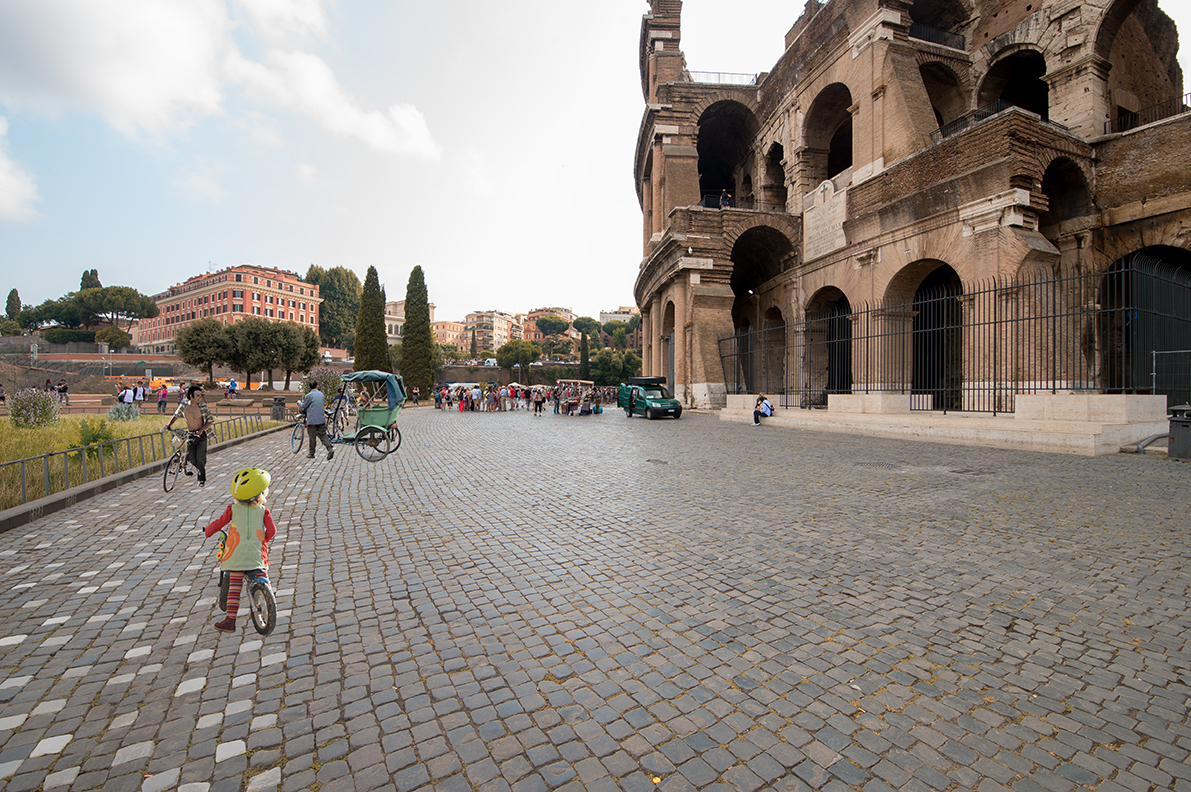
Starting from Romulus and Remus’ legendary birth site, tourists who will ride along the GRAB will be able to visit the contemporary architectural projects by Zaha Hadid and Renzo Piano and the street art in the Quadraro and Torpignattara neighbourhoods, as well as the historical landmarks of the Colosseum, the Vatican and the Trastevere neighbourhood. The ring will also facilitate the connections with parks (Appia Antica’s, Caffarella’s, and the Aqueduct’s) and the Tiber, Aniene and Almone’s waterfronts, marking the beginning of a future tourist green zone between the Imperial fora and the Regina Viarum.
Inclusive, accessible and safe – what else?
In terms of size, the 48,6 km long, easily accessible and exquisitely green cycling and pedestrian ring will extend throughout the city and beyond. In doing so, it will improve links between more and less affluent and central neighbourhoods. More specifically, the ring will wind for 29,7 km (66% of the total plan) along pedestrian and cycle paths, historic villas and riverbanks. Other 15,3 km will touch upon ordinary congested routes whose space will be given back to the people (pedestrians and cyclists), rather than cars.
The GRAB will also cross 8 metro stations on 4 different lines (A, B, B1 and C), as well as 13 stops on 6 different tram lines and 3 railway stations. Furthermore, there will be 3 other railway stations (Roma-Lido, Roma Nord and Roma-Giardinetti) and 9 metro stations less than a kilometre radius from the ring. Last but not least, the GRAB will be built using an universal accessibility vision – adequate width, smooth surface and safe intersections with ordinary road traffic will be binding features that will have to be harmonized with two upcoming 30 km/h Zones in the Quadraro neighbourhood to provide a safe and inclusive space for active travel in the city.

GRAB plans with representation of San Gregorio Street - Credits: Piano B Architetti Associati
Future of cycling? Omnes viae Romam ducunt, they say
As the GRAB and the transitory cycle route plan are being developed, it is clear that Roman bike lanes do exist and are here to stay, improve, and pave the way for a new and unique vision of breath-taking paths and easily accessible and faster routes.
Only time will tell if all roads would really lead to Rome – especially when it will come to the future of cycling.
____________________
About a CIVITAS Handshake “Future Cycling Capital”
CIVITAS Handshake is a Horizon 2020-funded project that enables tangible sharing of cycling knowledge and expertise through an innovative mentoring programme between cities; since 2018, it has paired ten highly motivated European cycling cities with three pioneering and world-class cycling cities: Copenhagen (Denmark), Amsterdam (the Netherlands), and Munich (Germany).
As one of the 10 identified “future cycling capitals”, Rome has greatly benefitted from this initiative and its mentorship relation with Amsterdam, thus prioritising urban space reallocation to innovative walking and cycling interventions.
____________________
About participatory process: ON
As it happened before with the launching of PUMS Roma, Roma Servizi per la Mobilità and Velolove encouraged a widespread participatory process in view of the plan: between January and February 2021, five meetings were held online, gathering more than 11,000 visualizations. These meetings fostered the engagement of citizens, associations and stakeholders, who could openly discuss GRAB’s future in relation to the city of Rome and its other mobility challenges.
Watch the online meetings here!
____________________
About Rome as a POLIS Member
Rome is represented in POLIS by its Mobility Agency (RSM – Roma Servizi per la Mobilità) which supports the Municipality in developing its mobility policies and manages the international cooperation on mobility issues on behalf of “Roma Capitale”.
Rome has been involved in several EU projects:
e-smartec, CITEAIR and CITEAIR II, CityMobil, Conduits, eSum, CIVITAS CATALIST, STADIUM, Green Emotion, 3IBS, CITYLAB, ICT-EMISSIONS, NODES, NOVELOG, PASTA, and ZEEUS.
____________________
About Velo-City 2021
The GRAB project and the Handshake initiative will be presented at Velo-City 2021 during the session 10.4 “High Impact Cycling Strategies” on September 9, 2021, from 9AM to 10AM.
Download the Programme here!
____________________
About the author
Francesco Iacorossi was Senior Project Manager at Roma Servizi per la Mobilità.
 Credits: Piano B Architetti Associati