
From Car Trips to Travel Chains
In Eastern and Western Uusimaa, the car still dominates. But a bold new project is proving that small, smart improvements—better bike paths, faster buses, and seamless connections—can transform how people move. From mapped travel chains to quality corridors, Uusimaa is showing how sustainable, climate-friendly mobility can work in practice, one journey at a time.
In much of Finland, the car remains king. In Eastern and Western Uusimaa, over two-thirds of trips are made by car, while buses, trains, cycling, and walking lag far behind: indeed, 68% of domestic journeys in Eastern Uusimaa and 71% in Western Uusimaa are done by car. Put together, walking, cycling, and public transport account for less than a third of trips.
It was against this backdrop that the Sustainable Travel Chains in Eastern and Western Uusimaa project was launched. Led by the Uusimaa Centre for Economic Development, Transport and the Environment (ELY Centre) in collaboration with the Helsinki-Uusimaa Regional Council, the project had a clear but ambitious mission: identify the most significant sustainable travel chains, prioritise them systematically, and define concrete actions municipalities and agencies could adopt to make these chains attractive, competitive, and climate-friendly.
Linking the links
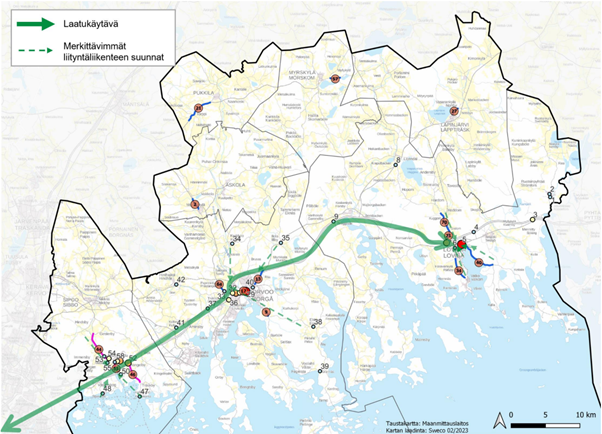
Eastern Uusimaa Quality Corridor: First-Priority Travel Chain Hubs and Prioritised Cycling Measures, Sustainable Travel Chains in Eastern and Western Uusimaa project
What makes this project stand out is its shift in perspective. Every trip is seen as a series of steps: commuting might involve walking to a bus stop, catching a bus, changing to a train, then cycling the final stretch. Success lies in how smooth, seamless, and stress-free those steps are.
To achieve this, the project team mapped 113 travel chains and applied a traffic-light-style ranking. Chains where public transport was fast, many people lived within walking or cycling distance, and switching between modes was easy, were given top priority. In total, 25 travel chains earned a ’green light’, marking them as great candidates for future investment.
Equally innovative was introducing the concept of ’quality corridors’. These are not just lines on a map, but travel routes where high demand, climate benefits, and practical improvements converge. Concentrating efforts on these corridors prevents resources from being spread too thinly, while creating strong, reliable backbones for everyday travel.
Trains and buses remain essential, but cycling and micromobility were given equal weight. Secure bike parking, safe access to stations, and space for bicycles on trains and metros are core elements of the system, not optional extras.
Results on the ground
The results of the project and study are tangible. As mentioned above, 113 travel chains were identified across the region, with 25 ranked as first-class. Unsurprisingly, rail links such as Kirkkonummi–Helsinki topped the chart, being fast, competitive with driving, and low in emissions.
Across the region, 261 key hubs and stops were mapped and categorised—from major terminals, like Porvoo or Lohja bus stations, to smaller but vital local interchanges—with clear targets for services, such as real-time digital information, improved shelters, and cycle facilities.
Cycle routes received equal attention to bus lines, connected to hubs, and mapped with suggested service standards, including continuous surfaces and logical wayfinding. Meanwhile, three ’quality corridors’ were singled out for focused investment—routes where the greatest shifts away from car travel can realistically occur.
The recommendations go beyond infrastructure. Better timetables, unified ticketing across municipalities, and real-time information systems are all part of the plan, designed to make public and active travel genuinely more appealing than private cars.
What we learnt
Working together beats going it alone: with 15 municipalities involved, success depended on dialogue. Workshops and interviews gave local voices real weight, which built commitment to change. Prioritisation was equally important—focusing on the most promising chains and ’quality corridors’ ensured resources are used wisely.
The study showed that while data is essential, people’s insights are valuable, too. Combining hard evidence, like commuting flows, with local knowledge made the findings both credible and actionable.
It also confirmed that cycling and micromobility are not side issues, but key parts of an inclusive transport system—truth is, recognising bikes and e-scooters as part of the solution strengthens connectivity and widens access.
The quality of the travel experience is everything—or at least, it matters just as much as the infrastructure. A poorly lit or unsheltered bus stop will never win over drivers; comfortable, safe, and well-connected hubs are just as important as extra services.
And finally, climate-friendly mobility wins bring other wins: beyond reducing emissions, sustainable travel chains support healthier lifestyles, fairer access to services, and more resilient local economies.
Beyond Helsinki-Uusimaa

Western Uusimaa Quality Corridor: First-Priority Travel Chain Hubs and Prioritised Cycling Measures, Sustainable Travel Chains in Eastern and Western Uusimaa project
While the study is about a specific Finnish region, its lessons have wider relevance. Across Europe, cities and regions are trying to cut emissions, improve accessibility, and reduce congestion. The Uusimaa model shows that the solution is not always building new motorways or expensive mega-projects, but stitching together what already exists, making buses, trains, bikes, and walking routes work together as one chain.
The project demonstrates that small, targeted improvements can reshape and shift travel habits. A safer cycle path to a station, a reliable bus link timed to meet trains, or a single ticket valid across municipalities can make the difference between someone choosing sustainable travel or defaulting to their car.
Rethinking regional mobility
The sustainable travel chains project in Eastern and Western Uusimaa provides a compelling model for regional mobility planning. Its innovations, such as its prioritisation framework, the concept of ’quality corridors’, and the full integration of cycling and micromobility, demonstrate how sustainability can be operationalised on a regional scale.
The identification of key chains, classification of hubs, service-level targets, and concrete improvement measures offer a clear roadmap. Meanwhile, the lessons learned underline the importance of collaboration, focus, adaptability and user-centred design.
Click here to read the article in its original format.
About the author:
Pasi Kouhia, Senior Adviser, Helsinki-Uusimaa Regional Council. As Senior Adviser in Transport, Kouhia oversees transport matters in Eastern and Western Uusimaa. He supports the Council’s work as the region’s strategic and land-use planner and advocate, shaping long-term mobility while guiding near-term development.
 ArtBBNV, Shutterstock