
Finding the Way
Rather than becoming more accessible, many city streets continue to function as daily obstacle courses for people with severe or partial visual impairments. Building truly equitable urban spaces requires holistic strategies that embed accessibility into every aspect of planning and policy—starting with a deep understanding of how people with blindness or low vision navigate the city.
Vision is our most dominant sense. We rely on it in daily life—for reading, learning, and walking. We take it for granted, yet over time, almost everyone will experience at least one eye condition requiring professional care.
According to the World Health Organisation, more than 2.2 billion people globally live with near or distance vision impairment, of whom around 285 million experience complete blindness or moderate to severe distance vision loss. Most vision impairment and blindness occur among people over 50, and as global populations age, these numbers are expected to further rise.
The term ‘visual impairment’ encompasses a spectrum of vision loss resulting from various eye conditions that alter the systems, structures, or functions of the eye. It includes both low vision, where some sight remains, as well as conditions of blindness. People with low vision may retain partial functional sight but often experience reduced central or peripheral vision, blurred vision, light sensitivity, and night blindness.
Globally, the leading causes of vision impairment include refractive errors such as myopia, hyperopia, astigmatism, and presbyopia, as well as cataract, diabetic retinopathy, glaucoma, and age-related macular degeneration. Many of these conditions can be prevented or managed with timely access to eye care, reducing their personal and societal impact.
People with low or no vision face considerable challenges in travelling independently and accessing public spaces—factors that strongly influence social inclusion, employment opportunities, and overall quality of life. Outdoor mobility is one of the greatest difficulties, affecting everyday activities such as shopping or socialising, and often contributing to feelings of fear, isolation, and loss of independence. Moreover, the high cost and limited availability of reliable assistive technologies exacerbate these barriers.
The economic implications are also profound: global productivity losses linked to vision impairment are estimated at around 356 billion euros annually, far exceeding the 21 billion euros required to close the gap in unmet vision care needs.
Moving without relying on vision
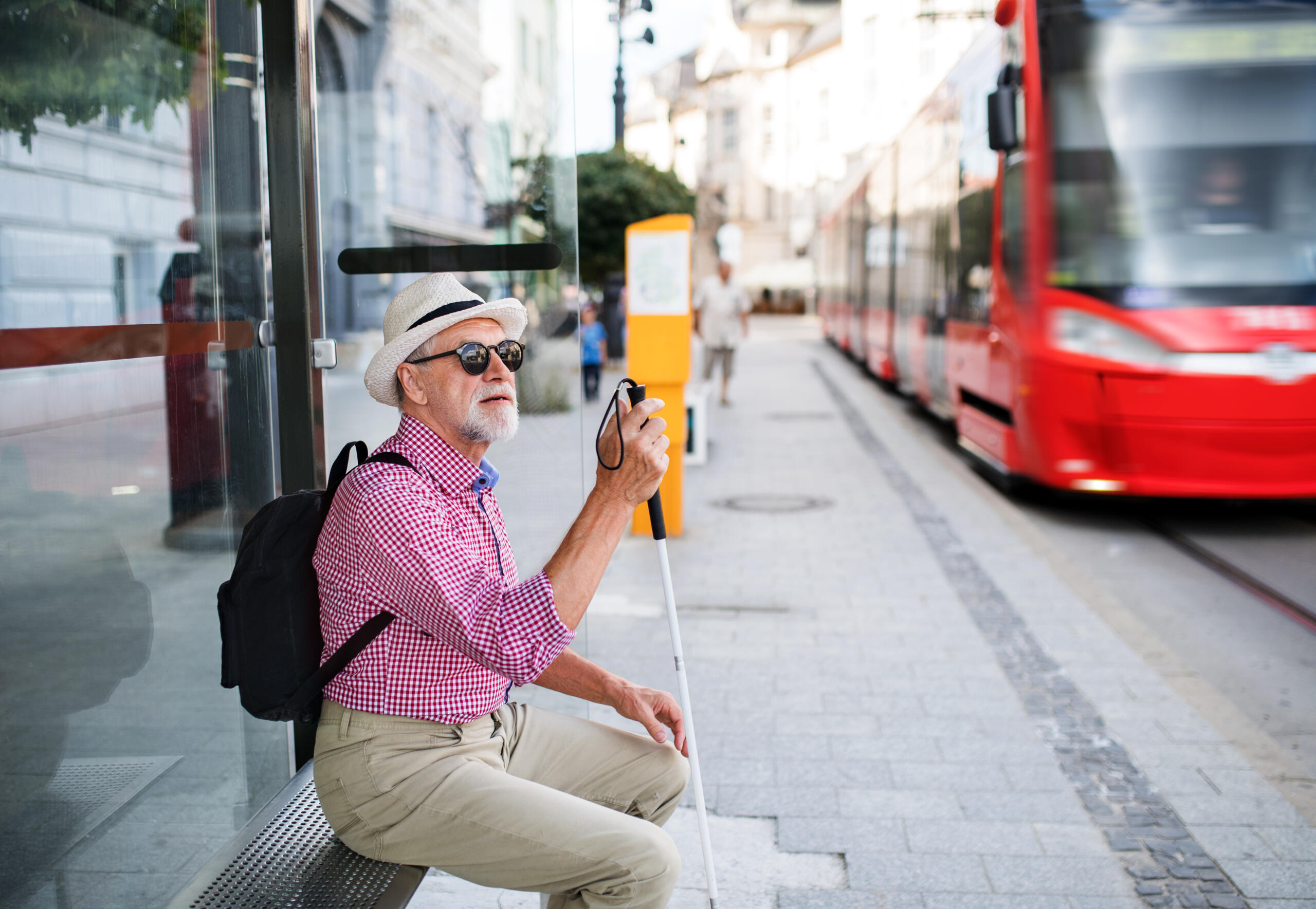
The inability to read monitors on buses and trains is a common issue that could be solved with auditory announcements, Ground Picture, Shutterstock
The way cities are designed can greatly affect how easily—or how difficultly—people with visual impairments move through them. Many walk more slowly, often due to balance issues or fear of tripping, and tend to stay within familiar areas where they can rely on known landmarks and routes.
According to the Royal National Institute of Blind People (RNIB), the main barriers to pedestrian journeys for blind and partially sighted people are, respectively, cars and other vehicles parked on pavements, poor quality of pavements, temporary street obstacles, paths shared with cyclists or e-scooter riders, and the lack of accessible crossings.
Colliding with obstacles is indeed one of the main issues. A 2015 survey by the RNIB found that, over a three-month period, most respondents had bumped into parked cars (70%), bins (64%), fixed street furniture such as benches (60%), and advertising boards (49%). Two-thirds (67%) reported feeling unsafe at road crossings. To make matters worse, temporary objects, cyclists on footpaths, and the recent surge of near-silent e-scooters only add to the daily uncertainty, often described by respondents as a ‘nightmare’.
Crossings, in particular, pose significant challenges. Many people with visual impairments struggle to detect them, align themselves correctly, or determine when it is safe to cross. Reading signage can also be a barrier, especially on public transport, where it may be difficult to read screens or identify route numbers, and lighting conditions can further complicate navigation, as shifts between indoor and outdoor spaces or travelling after dark can affect orientation and spatial awareness.
Paying attention
Inclusive cities aim to simplify mobility, ensure equitable access to information and services, and enhance liveability for all residents. Accessibility must not be treated as an afterthought, but as a core urban requirement. Moreover, because visual impairment exists along a spectrum, design solutions must accommodate the full range of visual abilities.
Urban planners can enhance visual accessibility through thoughtful design interventions, such as controlled road crossings and well-placed bus stops.
Sound cues are especially valuable for wayfinding: pedestrian crossings with audio signals not only help people cross safely, but also assist with spatial orientation. Similarly, auditory announcements on public transport and lift floor indicators are essential for passengers who cannot rely on visual displays.
Rapid advances in mobile and location-based technologies are also reshaping how people with visual impairments navigate cities. Many accessible navigation apps now use GPS and audio guidance to provide real-time information about routes, crossings, and points of interest. For instance, Google’s Lookout app, developed in collaboration with the blind and low vision community, uses computer vision and generative AI to interpret visual data and describe surroundings. Likewise, Wayfindr is a digital navigation system that uses Bluetooth beacon systems and 5G networks to guide people with visual impairments through urban environments. It was successfully tested in the London Underground system, proving the potential of audio navigation.

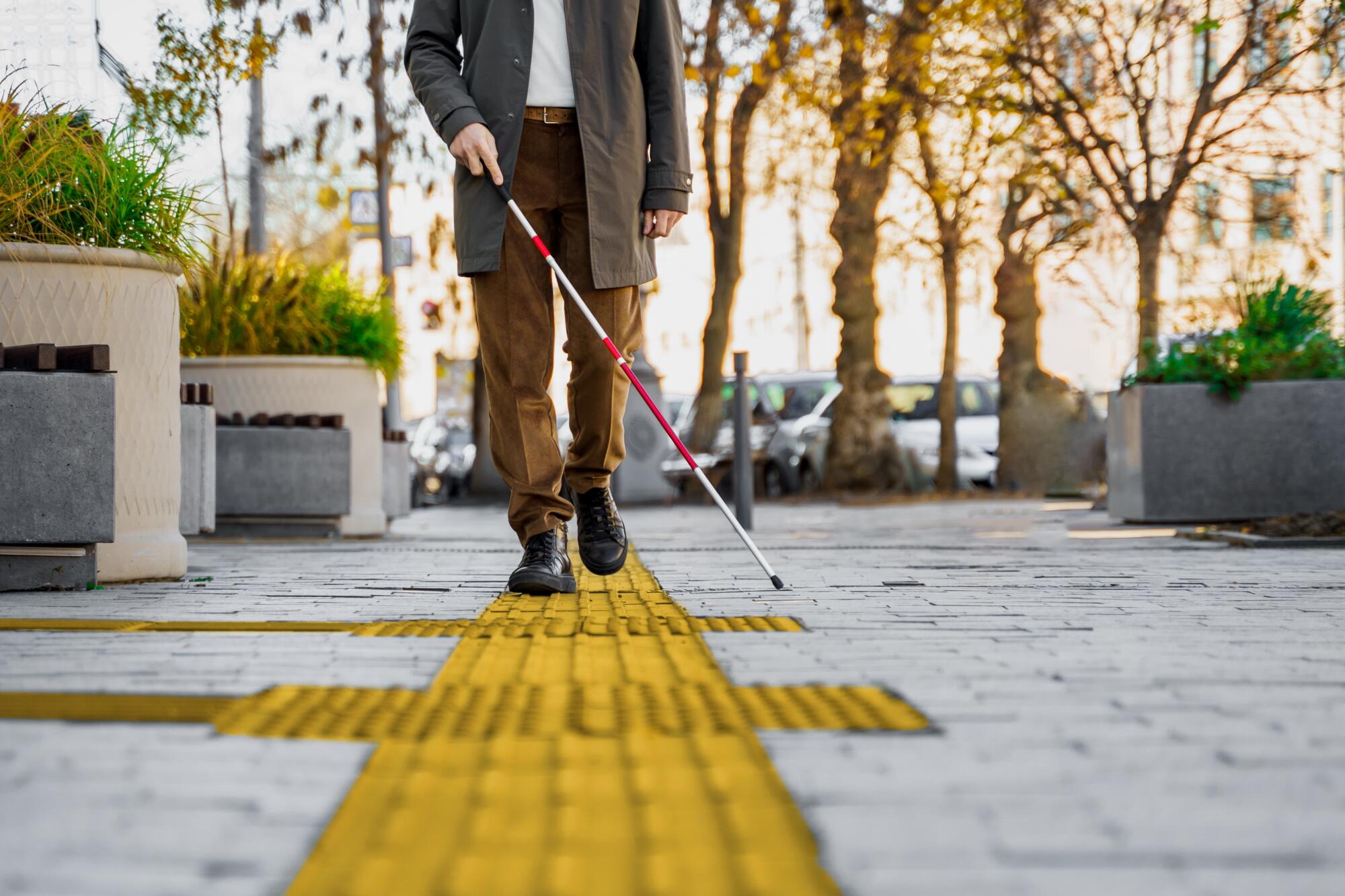
People with visual impairments navigate cities by relying on their remaining senses—especially sound cues—for orientation and wayfinding, i3rownara, Shutterstock
These emerging technologies promise great independence. To further enhance them, it would be crucial to improve locational accuracy and the identification of building entrances. Expanding affordable para-transit options and reducing the cost barriers of ride-hailing services can also widen mobility choices. Looking ahead, access to autonomous vehicles could also be transformative, eliminating one of the most significant mobility constraints: the inability to drive.
Cities should leverage the full potential of smart technologies. For this purpose, urban data can help identify weaknesses in transport infrastructure and guide evidence-based improvements. Smart city initiatives like Mobility as a Service (MaaS), which integrates various transport options into a single digital platform, can deliver real-time travel updates and personalised routing.
However, while smartphones are indispensable for these innovations, less tech-savvy users, particularly seniors, may struggle to engage with them. True inclusion, therefore, requires not only advanced technologies but also accessible design, affordability, and user training.
Reshaping urban spaces
Marburg, Germany, is a leading example of how a city can become genuinely accessible to people with visual impairments. Often called ‘Blindenstadt’ (‘city for the blind’), its commitment to inclusion dates back to the early 20th century with the founding of the German Federation of the Blind and Visually Impaired (DBSV) and a pioneering institute for blind education. This longstanding dedication has transformed the medieval town into a model of accessibility: public transport is equipped with tactile guidance systems, audible signals, and Braille signage, while streets and public spaces feature tactile paving and strong colour contrasts to support independent navigation.
Spain also stands out for its inclusive approach, largely driven by the influential work of ONCE, the National Organisation for the Blind. In Valencia, a city recognised as the European Capital of Smart Tourism in 2022, all buses are equipped with NaviLens technology, which provides real-time audio and visual information.
Vienna, Austria, offers another notable example. Winner of the 2025 Access City Award, it has introduced intelligent traffic lights and ensured that over 95% of metro, bus, and tram stations are accessible through tactile systems, low-floor vehicles, and multisensory emergency technologies.
These initiatives demonstrate that building more inclusive cities is possible. Governments and local authorities must be fully aware of the aids and adaptations that enable people with sight loss to get around safely and independently. Crucially, understanding and actively engaging with blind and partially sighted communities should be the first step in developing policies and practices that reflect real needs. Only by doing so can we ensure that the urban environment supports, rather than hinders, progress, participation, and independence.
Click here to read the article in its original format.
About the author:
Vittoria Maddalena, Communications Assistant, POLIS. Maddalena contributes to POLIS’ activities through producing news and social media content, including supporting events and campaigns. She holds a BA in Political Sciences from the University of Padova and a MA in European Studies from KU Leuven. She is passionate about decarbonisation, electromobility, and the green transition.
 ThomsonD, Shutterstock