
Clic.cat: The new digitalized transport on demand brand in Catalonia
Since 1991, the Generalitat de Catalunya has implemented on-demand transport services with the collaboration of local entities – today, 235 on-demand transport lines serve more than 736 towns in Catalonia. As of 2020, the Government of the Autonomous Region has further stepped up its game by creating the new service called ‘Clic.cat’. Cristina Pou Fonollà tells us more.
Transport on demand is an agile and efficient way to ensure access to public transport services in rural settlements and low-density urban areas. It provides citizens with an easy and sustainable transport option to meet their mobility needs and allow them to access health, social and service hubs.
Furthermore, transport on demand is a service stemming from requests made by citizens: this means that it is closely tied to user needs, rather than being a simple top-down operation.
For all these reasons, it is easy to see how the Government of Catalonia – also known as Generalitat de Catalunya, has decided to invest on a similar service for its citizens and visitors.
Digitalise to revitalise
Since 1991, the Generalitat de Catalunya has implemented on-demand transport services with the collaboration of local entities – today, 235 on-demand transport lines serve more than 736 towns in Catalonia. In the past, reservations were made by phone calls, but as of 2020, the Government of the Autonomous Region – and more specifically, the Department of Territory and Sustainability – has further stepped up its game by creating a new digitalized service: Clic.cat.
Credits: Department of Territory and Sustainability
Clic.cat responds to the demand-based transport model that was already in place, but it digitalises it, thus facilitating and speeding up the process of booking transport services for all citizens. The digitalisation process is pretty straightforward: in collaboration with private operators, the Government has developed different apps in function of the territory covered. The different apps – for iOS and Android – have the main goal to cover the largest number of users as possible. The different apps include all existing on-demand transport services in Catalonia, and are going to be advertised on vehicles and in brochures, as well as at bus stops.
Setting the rules for a sustainable and inclusive mobility
It is a truth universally acknowledged, that the recipe for sustainable mobility entails an efficient public transport offer – one that can be adapted to the needs of each area and caters to a different demographics. Metropolitan and denser areas need certain solutions for regular public transport, whereas scattered interurban areas with less dense population need different ones. In this sense, when the Department of Territory and Sustainability began implementing transport services on demand thirty years ago, it knew it had to collaborate with local councils and county councils in order to get its plan to work.
The National Mobility Guidelines of Catalonia establish that all areas of the territory must have public transport fitting their mobility needs – in particular, guideline n.1 provides for the implementation of alternative public transport systems in rural areas and states the will to improve its connection to the main public transport network. In addition, guideline n.25 highlights that it is necessary to develop different mobility planning instruments (on-demand services, but also home-to-school transport offers and more) and improve access to public transport by focusing on the pivotal connection between the scattered and less-populated areas and the municipal and county capitals of Catalonia.
Filling the blank space
Out of all mobility planning instruments, on-demand transport fits Catalonia’s work in regards to this urban-rural connection like a glove – as it especially meets user demands in rural and low-density areas, it works as a complement to the already existing bus lines and fills this blank mobility space accordingly.
What is more is that with on-demand transport service, it is not only possible to offer territorial coverage where public transport network lacks of it, but it is also possible to give a great sustainable mobility alternative to groups and the elderly who live in isolated municipalities and who do not have other mobility alternatives.
On-demand and public transport: when one hand washes the other
In 2019, a total of 59,200 passengers used on-demand transport services in Catalonia, which is the highest historical number of users to date and represents an increase of 15.6% users from 2018.
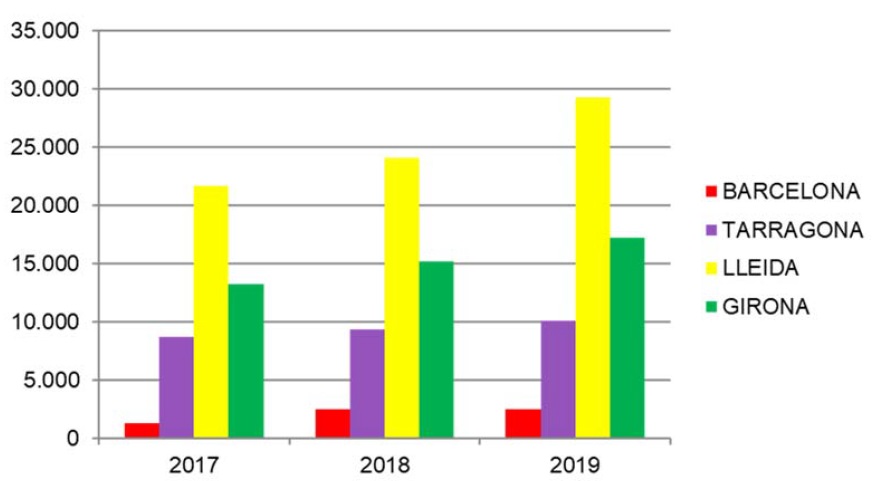
Evolution of on-demand transport passengers in Catalonia - Credits: Department of Territory and Sustainability
In 2020, the service was naturally affected by the pandemic: however, it did also recover much faster than traditional public transport – users shifted to on-demand services when the already existing bus lines were suspended or reduced, as well as when the collective trust towards public transport hit a low.
Now, as restrictions are slowly being lifted, the recovery rate is accelerating for both on-demand and public transport. The Minister of Territory and Sustainability of Catalonia Damia Calvet is still very much positive about the future of Clit.cat and its contribution to the existing public network in ensuring territorial cohesion and equity, while fostering sustainable mobility. As he put it, "on-demand services have been successfully operating in Catalonia for more than 30 years, all while harmonising with the municipalities and regional councils – with Clic.cat, we are making one more leap to improve and expand our work in this sense": one hand washes the other, and both are washing the face!
____________________
About Catalonia as a POLIS member
The Generalitat of Catalunya has been incredibly active in the field of sustainable mobility. As one of POLIS member regions, over the last several years it has been expanding and enhancing its interurban, and even cross border bus networks, updating lines, introducing electrification and establishing digital services to support the physical infrastructure. Indeed, its integrated approach to public transport has been utilised as key examples of best practices across POLIS working groups.
____________________
About numbers of 2019
The province of Lleida was the region with the most on-demand transport services. Indeed, it had 124 on-demand transport lines which carried 29,278 passengers. It was followed by the province of Barcelona, with 45 on-demand transport lines (plus two that have been recently created in the region of Anoia) and 2,505 passengers. Girona, which has 41 on-demand transport lines, was the province that carried the most passengers after Lleida, with a total of 17,298. Last but not least, Tarragona, with 23 on-demand transport lines, transported 10,119 passengers in 2019.
____________________
About Clic.cat
Clic.cat is substantially shortening the time required to make a reservation (15 minutes before the trip are sufficient!), as well as improve the access to and the management of the overall on-demand service.
With the app, users can:
- Check the exact time of their trips
- View the position of their bus
- View reservations they have made
- Add their favourite routes
- Cancel their reservations
- Rate the service
____________________
About the author
Cristina Pou Fonollà is Head of Public Road Transport at the Government of Catalonia - General Directorate of Transports and Mobility.
 Bus stop featuring a Clic.cat ad in Barcelona - Credits: Department of Territory and Sustainability