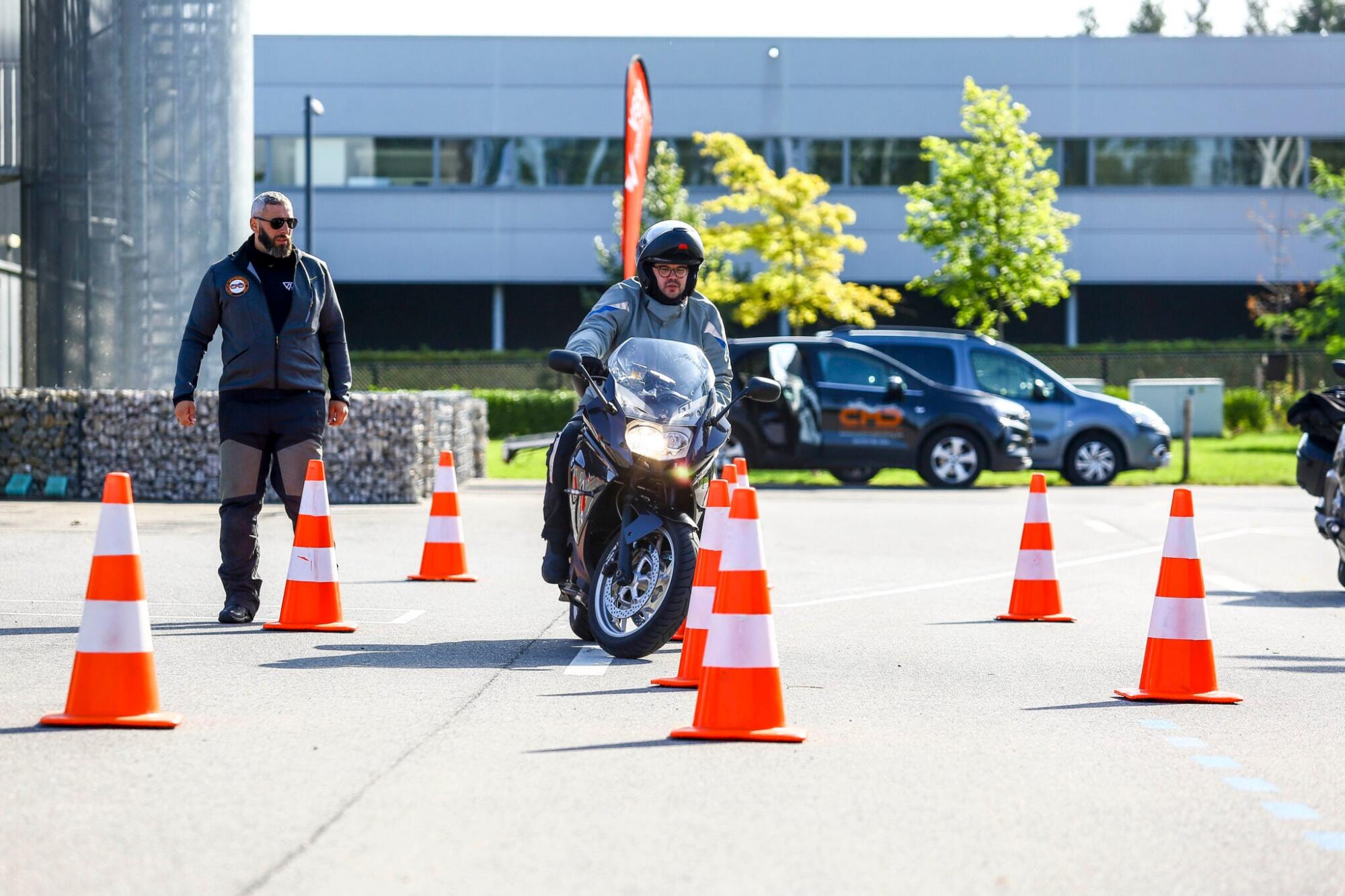
On its tenth anniversary, the European Motorcycle Training Quality Label enters a new chapter
After ten years of promoting high-quality voluntary post-licence rider training, the European Motorcycle Training Quality Label is entering a new chapter under the coordination of ACEM, the European Association of Motorcycle Manufacturers, and ifz, the Institute for Motorcycle Safety.
Since June 2026, the European Motorcycle Training Quality Label, an initiative dedicated to recognising excellence in post-licence training schemes, has been under the coordination of ACEM and ifz. The partnership combines ACEM's long-standing commitment to road safety with ifz's expertise in rider education and safety research.
The German Road Safety Council (DVR), a founding member of the Label, continues to manage the certified training programmes in Germany, while the International Motorcycling Federation (FIM) works to expand the initiative’s reach internationally.
Key European road safety stakeholders, including the European Commission and the European Transport Safety Council (ETSC), have long supported the Label. Recently, FIA Region 1, the Motorcycling MEP Club, and POLIS have also joined as official supporters.
Motorcyclists face high risks on the road
Approximately 40 million L-category vehicles circulate on European roads and streets. L-vehicles range from motorcycles to mopeds, and have great potential to contribute to lowering transport-related CO2 emissions and alleviate traffic congestion, as they are space-efficient and often more cost-effective than passenger cars, especially in urban contexts.
However, motorcyclists and moped riders are part of the group of 'road vulnerable users'. In fact, although they represent only a small percentage of the vehicles on the road, motorcyclists are involved in a disproportionately high number of road fatalities. In 2022, there were over 3,300 motorcycle-related deaths reported in the EU.
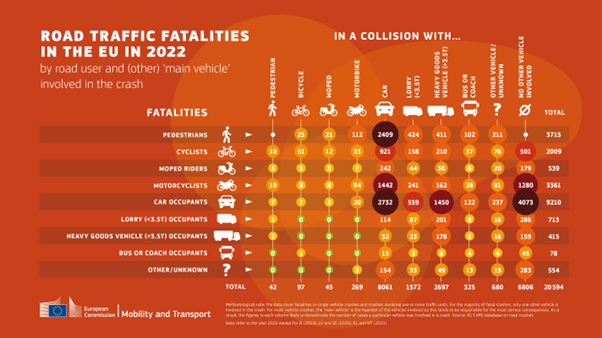
Collision matrix of road traffic fatalities in the EU in 2022 — Credit: European Commission
Statistics show that motorcyclists are 17 times more likely to die in a crash compared to car drivers. Notably, 94% of these fatalities involve men, with the highest risk among those aged 20-29. Many fatal accidents occur on bends and at intersections, often due to excessive speed or unforeseen road conditions.
To enhance the safety of motorcyclists and save lives, the motorcycle industry is adopting various solutions, such as daytime running lights, speed-sensitive electronic steering stabilisers, side-view assists, and blind spot detection. R&D in the safety standards sector is crucial to bring new safety technologies to market. For instance, Cooperative Intelligent Transport Systems (C-ITS) offer promising solutions as it facilitates communication between vehicles, helping to mitigate the common problem of drivers failing to see motorcycles in traffic, which is one of the most frequent errors in accidents.
A decade of advancing high-quality rider education
In this context, lifelong rider training for both new and experienced motorcyclists is also crucial. Advanced courses offer riders opportunities to increase their proficiency and improve road safety, as they foster the development of skills such as hazard perception and risk awareness.
However, as training courses vary considerably across EU countries and schools, it can be difficult for riders to identify the best training schemes and make informed decisions. To address this, in 2016 ACEM, the DVR, and the FIM joined forces and created the European Motorcycle Training Quality Label. Its objective is to help riders clearly and easily identify high-quality post-licence training offers in their countries, spreading safety-focused messages to riders and contributing to improving road safety and saving lives on Europe’s roads
Since then, the Label has grown into a well-established European network comprising 35 certified training programmes in ten countries and an expanding community of training providers.
Last year, the initiative celebrated two major milestones. First, it released the 'Instructor Guidelines for Voluntary Motorcycle Training', an evidence-based guide designed to support safer riding by promoting the cognitive and practical skills needed to anticipate and avoid the most common hazardous situations on the road. Second, the campaign ‘Learn – Ride – Enjoy – Repeat’ aimed to empower riders with high-quality knowledge and advanced tools by encouraging them to enrol in voluntary post-licence training. It was a huge success, involving 44 organisations in 22 countries.
What the future holds for the Label
Besides promoting high-quality training, the Label is a platform for knowledge exchange in the sector, and is currently expanding its cooperation to promote academic research on the topic. Currently, ACEM is involved in the AIGOR project with the University of Florence, a project exploring how artificial intelligence and riding data can provide novice moped and motorcycle riders personalised feedback on their riding style and potential risks in their first months on the road.
Moreover, the Label is currently looking for more training providers offering voluntary safety motorcycle training across Europe to apply for the certification. This is an opportunity for training providers to gain visibility among riders looking for certified training and associate themselves with an established and trusted network.