
Under the LENS
Motorcycles and other L-vehicles symbolise freedom and agility, yet their real-world emissions reveal a different story. The LENS project exposes how noise and exhaust emissions challenge cities striving for cleaner, quieter, and healthier urban environments.
Motorcycles, mopeds, Vespas, and even trikes—vehicles within the broadly defined ‘light category’ come in all shapes and sizes. These L-vehicles are often associated with freedom, rebellion, agility, speed, and holidays. Such feelings have been portrayed in films since the dawn of cinema, from Audrey Hepburn riding her Vespa through Rome to the iconic bike chases in Arnold Schwarzenegger’s ‘Terminator’ movies.
L-vehicle manufacturers capitalise on these emotional connections to sell their products, while critics highlight the issues of excessive noise and air pollution.
There’s no doubt: pollution is a growing challenge!

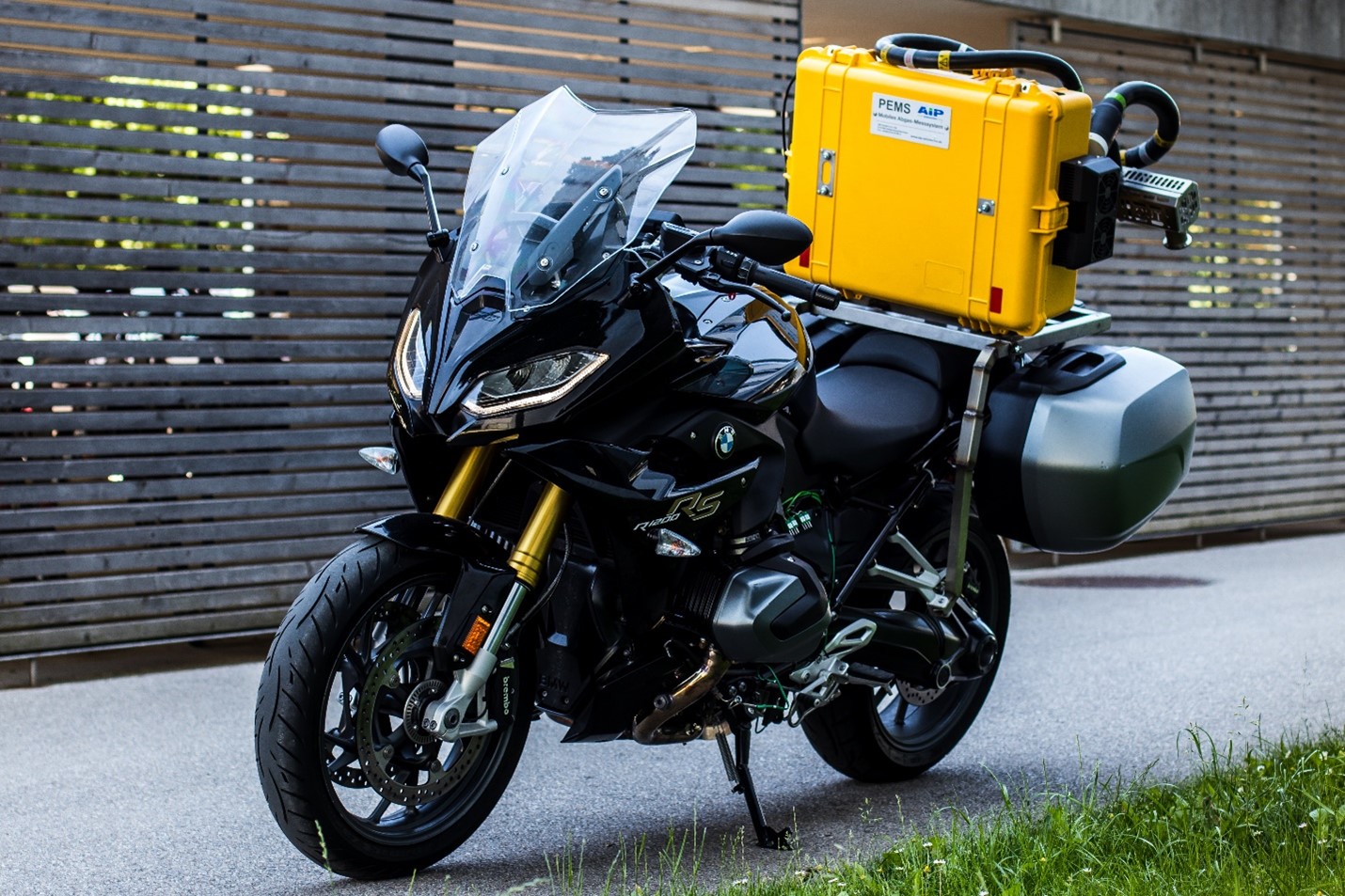
Yamaha motorcycle with a portable emission measurement system, Stephan Schmidt, TU Graz
The European Environment Agency (EEA) reports that air pollution alone claims at least 250,000 lives in Europe each year. Long-term exposure to noise above recommended limits disrupts sleep, heightens anxiety, impairs cognition, harms mental health, and is linked to about 48,000 new cases of heart disease and 12,000 premature deaths annually.
Additionally, noise pollution is the other noteworthy and widespread challenge, as approximately 20% or 100 million European citizens are exposed to unhealthy levels of road traffic noise. This is significantly caused by cars and motorcycles in both urban and rural areas.
These challenges will remain with more than 250 million registered passenger cars in the EU27 and nearly 40 million L-vehicles. The latter group creates a severe problem according to the German citizens’ initiative against motorcycle noise (Bundesverband gegen Motorradlärm). Their spokesperson, Holger Siegel, emphasised that motorcycle manufacturers use ‘noise as a business model by catering to the demand of motorcyclists’.
What did the LENS tests and laboratories reveal?
LENS project experts assessed L-vehicle emissions by thoroughly testing more than 150 vehicles on test benches, in laboratories, on real roads, and during roadside measurements. For all three aspects—noise, emissions, and real-world performance—new sensing tools were developed by partners across Europe.
From Aachen to Paris and Thessaloniki, teams of experienced drivers and technicians spent days testing everything from tiny two-stroke mopeds to large quads.
Emissions: Still behind the curve
Pollutants measured included, among others, CO2, hydrocarbons, NOx, and particulate matter. Results show that most of the existing fleet still falls under the EURO3 category, with only limited adoption of Euro 5 technologies. This points to a slow market shift toward cleaner models replacing outdated vehicles.
Although limits for L-category vehicles are nominally aligned with Euro 6 light-duty cars, real-world emissions often exceed laboratory results. Particle and NOx emissions remain the biggest contributors to the environmental impact of these vehicles, especially under dynamic driving conditions.
Overall, today’s L-vehicles remain a significant source of urban air pollutants. To match the performance of modern light-duty vehicles, both stricter Euro 5 enforcement and advances in emission control technologies are needed.
Noise: Louder on the streets
Noise tests using on-street microphone arrays, test-track setups, and on-board mounts revealed that motorised two-wheelers are considerable contributors to noise pollution in both urban and rural areas. Despite tougher regulations and stricter testing procedures, there is still a significant gap between controlled test results and actual noise levels in real-world conditions.
This was demonstrated using bespoke on-board systems specifically designed for the measurements, which recorded real-time noise and GPS data. The results showed that real-world driving often produces noise levels that exceed regulatory thresholds.
Researchers used these recordings to define fourteen typical real-world driving patterns, including aggressive accelerations, gear changes, throttle variations, and decelerations.
The project concluded that real-world noise emissions are complex and influenced by numerous factors, including driving behaviour and environmental conditions. The new driving patterns could help refine testing and enforcement so that regulations better reflect daily vehicle use.
What are the conclusions of the project?

On-street L-vehicle noise- and air pollution measurement setup in Leuven, Belgium, Niklas Schmalholz, POLIS
POLIS spoke with project coordinator Leonidas Ntziachristos from EMISIA, who provided insights into the multifaceted challenge:
‘We need faster fleet renewal by replacing older vehicles to drastically cut pollution: this gives a substantial overall benefit. Also, we need to measure more pollutants in smarter ways by improving testing methods, which can match real-world driving conditions. Authorities should invest in better tools for on-road testing with miniature and portable sensing equipment and use robust methods to determine exhaust flow on diverse engines so results are increasingly reliable’.
At the latest LENS consortium meeting, the partners agreed that stricter European regulation and regular emission tests will accelerate the phase-out of older L-vehicles—a trend already observed in the data of the LENS emission tests on different EURO-categories.
Takeaways for cities and regions
Are motorcycles and other L-vehicles major polluters or valuable alternatives for cities? As with most things, the answer lies somewhere in between.
L-vehicles are fast, space-efficient, and often more cost-effective than passenger cars—well-suited for cities. Yet tighter emission limits, regular vehicle monitoring, and smarter regulation remain effective measures to reducing their environmental footprint and promoting more sustainable behaviour among L-vehicle users.
However, meaningful progress also depends on dialogue and a deeper understanding among stakeholders, as actions by manufacturers, legislators, and registration authorities can be severely undermined by rider behaviour. The LENS analysis shows that motorcyclists themselves have a major impact on noise and emissions through their driving style and, in some cases, vehicle tampering.
Curbing such legal or illegal modifications will require stronger police enforcement. While automatic solutions such as noise cameras could help—detecting high-decibel events, recording license plates, and potentially issuing fines—they have not been deployed in European countries due to remaining legislative gaps.
Click here to read the article in its original format.
About the author:
Niklas Schmalholz, Project Manager, POLIS Network. Schmalholz is the main dissemination manager of the EU-funded LENS project. In his more than five years at POLIS, he worked on multiple projects related to parking, road safety, co-creation initiatives with citizens, and decarbonisation of freight.
 Stephan Schmidt, TU Graz