Member in the Spotlight: Noord-Brabant
From fast cycling routes and solar cycle paths to preparing for autonomous public transport, Noord-Brabant is driving the sustainable mobility transition with a clear regional vision. In this edition of Member in the Spotlight, the province reveals all on how it is tackling challenges while keeping inclusivity and climate goals firmly in focus.
POLIS member Noord-Brabant is breaking new ground in sustainable mobility, from pioneering fast, interurban cycling routes and solar-powered cycle paths to preparing autonomous buses through SmartwayZ.NL. With its Multi-Year Multimodal Mobility Packages (MMMPs), the province is delivering key measures across cities, towns and rural areas, with a clear aim to leave no citizen behind in the mobility transition.
In this feature of Member in the Spotlight, the province reveals all on how citizen engagement projects like SINFONICA and GREENGAGE are shaping policy, how CCAM is set to transform public transport, and how Noord-Brabant is meeting big challenges without losing sight of inclusivity and climate goals.
Interview with Edwin Mermans, Senior Advisor International Affairs, Province of Noord-Brabant, elaborated by Carlotta Inserra.
POLIS: Noord-Brabant has set out a clear mobility vision through its 2030 Mobility policy framework and the Multi-Year Multimodal Mobility Packages (MMMPs). Can you tell us more about how these strategies are shaping your current priorities and actions on the ground?
We are following these strategies to keep Noord-Brabant accessible, economically resilient, and inclusive to all. Our province faces many challenges and transitions, such as housebuilding, high nitrogen deposition, climate adaptation, and the increase of sustainable energy. Ultimately, regional and urban mobility systems must become smart, sustainable, safe, and inclusive. This calls for an adaptive approach, with all stakeholders engaged in a process of learning by doing and solving the puzzle together.
Given the complexity in both space and time, it is important to develop long-term strategies while also taking short-term actions today. The leading priorities in our current on-the-ground efforts are walking, cycling, public transport, on-demand shared mobility services, and private car use: our main investments are therefore in active travel and public transport. The MMMPs represent an important step in developing and implementing measures at a supra-local level.
A key element in our long-term strategy is brede welvaart, which refers to a broad understanding of prosperity, not just material wealth. It includes people’s overall well-being, health, education, social cohesion, environmental sustainability, and how prosperity affects future generations and people elsewhere in the world.

For Noord-Brabant, regional and urban mobility systems must become smart, sustainable, safe, and inclusive. This calls for an adaptive approach, with all stakeholders engaged in a process of learning by doing and solving the puzzle together. Credit: Noord-Brabant Province
POLIS: The MMMPs cut across different urban regions, connecting cities, towns, and rural areas. How does Noord-Brabant’s role as a province help ensure that all communities benefit equally from the mobility transition?
The starting point for the MMMPs is a province-wide urbanisation strategy. Every functional urban area is different and has its own emphases and challenges. Through the province-wide approach, it is easier to complete the puzzle. During implementation in the four functional urban areas, interaction between urban and rural stakeholders is essential. As a province, we are very much aware that the mobility transition has entirely different consequences for cities compared with the surrounding rural areas. Every stakeholder and partner takes steps in relation to their own context.
POLIS: Coordinating at the regional level often means balancing many local needs and stakeholders. As a province, what have been your biggest challenges and key learnings, and what forms of collaboration are most effective in ensuring an integrated approach to sustainable mobility?
As a province, we have very limited legal jurisdiction or instruments in most areas of mobility and infrastructure, apart from public transport and a few roads. In the Netherlands, power is shared between the national, regional, and local levels. We neither can nor wish to dictate to municipalities what they should or should not do: this means we must work in partnership and build trust. Our role is to persuade and gently steer them in our direction, while respecting differing interests, perspectives, and local priorities.
The transition towards a smart, sustainable, connected, safe, and inclusive mobility system is, by nature, a long-term process. Politicians, however, tend to be focused on delivering visible results within the four-year terms of office for their city or village. This requires us to think in terms of long horizons and long-term strategies, to define the end goal and outline the scenarios for how to reach it.
Fact-free politics and ideology can also be a hurdle. Fortunately, we are pleased that virtually all political parties have included in their programmes a commitment to investing in high-quality, uninterrupted cycling infrastructure both within and between cities.
POLIS: Noord-Brabant is working on several projects surrounding public participation and engaging citizens in the development of the province’s mobility solutions, such as SINFONICA and GREENGAGE. What are some of the tangible impacts from these initiatives? What is your advice for other cities and regions aiming to embed citizen engagement in their mobility planning?
It is essential to involve citizens before implementing the transformation of a mobility service. During the SINFONICA project, it became clear that people are open to innovation in the public transport system. However, people also find the idea of driverless public transport both exciting and challenging. Some already struggle to travel by regular public transport and to work out how it functions. The SINFONICA project focused on mobility for all, ensuring that vulnerable groups are included. It is important to communicate with these groups in society frequently. After all, a transformation through innovation should not prevent vulnerable people from being able to use automated buses in public transport.
Within GREENGAGE, we set up a pilot to experiment with citizen science strategies. The goal of this pilot was to obtain citizens' feedback regarding road maintenance of cycling infrastructure and to compare this input with the objective data on which road authorities base their planning. There was not a large difference between feedback from citizens and data from road authorities. However, a mismatch was noticed between citizens’ expectations of using the cycling roads and policymakers' expectations. Citizen engagement needs to be integrated into mobility planning from the start. It needs to be institutionalised with formal structures. Noord-Brabant, for example, finances a small and independent NGO for the consultation of public transport users.

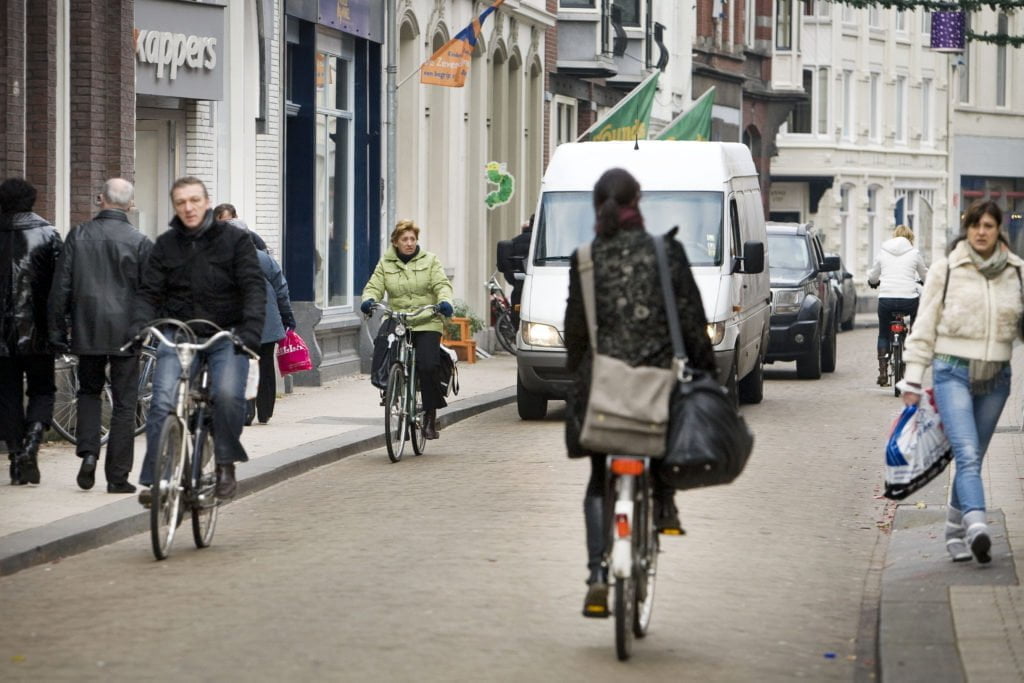
Getting more people in Brabant to cycle more often, further, and more safely – that is the goal of the province of Noord-Brabant’s cycling policy. Credit: Noord-Brabant Province
POLIS: Noord-Brabant has been actively preparing for the future of Connected, Cooperative and Automated Mobility (CCAM), with autonomous buses positioned as a solution to driver shortages, rising costs, and accessibility challenges. How does the province see CCAM transforming public transport in both urban and rural areas, and what steps are you taking to ensure that inclusivity remains central to these technologies as you move towards large-scale deployment?
We expect that driverless and automated public transport can indeed provide a solution to the challenges mentioned. When our bus operators wish to introduce this, we, as the public transport authority, must be prepared. We anticipate that autonomous buses will initially be deployed on routes with dedicated bus lanes. However, demand-responsive transport in rural areas is also a possible application for CCAM vehicles.
It is very important that public transport remains both accessible and affordable. That is why we were a partner in the SINFONICA project, which focused on accessibility for vulnerable groups. We will also soon be launching a driverless shuttle at the Efteling theme park, where we expect to gather further input on accessibility.
In the Interreg Netherlands–Flanders project CCAM Proving Region, a cross-border testbed is being organised with industry, research institutes, and public authorities. In addition, this year, we launched the Interreg Europe project Next Ride. Through this project, we aim to ensure that our policies on accessibility, affordability, and social safety are ready for the introduction of CCAM into our public transport system.
Participation in SINFONICA and other projects has greatly increased awareness within the provincial public transport team of both the opportunities CCAM offers and the need to put the user at the centre.
POLIS: Cycling and active mobility are central to Noord-Brabant’s identity, with key actions such as the development of fast cycling routes and innovative solar cycle paths. Can you tell us more about these and how they support the province’s broader multimodal strategy and contribute to achieving your climate goals?
Getting more people in Brabant to cycle more often, further, and more safely – that is the goal of the province of Noord-Brabant’s cycling policy. Together with the municipalities, the cycling team is working on developing a strong regional cycling infrastructure, encouraging the use of bicycles, and providing good facilities for bicycle parking at public transport hubs.
The population in cities is growing rapidly, and with it the number of homes in both urban and rural areas. This makes it necessary to change the way we travel within the province; otherwise, the roads will become congested. By choosing the car less often, we can keep Noord-Brabant both accessible and liveable: making cycling even more attractive is therefore a key task. The non-stop interurban cycle roads play an important role in this, serving as the backbone of our cycling network.
Research on the routes already completed shows that the number of new cyclists using them is significantly higher than the cycling potential we had estimated back in 2015. It makes it possible to commute comfortably and safely with an electric bike between cities at distances of 20–25 km.
POLIS: Staying the course toward sustainable mobility is not without hurdles. What lessons or encouragement would Noord-Brabant share with other regions to keep moving forward despite obstacles?
We learned long ago that it is essential to work with all stakeholders in a process of learning by doing. This involves not only our cities and villages, but also universities, industry, SMEs, and citizens’ organisations. The challenges we face are complex – both in terms of the number of stakeholders involved, the obstacles encountered, and the dynamics over time. What is valid today may already be outdated tomorrow. We therefore need to be adaptive, flexible, and able to respond quickly to both threats and opportunities. We look with some envy at how, for example, Paris used the COVID-19 crisis to accelerate the transition towards more active mobility and reduced private car use.
The challenges facing Noord-Brabant are significant and growing. By far the largest is the extreme nitrogen deposition caused by the agricultural sector, as it blocks much of the new infrastructure development. In addition, delays in investment in the electricity grid are causing major problems in expanding the charging infrastructure required for buses and lorries. As a result, the transition to zero-emission mobility is proceeding much more slowly than necessary, also as a consequence of short-term policymaking. Noord-Brabant is, however, relieved not to have invested in hydrogen refuelling stations for lorries and buses. The future of zero-emission transport lies in battery-electric solutions.
I don’t think it should be about what other regions can learn from us. It ought to be about what we, along with the rest of Europe, can learn from Ukraine. What is happening there is without precedent. The way Ukraine, on all levels, manages to fast-track innovations under the harshest of circumstances is astonishing. Try, fail, learn, succeed, repeat. It is the only way.

- Related Members