
EU Automotive Package: A concerning 'step back' impacting cities and regions
On 16 December 2025, the European Commission unveiled its Automotive Package, a flagship initiative intended to steer Europe’s automotive sector toward clean mobility, decarbonisation, and competitiveness.
While it contains a few promising measures, it raises serious concerns for cities, regions, and the future of Europe’s climate ambitions.
Building on previous initiatives like the Automotive Action plan and the Strategic Dialogue on the Future of the European Automotive Industry, the proposed Automotive Package includes a series of initiatives aimed at 'boosting clean mobility, decarbonisation, and competitiveness in road transport'. Unsurprisingly, it mostly responds to the needs of the automotive industry without considering the interests of a multitude of other stakeholders. Among others, it proposes:
- The revision of the existing CO₂ emission standards for cars and vans: from 2035 onwards, carmakers will need to comply with a 90% tailpipe emissions reduction target, while previously this target was 100%;
- A €1.8 billion Battery Booster initiative to support EU battery production and supply chains;
- An automotive omnibus to simplify administrative burden and cut red tape, simultaneously introducing a new vehicle category under the Small Affordable Cars initiative: EVs “made in EU”, up to 4.2 metres in length;
- A regulation on green corporate fleets, mandating that a national-level percentage of new corporate car and van registrations by large companies is zero or low-emission from 2030 onwards.
 While some of these measures might bring positive impacts for cities and regions, POLIS is also very concerned about some clear shortcomings. For cities and regions across Europe, this is not merely a regulatory debate: it is a question of public health, social equity, industrial competitiveness, and the credibility of Europe’s climate leadership with implications that go far beyond the 2035 watershed milestone.
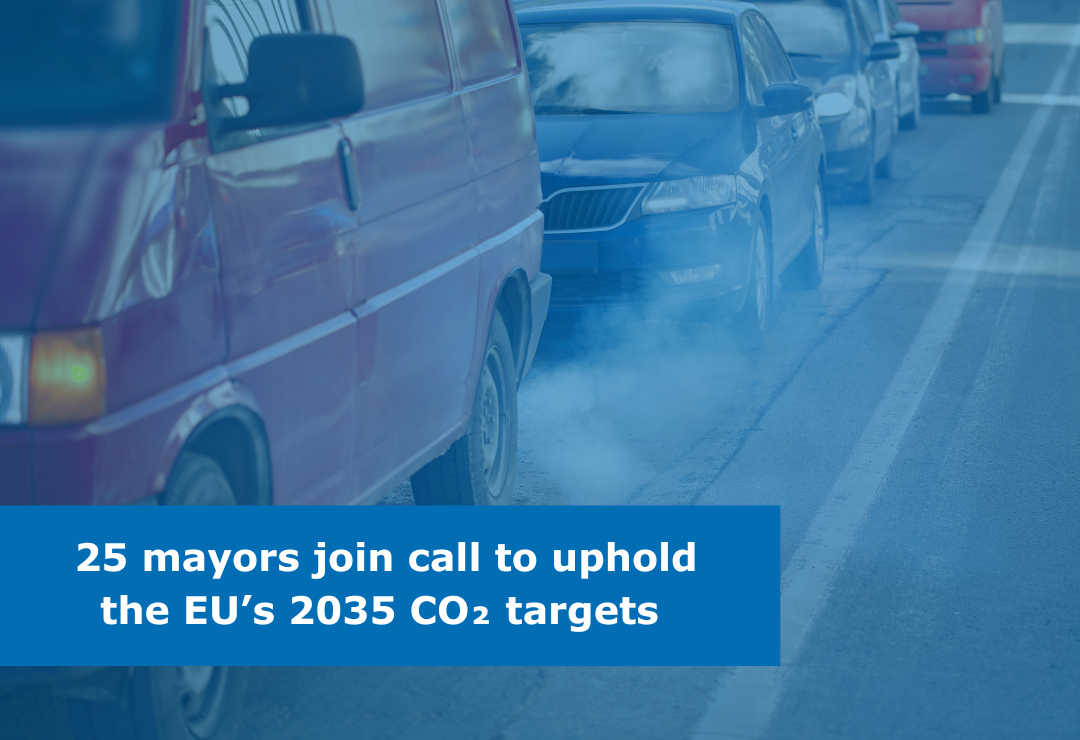
This is why more than 25 European mayors, represented through the C40 Cities, Eurocities, ICLEI Europe, and POLIS networks, have recently signed a joint letter urging the European Commission to stay on course and maintain the phase-out of new CO₂-emitting cars and vans by 2035.
A 'step back' on previously agreed CO₂ standards
The proposed revision of the CO₂ emissions standards for cars and vans not only constitutes a step back on a previously agreed path towards the electrification of road transport, but also negatively impacts local and regional authorities’ ambitions to create cleaner and healthier places for their citizens.
It is no exaggeration to say that, by allowing hybrid cars and ICE vehicles running on e-fuels and biofuels to still be sold, this proposed revision effectively 'kills' the 2035 ICE ban previously agreed, even in the presence of strong evidence that the tailpipe emissions of such vehicles remain as harmful as petrol and diesel for public health and contribute to urban noise pollution.
The revision also impacts compliance with the future requirements of the revised Ambient Air Quality Directive. With more ICE and hybrid vehicles being sold for a longer time, local authorities will have no other option than to implement more stringent local measures towards zero-pollution, which are politically costly. It will affect the planning and level of ambition of future Low and Zero-Emission Zones, and until traffic authorities are provided with the certainty that geofenced hybrid/range extender solutions can be applied and locally enforced, they will have no easy way to identify if a hybrid vehicle is running on zero-emission mode.
For what pertains to climate neutrality, more than 110 cities, including several POLIS members, have committed to becoming climate-neutral by 2030 as part of the Climate-Neutral Cities Mission, notably a European Commission initiative. One must wonder: how can a reduced level of ambition in the CO₂ emission standards be reconciled with local climate neutrality targets, given the huge contribution from road transport to the CO₂ emissions in urban environments?
Finally, the revision sends a confusing signal to industry, local and regional authorities, and citizens, as according to a recent study from Transport & Environment, this proposal might lead to up to 25% fewer BEV sales in 2035. This will impact cities' deployment of EV charging infrastructure, namely the usage rate and return on investments. It will also bring increased pressure on the public sector as a 'backstop' and guarantee of EV charging investments that are no longer pursued by the private sector.
Clean fleets should not create first and second-class citizens
The proposed Greening Corporate Fleets initiative brings some positive aspects welcomed by POLIS, like a continued distinction between the obligations for public entities under the Clean Vehicles Directive versus private enterprises targeted by this proposal, and the focus on large companies.
However, establishing different levels of ambition between Member States risks continuing the current trend of 'two-speed' electrification in Europe and discrepancies between levels of EV adoption across countries.
When it comes to clean air, we should not have first and second-class citizens, and this proposal risks creating an argument for cities in countries with low targets to have less ambitious strategies for zero-emission transport. Moreover, as has previously raised by POLIS and several other organisations, the proposal does not fully acknowledge the full mix of e-mobility options.
How do we go from here?
As a network of more than 100 cities and regions with competences to regulate and legislate on mobility and climate neutrality, establish procurement procedures for zero-emission fleets, and incentivise a shift towards more sustainable mobility, we are very concerned about creating a precedent where an industry can push to change legislation overnight, thus severely impacting our members long-term strategies (SUMPs, Climate City Contracts etc.).
For Europe to reach its climate targets, it needs cities and regions. And for a successful implementation of the European Green Deal at the local level, we need legislative stability.
To enable this, we invite the European Commission to establish a multi-stakeholder coalition committed to ensuring this stability and predictability. This 'electromobility pact' can ensure the deployment of charging solutions building on improved grids, and relying on the availability of EU-manufactured vehicles in all vehicle categories—LEVs, buses, and coaches included.
On short notice, we invite the European Commission to engage in a dialogue with stakeholders to understand the impacts of the Automotive Package on adjacent legislation. Specifically, EURO7 needs to be studied and potentially revised.
POLIS remains committed to an ambitious car decarbonisation framework for 2035 and beyond, as the way to ensure cleaner air, healthier communities, and more liveable cities. We will also continue our joint advocacy efforts with other organisations to ensure that the voice and interests of cities and regions are heard during the discussions with the European Parliament and the European Council.