
Wheels Keep Turning
When strikes, roadworks, or major events put pressure on urban transport, people still need to move. Recent public transport strikes in Brussels and London show how shared micromobility can help cities absorb disruption, prevent short trips from shifting to cars and keep networks resilient.
Cities often judge transport systems by how well they work on an ordinary day. The real test comes when conditions are anything but ordinary.
A public transport strike, planned engineering works, road closures, a major event that compresses thousands of journeys into a few hours, a station closure that interrupts a familiar commute: these are the moments that reveal whether a city’s mobility system is genuinely resilient, or simply efficient when everything goes to plan.
Recent public transport strikes in Brussels and London offer a clear lesson. In both cities, disruption to core public transport services was followed by a sharp rise in shared micromobility use.
This was not just a temporary increase in trips, and showed that, when parts of the transport network fail or come under pressure, shared e-bikes and e-scooters can help absorb demand quickly and at scale. This is not an argument that shared micromobility can or should replace public transport. Public transport remains the backbone of urban mobility. But a backbone alone is not enough. Cities also need flexibility; they need modes that can absorb pressure when fixed route systems are disrupted, and that can offer residents a practical alternative before they default to private cars.
That last point is crucial. When a metro line is down, buses are cancelled, roads are blocked, or a station is closed, the risk is not only inconvenience: it is that people fall back on the least efficient option available—namely, driving. For cities trying to cut congestion, improve air quality, and reduce dependence on private vehicles, that is a serious policy problem.
Shared micromobility can help solve it. It gives people another way to move when the system is under strain, while also helping prevent short urban journeys from shifting back into cars, taxis, or ride-hailing. In that sense, its value goes beyond supporting public transport, because it also supports wider city goals around congestion, emissions, and street space.
The old ‘first and last mile’ label no longer captures the full picture. In disruption scenarios, shared micromobility is doing something bigger. It keeps cities moving.
Disruption reveals infrastructure
The clearest example came in Brussels in the week of 24-26 November 2025, when a three-day public transport strike from Monday to Wednesday severely disrupted metro, tram, and bus services across the city, leaving many residents without the network they normally relied on.
The response was immediate. On the first day of the strike, Voi’s e-bike rides increased by 40%. On the second day, they were 100% above an average day. By the third day, they were up 120%.
Those numbers matter because of what they reveal. This was not a small behavioural shift at the margins of the system; it was a significant transfer of demand. As the disruption continued, demand did not fade. It grew. That suggests people were not making novelty trips or reacting out of curiosity, but finding a practical transport option and relying on it.
An earlier strike in Brussels in 2025 pointed in the same direction, leading to record-breaking ride numbers across the wider shared micromobility ecosystem. Together, these moments show that micromobility is no longer something ‘nice to have’: when traditional transport stalls, shared micromobility can take the load, and it can do so not marginally, but materially.
The spatial dimension matters, too. Disruption patterns are not limited to leisure routes or city centre journeys. Geospatial data shows riders connecting outer districts to transit hubs, filling first and last mile gaps, and moving across the city in ways that reflect the full complexity of urban life. The geography of this demand looks far more like critical infrastructure than a convenience service.
London confirmed the same pattern in a different urban context. On 22 April 2026, during the first day of a 24‑hour Tube strike by RMT drivers, Voi saw record‑breaking demand in London. Rides rose by more than 51% compared with the previous week, riders increased by 53%, and new user registrations jumped by 110%.
That final figure is especially important. The surge was not only driven by existing users riding more often: it actually brought new people into the system at speed. Faced with disruption to one of Europe’s largest public transport networks, many Londoners were willing to change their behaviour quickly and use a shared mobility option they might otherwise have overlooked.
This has clear policy implications. It suggests shared micromobility is not limited to a fixed or niche user base. When the need is there, it can absorb new demand quickly and provide a practical fallback when usual services fall short.

Voi trip patterns in Brussels during public transport disruption — Credit: Voi Technology
From reactive response to proactive planning
The lesson from Brussels and London is larger than strikes. The same logic applies when maintenance shuts a station, roadworks create local bottlenecks, a bridge closure diverts traffic, major infrastructure works disrupt a corridor for weeks, or large events such as festivals and football matches compress thousands of journeys into a short time window. The immediate cause may differ, but the policy challenge is the same. How does a city maintain mobility without pushing more people back into cars?
Public transport cannot answer that question alone, because disruption often affects public transport itself. Cities need another layer of capacity that is flexible, visible, and ready to be deployed. Shared micromobility can be exactly that, but only if cities and operators plan for it together.
Major events show how this works when pressure is predictable, and Stockholm offers a clear example. On 31 March 2026, the day of a World Cup qualifier, the city accounted for 10% of all Voi trips across 130 European cities. This was more than a simple surge in demand; it demonstrated what micromobility can do when operators know pressure is coming and can prepare in advance.
Vehicles can be positioned close to stadiums, stations, and event corridors. Operational teams can be deployed in advance. Fleet availability can be managed in real time. Parking arrangements can be adapted where necessary, so that additional demand does not create unnecessary clutter or conflict on pavements.
The same approach can be applied to planned public transport works, roadworks, large cultural events, demonstrations, temporary street closures, and severe weather disruption. Cities often have advanced knowledge of these pressures. If shared micromobility is treated as part of the transport system, rather than as an external consumer service, it can be integrated into the response.
That means sharing information earlier, including operators in disruption planning, and identifying key corridors where additional micromobility capacity could prevent short journeys from shifting into cars. It also means building regulatory frameworks that allow operators to respond quickly when demand moves.
Overly fragmented or temporary regulation can limit this potential. If fleet caps, parking rules or operating areas are too rigid, cities may restrict the very flexibility they need during moments of pressure. Good regulation should still protect safety, accessibility, and public space. But it should also recognise that flexible shared mobility can support wider public goals when properly managed.
This is where collaboration becomes essential. Operators bring real-time data, operational capacity, and experience of demand patterns. Cities bring knowledge of planned works, public transport pressures, traffic management, and local priorities. Used together, those strengths can turn shared micromobility from a reactive fallback into a planned resilience tool.
Regulate for the role
The policy challenge is not whether shared micromobility influences urban mobility: the evidence increasingly suggests that it does. The question is how cities should regulate it.
Brussels recently brought that question from and centre by deciding not to renew licences for shared e-scooter operators from 2027. The decision follows a period of rapid growth in e-scooter use, alongside ongoing concerns around safety incidents, pavement obstruction, and enforcement in densely used public spaces. Shared bicycles and e-bikes will remain part of the city’s mobility offer.
This matters because the evidence from Brussels and London shows that shared micromobility should not be merely seen as a consumer service sitting outside the transport system. When networks are disrupted, it absorbs demand, supports public transport, connects areas that still need to function, and reduces the likelihood of people falling back on private cars.
Cities increasingly talk about resilience, but resilience is not an abstract ambition. It is the practical ability to keep people moving when conditions are difficult. Shared micromobility is already contributing to that task.
The policy challenge is to recognise its role and regulate accordingly. That does not mean giving operators a free hand: it means designing partnerships, data sharing processes, and operational rules that allow micromobility to support the network when pressure rises. Once a mode becomes part of how cities cope with disruption, it is no longer peripheral: it is part of the network.
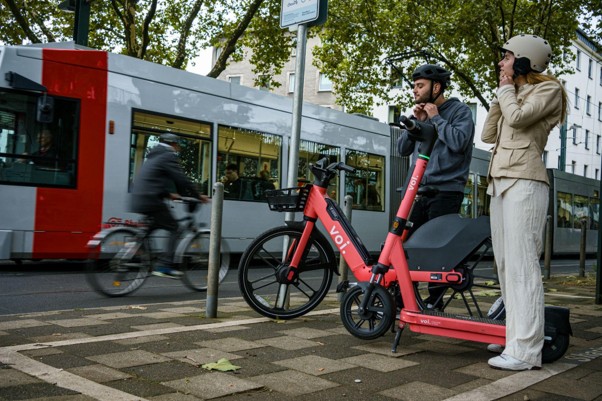
Riders using Voi e‑bikes as part of their daily journeys in a tram‑served corridor — Credit: Voi Technology
Click here to read the article in its original format.
About the authors:
Paulina Charrier, Senior Market Development Manager, Voi Technology. Charrier is a senior commercial leader with extensive experience in market expansion and strategic partnerships. She leads end‑to‑end market entry and commercial collaborations, previously managing partner operations to enhance onboarding and revenue while promoting intermodality between micromobility and public transport. Before joining Voi, she worked on mobility and innovation at the French Ministry of Economy and the City of Paris.
Sofie Cederberg, Senior Communications Manager, Voi Technology. Joining just after the company's founding in 2019, Cederberg has grown alongside Voi ever since, building expert, hands-on knowledge of communications and media relations in the European shared micromobility field.
Julia Tegelberg, Policy Manager, Voi Technology. Tegelberg is a policy professional working at the intersection of regulation, economics. and strategy in the mobility sector, with a background in new business development. She analyses how evolving regulatory frameworks and market conditions influence expansion, positioning and long‑term strategy.
 Credit: Voi Technology