
Starting Small
Helmond is a renowned living lab for smart and sustainable urban mobility, which has successfully balanced innovation, liveability, and citizens’ engagement. Not afraid of ambitious goals, the city is proof that starting small goes a long way.
Interview with Matthieu Graindorge, elaborated by Vittoria Maddalena.
POLIS: As digitalisation and smart solutions in mobility increase, how can small cities like Helmond ensure these technologies respect citizens’ needs and improve the quality of life?
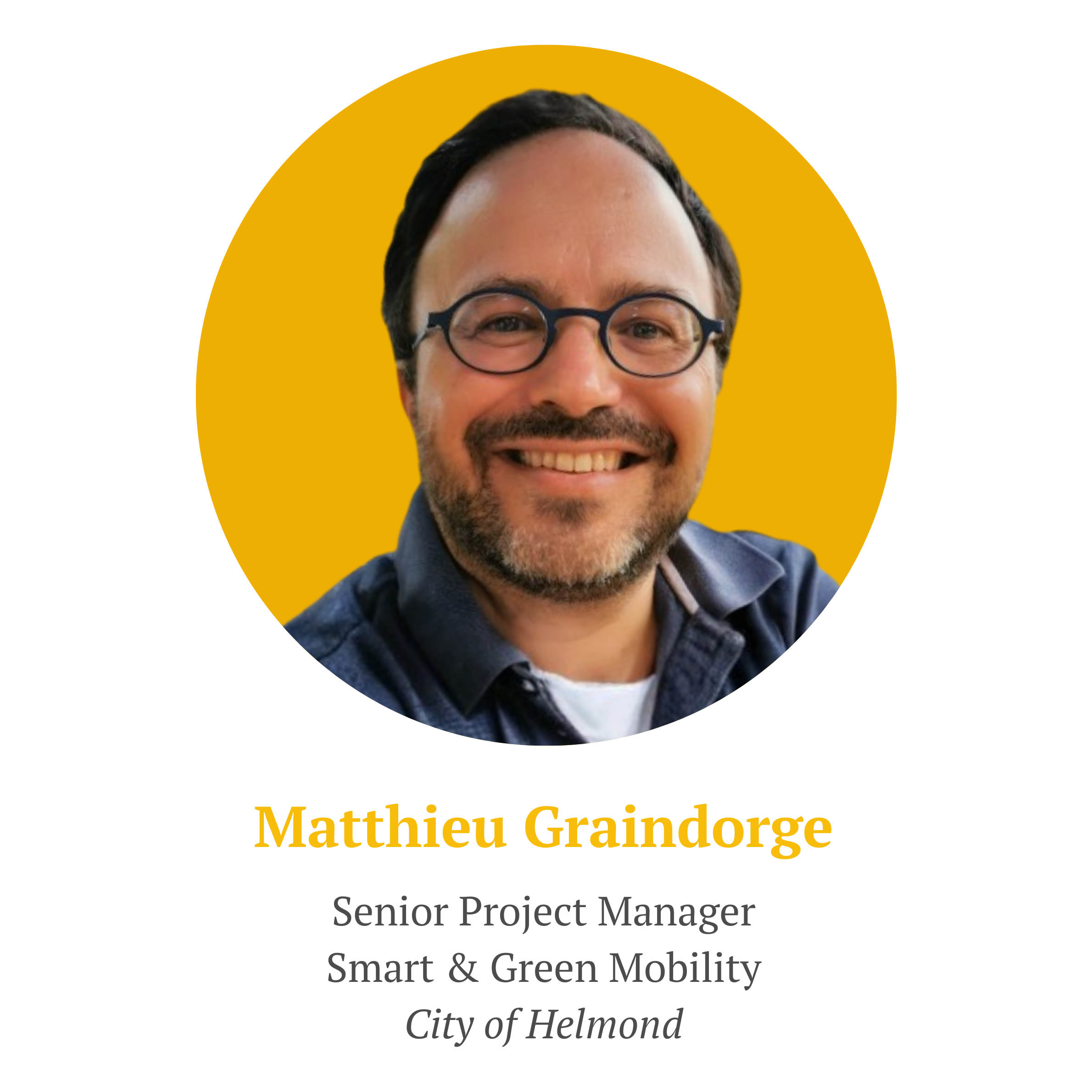 Matthieu Graindorge: We see digitalisation and smart mobility as tools, not goals in themselves. In Helmond, we first focus on solving concrete challenges, like improving road safety for cyclists and pedestrians, reducing transport poverty, and making public transport more accessible. Only then do we choose the most suitable solutions or building blocks.
Our approach is rooted in co-creation and inclusivity because we believe that technology must serve people. That is why we use data-driven approaches and tools like digital twins to refine solutions before implementation. In this regard, we have great expectations for the new living lab at the Automotive Campus—MARQ—which allows us to test innovations in a controlled yet realistic environment.
POLIS: Helmond has ambitious climate and mobility goals in its Mobility Vision and the Climate City Contract. What role does urban mobility play, and how can sustainable mobility improve liveability?
Graindorge: How we move affects everything: climate, health, and liveability. Transport cannot be approached in isolation; it must integrate with health, land use, housing, and social equity.
Our active mobility approach prioritises cycling in urban design, making it the easiest and safest choice over private cars. We want Helmond to be climate-neutral, but also vibrant and inclusive.
POLIS: Looking ahead, what challenges do you expect to face as a medium-sized city in the coming years, and how are you preparing for them?

Co-creating with citizens, especially vulnerable groups, is a priority for Helmond, Matthieu Graindorge
Graindorge: Helmond is growing fast, with 15,000 new homes planned by 2040—a 30% increase compared to the current status—and the Brainport Region is aiming for 100,000 by 2050.
This growth, however, brings pressure on mobility, housing, and climate aspects. One of our biggest challenges is behavioural change: shifting from a car-oriented culture to one based on active mobility and seamless, multimodal transport.
To achieve this, we are working to:
- Reduce car dependency: by 2035, we aim to cut the main road Kasteeltraverse’s capacity by over 50% by rerouting traffic and prioritising active modes, public transport, and clean vehicles.
- Integrate mobility with urban planning: new districts, like Stationskwartier, are being designed for active and shared mobility.
- Ensure social equity: Growth must benefit everyone, so we are working to improve access to jobs, healthcare, and daily facilities, using technology to make alternatives to the private car more attractive.
Finally, regional cooperation—notably through our Climate City Contract with Eindhoven—helps us align housing, transport, and energy planning so growth does not erode liveability.
POLIS: Helmond is a living lab and participates in many EU projects. What have been the most significant lessons so far, and how has the city changed?
Graindorge: Our experience as a living lab has taught us to start small, iterate, and scale what works. We have moved from isolated trials to integrated pilots, so innovations become part of how we operate daily. Success is measured in the end by the benefits delivered to citizens, not just technical milestones. Projects like MOVE2CCAM proved that co-creating with residents—notably vulnerable groups—ensures solutions like automated shuttles or smart cycling infrastructure truly meet their needs.
Partnerships with industry, universities, and research centres are equally vital: they help us turn experiments into operational improvements and embed innovations into city processes.
POLIS: Reflecting on the Urban C-ITS Award 2023, what were the milestones that enabled successful Cooperative Intelligent Transport Systems (C-ITS) implementation?
Graindorge: Helmond’s C-ITS success stems from nearly two decades of consistent work and collaboration. First, building a strong local ecosystem—our team, the Automotive Campus, and partners from industry, research, and European projects—enabled testing, learning, and deployment.
Second, we have evolved from car-focused pilots to a multimodal approach. Early C-ITS projects like Freilot or Compass4D targeted car or truck traffic, but over time, we expanded to include pedestrians and cyclists, with safety and sustainability as goals. Today, our systems optimise vehicle flow while protecting vulnerable road users.
Third, European cooperation has been crucial. Participation in multiple EU projects brought co-funding, expertise, and visibility, accelerating deployment.
POLIS: Are you planning to exploit Connected, Cooperative, and Automated Mobility (CCAM)’s potential in Helmond’s broader transport system?

Automated public transport solutions have been tested first in simple environments, Jim Eijkemans
Graindorge: CCAM services are not yet operational, but we see them as key to complement public transport, reducing car dependency, and creating a smart, shared, and inclusive urban mobility. Our approach is gradual, transparent, and rooted in co-creation. Through projects like MOVE2CCAM, we have tested automated solutions and worked with citizens and stakeholders to develop real use cases.
We start with simpler environments, like industrial areas, before scaling to more complex urban settings. This phased approach ensures safety, legal compliance, and scalability.
Stakeholder cooperation is essential. We leverage our local ecosystem—partners like Eindhoven University of Technology, TNO, the Province of Noord-Brabant, and the City of Eindhoven—to align CCAM with broader regional goals. Networks like POLIS and the CCAM Partnership connect us with cities, manufacturers, and researchers worldwide, ensuring shared learning and best practices.
POLIS: How have these innovations impacted citizens, and how do you ensure less tech-savvy groups are included?
Graindorge: Innovation must be inclusive by design. We co-create with citizens to ensure accessibility and deploy user-friendly services. Technologies are designed to be intuitive and accessible for all ages, fostering independence and social connection, especially for elderly residents.
POLIS: Reducing car dependency is a challenging task. How does Helmond use technology to promote active travel, especially cycling?
Graindorge: Technology must enhance active modes. By 2035, we want a city centre designed for people, not cars. Cycling should be the easiest, safest, and most comfortable choice. C-ITS can prioritise cyclists at traffic lights and warn of hazards.
Digital twins help optimise cycle networks and reduce conflicts with cars. Real-time information shows the fastest, safest, or most comfortable routes, especially for elderly people. Our cycling strategy also prioritises accessibility: wider bike paths, smoother surfaces, and safer intersections.
POLIS: Any upcoming initiatives or projects you find exciting?
Graindorge: From next year, Helmond will participate in the Horizon Europe CoreSpaces and PeriAsty projects, which could boost our Climate City Contract locally and regionally. We will also start the Connecting Europe Facility (CEF) initiative TISGRADE, aimed at upgrading the availability, quality, and interoperability of real-time traffic data across Europe. Projects like INTERREG’s CCAM Proving region and FLEX have recently begun—all exciting and diverse initiatives!
POLIS: What advice would you give other cities transitioning to smart and green mobility?
Graindorge: Start from the problems citizens experience and co-create solutions—some smart, some low-tech—that meet real needs. Begin small and scale gradually and sensibly: continuity is important, and change takes time.
Leverage partnerships, particularly local ones, because no (small) city can do it alone. Collaborating with industry, academia, and networks like POLIS accelerates both learning and action.
Finally, keep equity and inclusivity central: if benefits are uneven, public support evaporates.
Click here to read the article in its original format.
About the contributors:
Interviewee: Matthieu Graindorge, Senior Project Manager Smart & Green Mobility, City of Helmond. Graindorge coordinates EU projects at the City of Helmond, within the team Urban Innovation and Networks. Graduated with a Master’s in Political Science, he has 25 years of experience in EU mobility and energy projects. In Helmond, he has led some EU projects related to C-ITS, CCAM and UVAR and will contribute to two Mission Cities projects starting in January 2026.
Interviewer: Vittoria Maddalena, Communications Assistant, POLIS. Maddalena contributes to POLIS’ activities through producing news and social media content, including supporting events and campaigns. She holds a BA in Political Sciences from the University of Padova and a MA in European Studies from KU Leuven. She is passionate about decarbonisation, electromobility, and the green transition.
 TNO
TNO