
Next Stop
Switzerland's transport system is the envy of many. The trains are safe, clean and punctual. A comprehensive service, with trains arriving every 30 to 60 minutes, covers almost the whole of Switzerland and ensures reliability. However, even the best system has its limits. To guide the long-term development of Switzerland's mobility system, a SBB project team has developed a whole new mobility vision, showing that a transition to a more sustainable mobility system is feasible.
Switzerland’s transport system is among the most admired in the world, known for its precision, reliability, and integration. But as the country looks into the future, this success story faces new pressures and expectations.
The next 30 years will be characterised by significant uncertainty and major challenges, including the consequences of climate change and population growth, as well as the need to use resources sustainably.
These challenges are already evident: for example, Switzerland's population has grown from approximately 7.2 million to 9 million over the past 25 years, and the federal government expects this figure to reach 10.5 million by 2050. Meanwhile, more people are seeking attractive public transport options and seamless door-to-door travel chains that enable smooth and comfortable journeys.
A matter of adaptation

SBB’s network continues to grow denser, requiring smarter planning and coordination, SBB
One thing is clear: if the railways are to remain viable in the future, they must adapt to respond flexibly to new developments. New measures—such as double-decker trains and extended platforms—have already been implemented in Switzerland to accommodate more passengers. However, there is limited capacity for additional trains due to space constraints, tight budgets, and lengthy construction timelines. While the potential of new technologies and digitalisation is significant, it is not sufficient on its own. What is needed is a smarter, more efficient way to use the existing infrastructure, supported by a shift in how transport is planned—not just from station to station, but also from door to door.
To address these challenges and provide guidance on the long-term development of Switzerland's transport system, a project team at SBB has developed a mobility vision outlining how the mobility system should evolve to meet a broad range of long-term requirements. The guiding question was this: Can Switzerland provide every person with access to public transport every 15 minutes, to any destination, within a reasonable timeframe and budget?
Approaches for the future: Three principles, ten tools
The vision for the future of mobility is built on three guiding principles, supported by ten practical tools. Together, they outline how public transport can expand and integrate across international, national, regional, and local levels, making the most of existing resources through better coordination between different modes of transport, including light rail, trams, and buses.
Complementing mobility

Strengthening local transport enables passengers to reach their destinations quicker, making the entire system more efficient, SBB
Rail is best suited for medium- and long-distance travel, moving large volumes of people and goods safely, quickly, and sustainably. But for shorter journeys, other modes are better suited. In cities and urban areas, trams and light rail provide more frequent services and better access to residential districts. In rural areas, smaller modes such as cars and buses—many of which will be autonomous in the future—play an important role in linking people to the network. The aim is to ensure that every mode of transport complements the others, rather than competing with them.
Systematising rail transport
While trams and buses excel at short-distance travel, railways can focus on their strengths: serving medium and long-distance routes efficiently and at harmonised speeds. The vision foresees regional and long-distance trains, as well as freight trains, running at regular intervals—every 15 minutes within Switzerland and every 60 minutes to major European destinations. Achieving this will require targeted infrastructure expansion, new technologies, and operational innovations that allow trains to run more frequently on the existing network.
Integrating the overall system
The third principle calls for closer integration of transport planning, financing, and management with spatial planning. This means designing transport systems around complete door-to-door travel chains, ensuring all modes of transport, including rail and road, work together seamlessly. Intelligent coordination of existing planning tools and selective regulatory updates will be key to making this possible.
A worthwhile vision

Applying the vision’s principles through modelling demonstrates the feasibility of a 15-minute nationwide mobility system, SBB
To develop this vision, SBB experts analysed the three principles and ten associated tools in depth, developing a sample network diagram and simulating potential effects. The results were impressive: the share of public transport in the modal split could increase by around two-thirds, cost recovery ratio would improve, and the overall system would operate more efficiently. Yet, the results also show that supply alone is not enough.
A supportive regulatory framework is indeed essential to make the system work. One reason public transport is becoming more attractive is that private cars are losing ground in growing conurbations, where traffic congestion is higher, regulations are tighter, and parking is harder to find. These trends are already visible in SBB’s models.
The 15-minute mobility vision demonstrates that a true transport revolution is possible. To achieve it, all modes of transport—including private cars—must play to their strengths, service must offer convenient, door-to-door travel every 15 minutes, and the regulatory framework must evolve to support these changes. With these steps, Switzerland’s mobility system will be ready to meet the challenges of the next 30 years and beyond.
Pilot project 'iamo'
Improving local transport is essential to making public transport a truly appealing alternative to owning a car—or a second car. When implemented correctly, automated mobility can make public transport more flexible, reliable, and cost-efficient, whether through scheduled or on-demand services. In fact, if operating costs could be halved through automation, the same budget could deliver twice as much service.
To test this theory and expand the dialogue with stakeholders, SBB has launched the ‘iamo’ pilot project in Furttal, near Zurich, in collaboration with the cantons of Zurich and Aargau and the Swiss Transit Lab. The goal is to let both the public and experts experience automated technology first-hand—after all, 'riding is believing'. The project aims to move beyond theory and open an informed dialogue about the role of automation in public transport. Drawing on real-world experience and feedback, partners are working together to build the foundations for the mobility systems of tomorrow.
If all goes according to plan, residents in the region will be among the first in Europe to test a fully automated mobility service with no staff on board by the first half of 2026. The project team is currently conducting preparation and test drives to make this ambitious step possible.
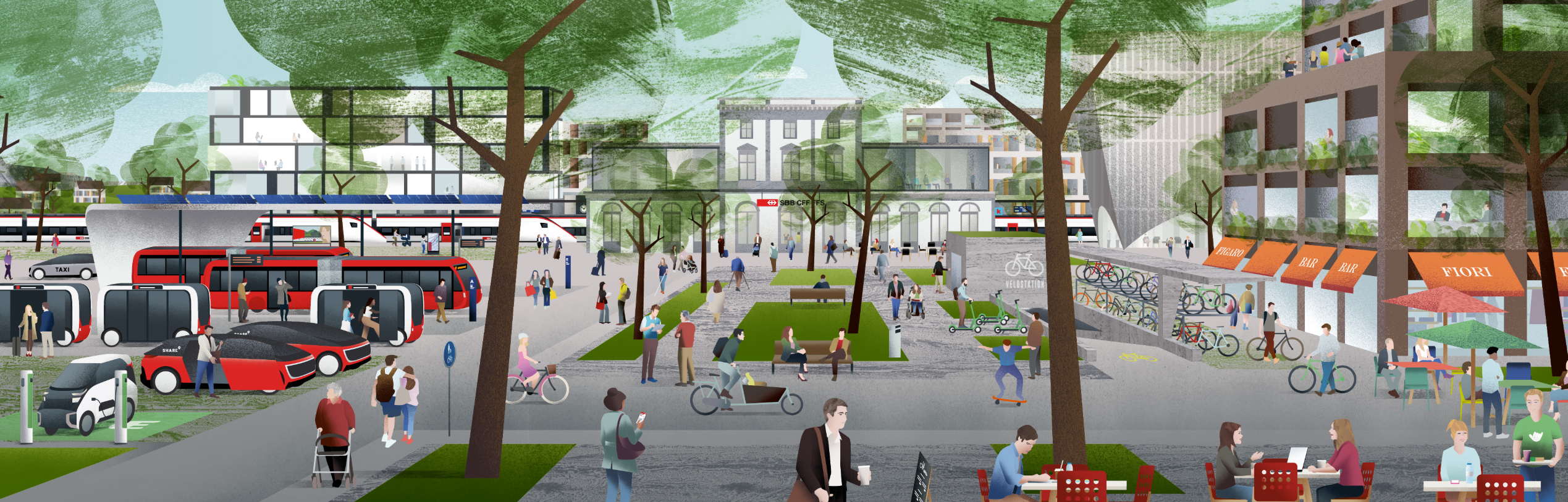
Concept image of a train station in the SBB project team’s mobility vision, SBB
Click here to read the article in its original format.
About the authors:
Julian Moritz Renninger, Project Manager, SBB. Moritz Renninger works in SBB’s Passenger Transport Division (Passenger Service Markets), shaping long-term mobility vision and leading the autonomous-driving pilot. He holds a Master’s degree in Economics (University of Zurich) and an MAS in Spatial Planning (ETH Zurich). He co-organises events for the association ‘Labor mit Utopieverdacht’ and serves on the Swiss National Planning Association (FSU) board.
Philippe Stadler Benz, Project Manager, SBB. Dr Stadler Benz works on SBB’s First and Last Mile Team, assessing the size of mobility areas at Swiss railway stations. He is also responsible for research collaboration on first and last-mile mobility and stakeholder management. He holds a Doctorate and a Master’s in Environmental Sciences and an Advanced Master’s in Science, Technology, and Policy, all from ETH Zurich.
 Lorin Both, Unsplash