Mediterranean Metamorphosis
Barcelona and Marseille showcase contrasting approaches to transforming public spaces and mobility. From Superblocks to gradual boulevard redevelopments, these cities reveal how planning rhythms, design, and strategic vision shape the future of urban movement and shared streets.
Since the late 1990s, European cities have been rethinking how public space is shared. Under the banner of sustainability, many have sought to curb car dominance in favour of walking, cycling, and public transport through pedestrian zones, cycling networks, and the expansion of tram and bus systems. This approach aligns with the broader framework of sustainable development, aiming to curb the impact of polluting and space-consuming mobility. Over the past decade, new forms of mobility, notably electric scooters, e-bikes, and other personal mobility devices, have emerged, reshaping the ways public spaces are used. This diversification of mobility forms and practices, while encouraging a reduction in car use, raises new questions about how different users coexist, given their differing speeds and spatial demands.
Within this context, examining the two Mediterranean cities of Barcelona and Marseille highlights two distinct ways of translating sustainable mobility ambitions into public space design. Although both face similar challenges, such as pollution, congestion, pressure on coastal areas, and city-centre attractiveness, their contrasting urban trajectories influence how projects are ultimately realised.
From planning to practice

Superblock in the Sant Antoni neighbourhood in Barcelona, Spain, Luis García Rios
To understand these differences, it is necessary to look at how strategic plans are turned into tangible urban transformations. The contrast between Barcelona and Marseille becomes then particularly evident.
In Barcelona, the Superilles or Superblock’s principle, introduced in the 2013–2018 Urban Mobility Plan of Barcelona’s City Council, proposes a reconfiguration of the city’s public spaces. The concept limits motor traffic to the perimeter streets of each block, calms internal streets, creates new public squares, and integrates local urban logistics within each defined Superblock area.
The Superblocks are especially noteworthy as they demonstrate how an urban design principle can integrate mobility, public space, and quality of life. The 2016 case study of the Poblenou neighbourhood—a former industrial neighbourhood in Barcelona’s Sant Martí district—illustrated the city’s capacity to rapidly transform ordinary streets into places for social life through tactical interventions such as ground markings, temporary street furniture, and plantings.
What began as a temporary, low-cost experiment soon evolved into a permanent urban transformation. Lessons from Poblenou informed later projects such as the Sant Antoni Superblock and, more recently, the Green Axes, which extend the same principles of traffic calming and public space creation, as seen on Consell de Cent Street in Barcelona.
By contrast, Marseille’s approach reveals a more gradual process. Since 2010, the city has implemented transformations to public spaces and traffic circulation, such as the partial pedestrianisation of the Vieux-Port, the redesign of Cours Lieutaud, and the Jarret bypass. These transformations have had a significant impact on reducing car traffic in the city centre of Marseille. With the 2020–2030 Mobility Plan of the Aix-Marseille-Provence Metropolis (AMP), the city outlines strategies such as calming central areas and developing Multimodal Urban Boulevards to redistribute street space among different transport modes. Recent examples of these strategies include the redesign of La Canebière Avenue in 2019 and Place Castellane in 2025.
The pedestrianisation of La Canebière Avenue, for example, returned part of the street between Quai des Belges and Cours Saint-Louis to pedestrians and cyclists: the kerbs were removed to create a single-level shared space, and speed limits were introduced for light motorised vehicles. More recently, Place Castellane has been entirely reconfigured as part of the north–south extension of tram line 3. The car-dominated roundabout has been replaced with a large pedestrian square equipped with urban furniture and planted areas. Today, this square serves as a major intermodal hub, connecting metro, bus, and tram networks.
Together, these examples illustrate Marseille’s step-by-step approach—focused on key nodes rather than systemic reconfiguration, and while these interventions reflect a will to reduce car dominance and promote intermodality, they lack a comprehensive conceptual framework comparable to that of Barcelona's Superblocks.
Convergences and divergences
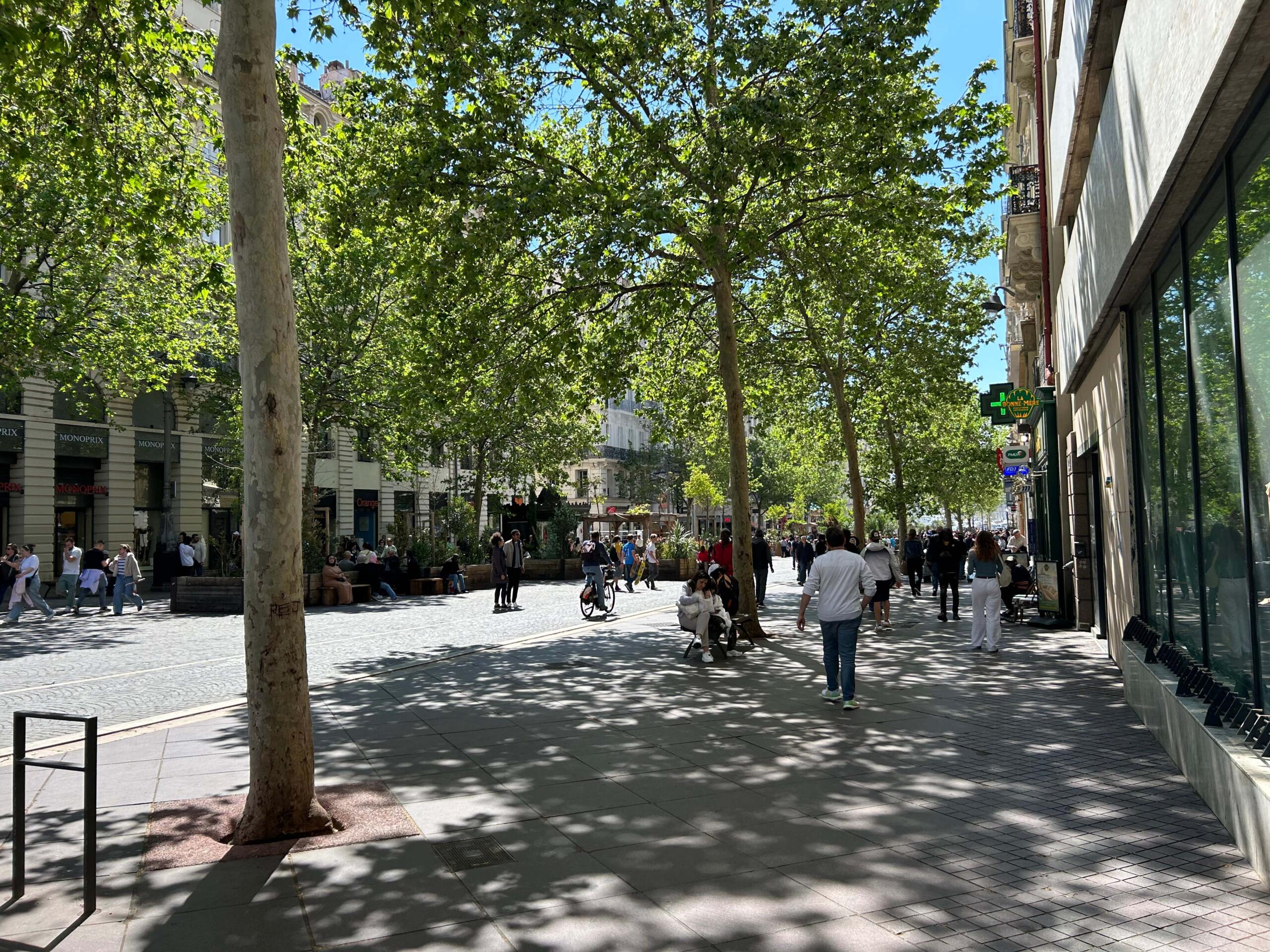
The pedestrianisation of La Canebière Avenue, Marseille, France, Luis García Rios
Barcelona and Marseille share several ambitions: reducing car dominance, promoting active mobility, improving intermodality, and advancing decarbonisation goals. Their main differences lie in the degree of integration and implementation capacity.
In many ways, these differences reflect their respective governance traditions and planning cultures. Barcelona benefits from a consolidated metropolitan tradition that fosters alignment between plans and urban projects. Marseille, with its vast and heterogeneous territory, is moving forward gradually, relying on specific interventions in public spaces with a technical approach based on a reorganisation of traffic flows. However, there is currently no established conceptual planning model to guide the development of these public spaces. These contrasts also highlight a difference in the timeframes of urban mobility planning: Barcelona works in short, five-year cycles, guided by monitoring indicators that allow for ongoing adjustments and course corrections. Marseille, however, operates on a ten-year horizon, implemented progressively through Local Mobility Plans, which can make it more difficult to respond rapidly to emerging forms of mobility.
Mobility planning and public space interventions advance in a coordinated way in Barcelona, reinforcing the overall coherence of projects. Marseille, by contrast, tends to move forward through parallel but separate processes—mobility planning and public space projects share similar goals but are often developed independently. This divergence suggests that integrating mobility planning and public space design remains a key challenge for many cities seeking greater coherence in their transformations.
Tactical interventions have also played a defining role in Barcelona’s approach, allowing urban design principles to be tested in a reversible way before being made permanent. Marseille’s projects, meanwhile, tend to rely more on large-scale and lasting redevelopments. Both approaches offer valuable lessons on balancing experimentation with long-term urban vision, showing that cities can benefit from combining small-scale experimentation with long-term, durable transformations.
Beyond governance and design culture, the rhythm of urban mobility planning itself directly influences how cities adapt to emerging mobility forms. Barcelona’s relatively short five-year cycles encourage quick and regular adjustments, whereas Marseille’s longer ten-year horizons foster a more gradual evolution—less reactive, but more stable. In other words, planning rhythms are not merely technical parameters, but key determinants of a city’s adaptability.
Two sides of the same coin
In a context of diversification of mobility forms and practices, Barcelona and Marseille illustrate how approaches can vary widely—sometimes highly integrated and conceptually driven, other times gradual and fragmented and gradual—yet both reveal that successful sustainable mobility relies as much on aligning strategic mobility planning with the design of public spaces as on infrastructure alone. Public spaces remain essential arenas for observing, testing, and regulating the ongoing transformation of how cities move and function.
Click here to read the article in its original format.
About the author:
Luis García Rios, Architect and Urban Planner, PhD Candidate in Urban and Regional Planning at Université Gustave Eiffel and Aix-Marseille University. Garcia Rios is an architect with a Master’s degree in Urban and Regional Planning from the University of Strasbourg. His work combines professional practice and research in urban and territorial issues. He is pursuing a doctoral thesis on public spaces and urban mobility in Europe at the LMA (Gustave Eiffel University) and LIEU (Aix-Marseille University) laboratories.
 Luis Garcia Rios