
How Much Do We Move?
Women and men do not move through space in the same way, especially in rural areas where transport options are limited. Using cell phone big data from Northern Italy, this study reveals how gender, geography, and accessibility shape everyday mobility, exposing hidden inequalities in access.
Mobility is essential to everyday quality of life: people commute to work, go to school, visit doctors, shop, care for family members, or simply enjoy their free time. The ability to travel easily and affordably is closely tied to social inclusion, well-being, and access to opportunities. Yet, mobility is not experienced equally: income, age, place of residence, access to a car, public transport availability, and gender identity can all influence how freely people move. Studying mobility, therefore, also means studying inequality, even more so in rural areas, where transport options are often limited.
For decades, researchers have relied on surveys, census data, and travel diaries to understand mobility patterns. These tools remain valuable, but they often involve limited samples, may miss short or irregular trips, and are costly for public authorities to collect. Today, cell phone big data offers a different perspective, making it possible to observe movements across large areas and over long periods of time. While this data cannot reveal the purpose of a trip or the mode of transport used, it can show where people move, when they move, and how varied their movements are.
These questions are especially relevant in Friuli Venezia Giulia (hereby referred to as FVG), an autonomous region in northern Italy, where cities, rural communities, mountain areas, coastal destinations, and border zones coexist within a relatively small territory. The region offers an ideal setting for exploring whether men and women move differently, and whether these differences become more pronounced in so-called ‘inner areas’—rural or peripheral territories located far from essential services.
Big data and entropy
Tracking cell phone signals through cell-ID positioning for trips made within FVG during 2023, a year in which mobility had largely stabilised following the COVID-19 pandemic and tourism flows had returned to normal, it is possible to identify different types of travellers: short-distance commuters moving across nearby municipalities, long-distance commuters travelling across FVG, intra-province travellers, intra-region travellers, and Italian visitors living outside the region.
Travellers and commuters are distinguished, because commuters generally return to their starting point every day. This distinction matters: a daily commute, a trip to the seaside, access to public services, and a tourist excursion all follow different spatial logics. Looking at these movements separately helps reveal where gender differences are most visible.
To understand how varied these movements really are, the study ‘A big data analysis of the gender gap in mobility at the regional scale: Insights from northern Italy’ uses Shannon’s entropy index. Imagine two people making the same number of trips. One repeatedly travels between home, work, and the supermarket; the other moves between workplaces, shops, relatives, services, and leisure destinations. Although both make the same number of trips, the second person has a more diverse mobility pattern. Entropy offers a way of measuring that diversity, where a higher value means trips are spread across more destinations, while a lower value points to movements that are more concentrated and predictable. This matters because reaching a wider range of destinations can also mean access to a broader range of opportunities.
In Friuli Venezia Giulia, mobility is shaped by both everyday routines and seasonal rhythms. Most trips are made by short-distance commuters and people travelling within the same province—FVG has four: Trieste, Udine, Pordenone, and Gorizia, reflecting ordinary activities such as work, study, shopping, and access to services.
Tourism becomes particularly visible during summer: Italian visitors from outside Friuli Venezia Giulia account for fewer trips overall, but their movements rise sharply in the month of August. Coastal towns such as Lignano Sabbiadoro and Grado, alongside mountain destinations and cultural centres like Tarvisio and Trieste, attract large numbers of visitors. By contrast, short-distance commuting remains relatively stable throughout the year, dipping slightly in August before increasing again in autumn.
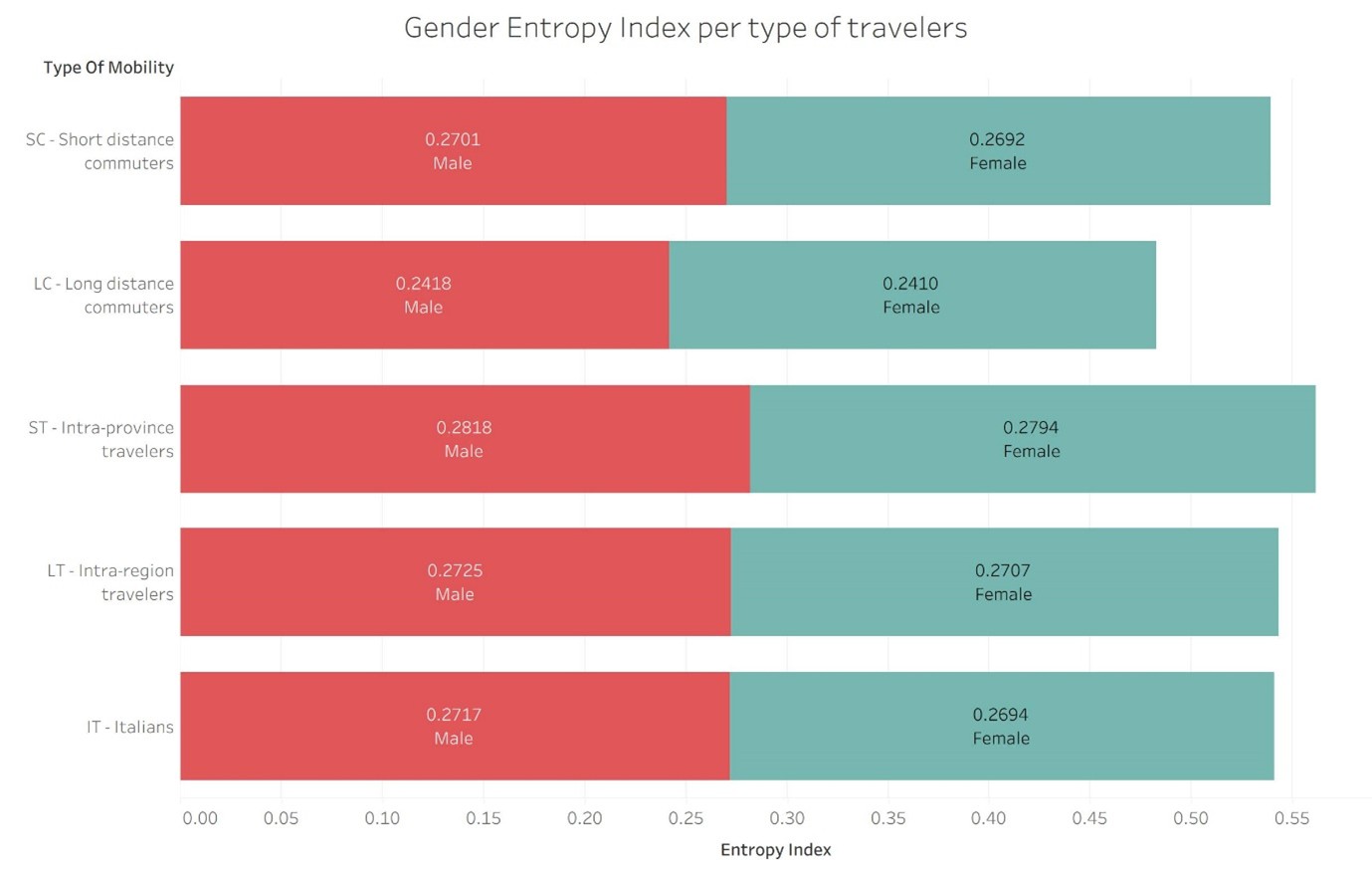
Gender Entropy Index per type of travellers in Friuli Venezia Giulia, Italy — Credit: IUAV and University of Udine/POLIS
Focusing on gender differences
One pattern appears consistently across all traveller categories: men make more trips than women. Overall, men account for around 55% of trips, compared with 45% for women, and this imbalance remains quite stable throughout the year, as it is reflected across more than 426 million recorded trips.
The gap is most evident among long-distance commuters, people travelling across the region, and Italian visitors from outside Friuli Venezia Giulia. It is less pronounced among short-distance commuters and intra-provincial travellers.
In other words, gender differences become more visible as mobility expands across wider areas. Men are more present in longer and more dispersed trips, where their share rises to almost 60% and in some months even slightly above, while women remain relatively more concentrated within local mobility patterns. That being said, counting trips tells only part of the story: it is equally important to look at how many different places people actually reach. These differences suggest that gender shapes not only how much people travel, but also the spatial scope and diversity of their daily mobility.
When mobility diversity is taken into account, men generally display slightly higher entropy values than women. In practice, this means that men tend to access a broader range of destinations, while women’s movements are often more concentrated and predictable. At the regional scale, these differences are not always very dramatic, but the same tendency consistently appears across traveller groups and throughout the year: men generally experience a wider mobility range.
Seasonality also changes the picture. In absolute terms, mobility surges in spring and early autumn, with intra-province trips peaking in October at over 8.1 million daily-recorded movements, while short-distance commuting reaches its annual high of nearly 22.8 million trips in the same month.
Tourism introduces a sharp summer distortion: Italian visitors more than double their activity in August, rising to roughly 2.46 million trips, compared with just over 1.16 million in February, and mobility becomes more varied for both men and women, as holidays, tourism, and leisure travel increase—during winter, on the other hand, movements become more localised and routine-driven, as leisure trips decline and everyday obligations dominate mobility patterns.
Increased disparities in rural areas
The sharpest differences emerge when comparing inner and non-inner areas. Inner areas are defined by the Italian Territorial Cohesion Agency as rural, peripheral, or mountainous territories where access to essential services is more difficult. Public transport is often infrequent, distances are longer, and reaching schools, healthcare facilities, or workplaces may require considerable effort.
Non-inner areas benefit from a stronger network of urban and industrial centres, including Udine, Pordenone, Gorizia, as well as industrial hubs such as Monfalcone and Tolmezzo. These nodes generate denser and more varied mobility flows, both for commuting and for service-related travel.
Trips originating from inner areas in FVG show lower mobility diversity than those starting from non-inner areas. In other words, people living in these territories tend to reach fewer and less varied destinations: their mobility is more constrained and service-dependent. The difference is particularly pronounced for women, whose mobility diversity is lower than men’s, especially during the winter months. This points to a broader issue: territorial isolation appears to affect women more strongly. When services are distant and transport options limited, women seem to experience a narrower range of movement and opportunity.
It would then not be inaccurate to say that the gender gap in transport is closely connected to the organisation of territory, the location of services, and the availability of mobility options. Big data makes these patterns visible on a regional scale: men tend to make more trips and access a wider range of destinations, while women’s mobility remains more localised and predictable, especially in inner areas.
Women may therefore face greater constraints when living in places with weaker accessibility. Transport policies should pay closer attention to the relationship between gender and territory. Strengthening collective transport in rural areas could help reduce these inequalities, and so would flexible
solutions, such as Demand-Responsive Transport (DRT), community transport schemes, or stronger links between small municipalities and major service centres.
This shift towards more flexible, demand-driven mobility is already visible on the ground in several pilot services across the region. One example is the UDonDemand service operated by TPL FVG in the Val Degano area, covering municipalities such as Forni Avoltri, Rigolato, Comeglians, Ovaro, and Raveo. Designed to connect isolated hamlets with interchange points towards Sappada and Tolmezzo, the service operates only upon reservation via app or call centre, offering a flexible alternative where conventional routes are sparse or infrequent.
A similar logic underpins the SMARTBUS pilot developed in the Karst area near Trieste, where on-demand shuttles link peripheral settlements such as Opicina, Cattinara, and Draga Sant’Elia with key interchange hubs like Prosecco, integrating weak-demand territories into the wider urban network. Although the SMARTBUS project has since been temporarily halted following a regional restructuring of public transport governance, it remains a reference case for how digital booking systems and flexible routing can reshape accessibility in peripheral regions.
Beyond transport
The patterns emerging from the data show that gender, geography, and accessibility are deeply interconnected. Hence, understanding how people move impacts their accessibility to opportunities and, ultimately, their quality of life.
Building fairer transport systems requires planning that takes gender differences, rural isolation, and everyday access to opportunities seriously. A more inclusive mobility system is essential not only for territorial competitiveness, but also for social equity.
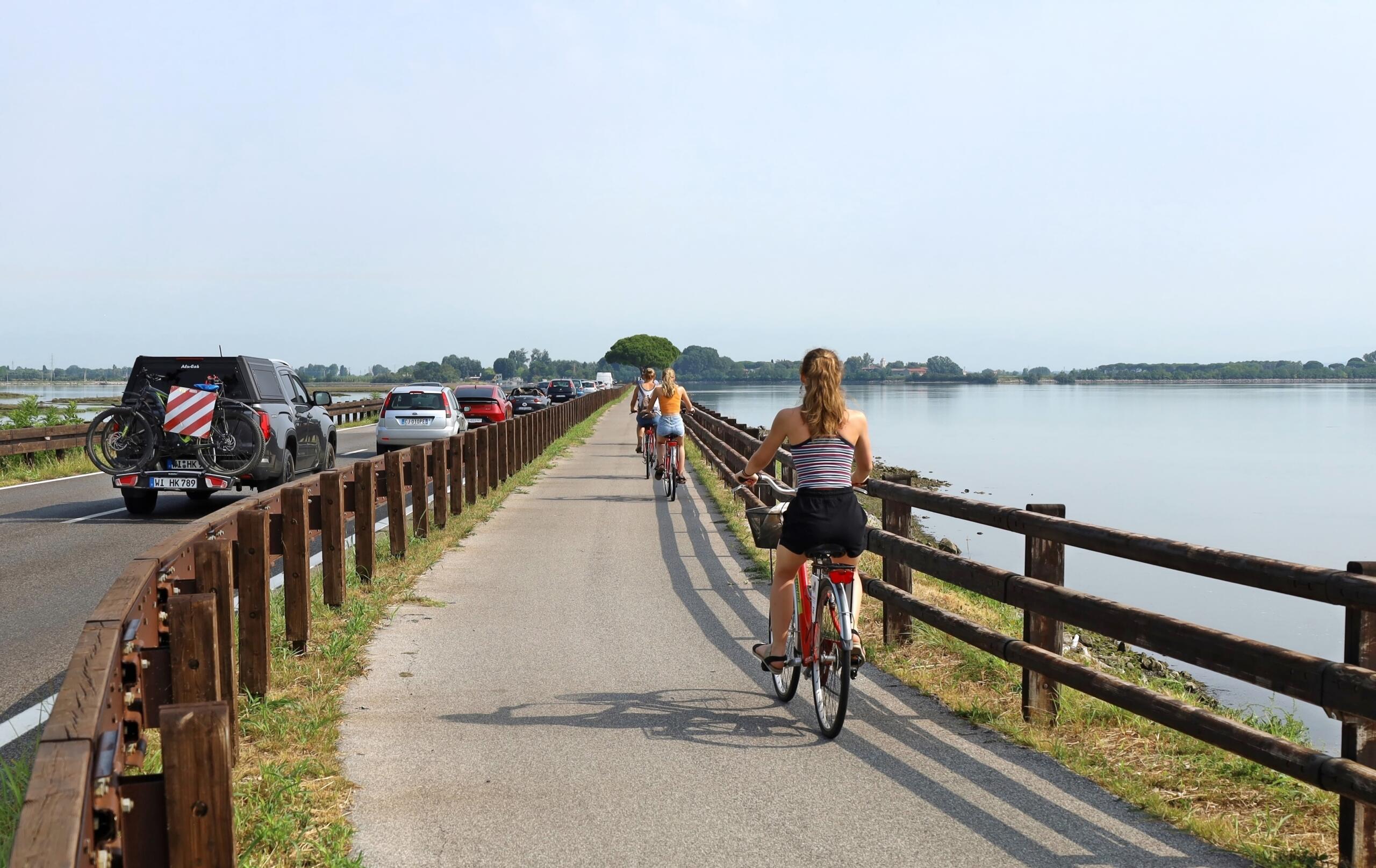
Alpe Adria Cycle Route in Grado, Friuli Venezia Giulia, Italy — Credit: lucapbl, Shutterstock
Click here to read the article in its original format.
About the authors:
Dario Bertocchi, Post-doc Research Fellow, University of Udine. Bertocchi is an Assistant Professor of Geography at the University of Udine and teaches at Modul University Vienna, IMC Krems University of Applied Sciences, and Ca’ Foscari University of Venice. His research explores tourist and resident behaviour through big data from social media and mobile networks, supporting sustainable tourism planning and mobility management, including in complex destinations such as Venice.
Francesco Bruzzone, Post-doc Research Fellow, Iuav University of Venice. Bruzzone is a Research Fellow in transport planning and focuses on urban mobility, parking management and sustainable transport systems. He works on EU-funded projects and applies GIS and data standards to analyse accessibility, cycling and public modes potential and multimodal networks in Italian and European cities.
Silvio Nocera, Full Professor of Transport Engineering and Planning, Iuav University of Venice. Nocera’s research covers economic evaluation of transport systems, external costs of mobility, high-speed rail, and active travel, with a strong focus on carbon emissions and sustainability. Ranked among the top 2% most cited scholars in ‘Logistics & Transportation’, he advises major EU-funded projects.
 Credit: SiposM, Shutterstock