Who Drives Automation?
Automated vehicles are leaving the testing phase and entering real city streets across Europe. As this shift accelerates, cities warn that the real question is not whether automation arrives, but whether it will serve public transport, reduce congestion, and improve accessibility, or quietly reshape urban mobility around private interests.
Automated mobility is no longer merely the ‘technology of the future’. After years of development through research projects, pilot schemes, and experimental deployments, the mobility pace has picked up, and automated vehicles (AVs) are increasingly being introduced into real-world transport systems. Across Europe and beyond, public and private actors are accelerating efforts to integrate automated mobility services into urban environments.
This transition comes at a time when cities and public authorities face growing pressure to provide public transport systems that are safer, more sustainable, efficient, and accessible for everyone. In this context, the deployment of AVs should not be viewed as an end goal, but rather to advance broader public objectives, such as sustainability, accessibility, and social inclusion.
Then, a critical question emerges: how can cities ensure that these technologies are deployed and operated in the public interest?
This question is at the core of the new joint charter by POLIS and Eurocities, which sets out a common direction for automated mobility in Europe—one where automation strengthens public transport, supports broader societal goals, and is shaped around the needs and responsibilities of cities. Bringing together a shared position from cities and regions across Europe, the Charter translates these ambitions into a set of practical principles for deployment.
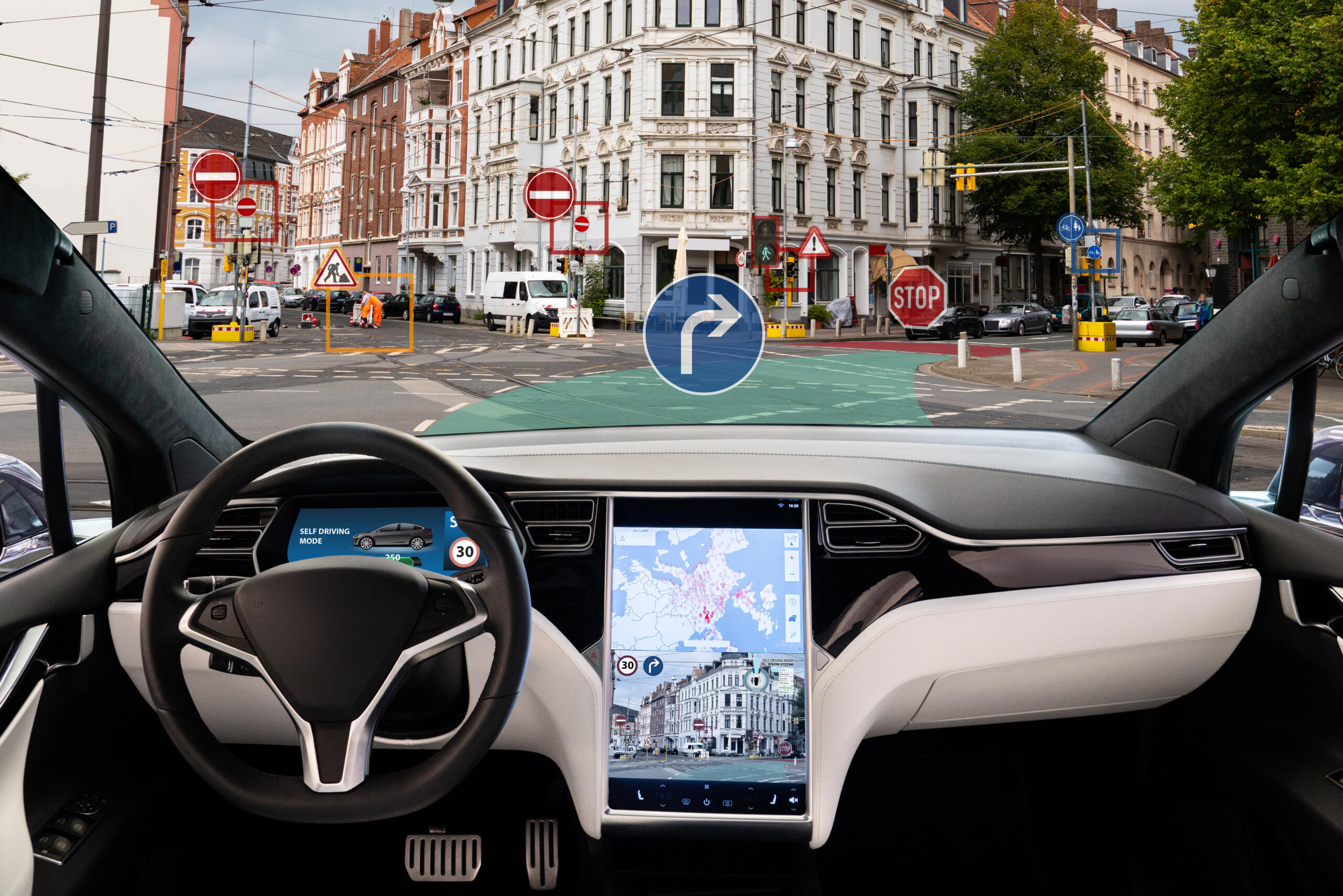
Autonomous car with HUD (Head Up Display) — Credit: Scharfsinn, Shutterstock
Why getting automation right matters for cities
Cities face growing pressure to reduce emissions and congestion while improving accessibility, efficiency, and the quality of public transport. In this context, automated mobility is increasingly presented as a tool that could help address some of these challenges. If deployed well, it could contribute to safer roads, more flexible transport services, improved connectivity particularly in areas where existing transport options remain limited, and more efficient urban logistics operations.
However, the benefits of automation are not guaranteed. Without clear public direction, automated mobility could also generate unintended consequences, including increased congestion, higher numbers of empty vehicle kilometres travelled, and even greater pressure on already limited public space. Questions of accessibility, affordability, and public trust further shape whether these technologies will deliver meaningful public value, thus becoming more widely accepted.
As automated mobility gradually moves from pilot experimentation to large(r)-scale deployment, cities’ concerns emerge, and implications extend beyond any technological aspect. Indeed, automated vehicles have the potential to reshape traffic circulation, parking demand, curbside management, and the use of public space. For cities, the real challenge is therefore not whether to adopt automation, but how to govern and integrate it into existing transport systems in ways that support broader goals of sustainability, accessibility, and quality of life.
What good deployment should look like
In practice, the value of automated mobility is not determined by the sophistication of the technology itself, but by whether it meaningfully improves how transport operates within cities. Its success ultimately depends on whether it contributes to existing urban mobility goals.
For many cities, this means strengthening public transport and sharing mobility rather than increasing reliance on private cars. When appropriately integrated, automated services can reinforce first- and last-mile connections, improve accessibility in underserved areas, and complement existing public transport networks. This approach also applies to the broader Cooperative, connected and automated mobility (CCAM) ecosystem, which includes not only automated vehicles, but also the infrastructure, digital systems, and policy frameworks required to embed automation within urban mobility networks. A central requirement is then integration. AV solutions should operate within existing urban environments, alongside pedestrians, cyclists, and public transport, rather than prompting a redesign of public space around their needs.
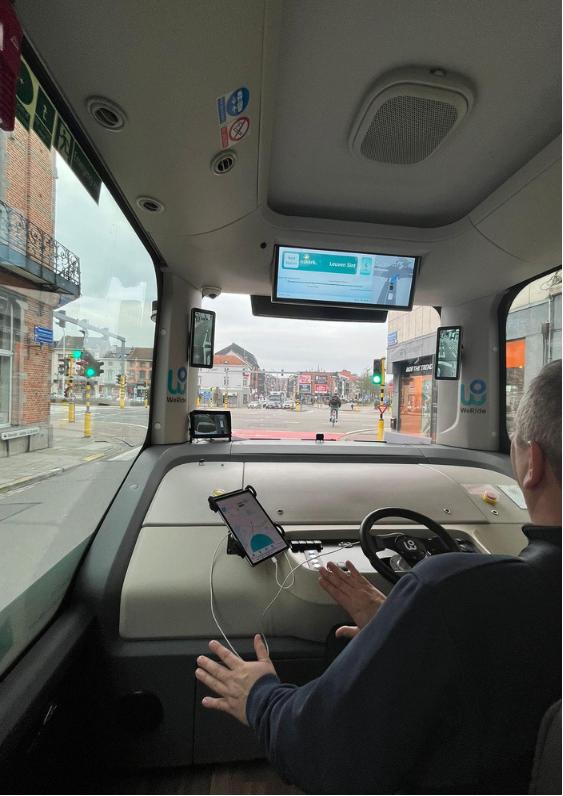
This approach is already being explored in practice. In Leuven, the deployment of autonomous public shuttles has begun along a pilot route of approximately 4 kilometres between Leuven Station, Heverlee, and the Haasrode research area. Rather than operating as a standalone service, the shuttles are integrated into the existing public transport network, showing how automation can reinforce (and not replace) first- and last-mile connectivity. Moreover, it illustrates how automated services can be deployed to address a specific mobility need, rather than introducing automation for its own sake.
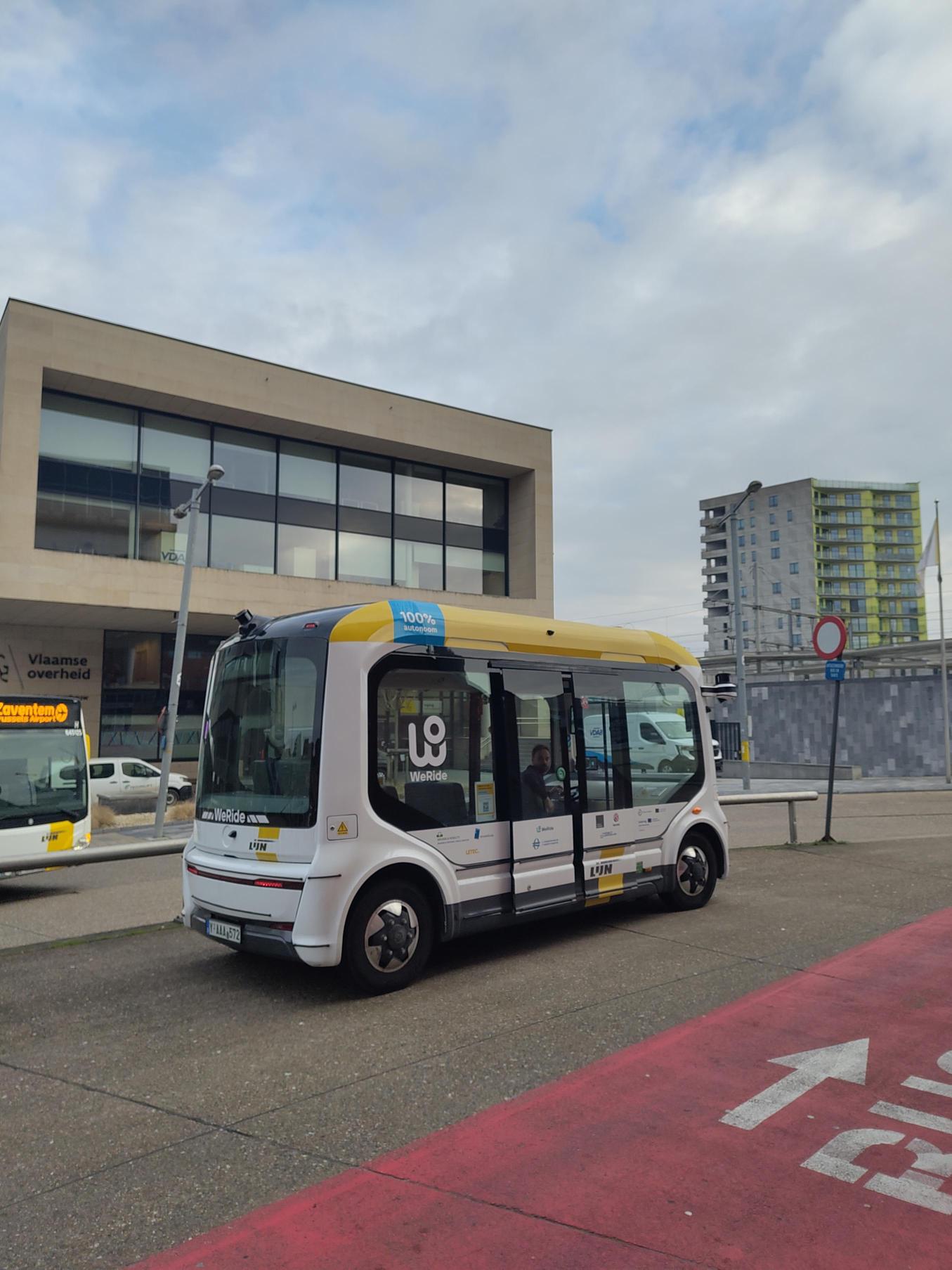
The Leuven autonomous shuttle bus — Credit: Alessia Giorgiutti
Europe can shape a different path
As automated mobility expands, cities will need the appropriate tools to manage its impacts. The ability to apply operational rules, access restrictions, and traffic management measures will be crucial to prevent increased traffic congestion, unnecessary vehicle trips, and additional pressure on public space. Access to reliable operational, traffic, and safety data will be equally important, enabling cities to evaluate the real impact of automated mobility services and make informed policy decisions about their management. At the same time, transparency, cybersecurity, privacy protection, and public engagement will remain critical for building reliable and trustworthy CCAM systems.
This approach is already visible in Oslo, where public transport authority Ruter has explored automated mobility primarily as an on-demand complement to existing public transport services. Rather than replacing high-capacity transit, automated services have been considered for first and last-mile connections and areas with limited transport options, demonstrating how automation can be used selectively where it adds values, rather than being applied across an entire network.
A new model for automated mobility
The question is no longer whether automation will reach cities, but under which conditions and according to whose priorities it will be integrated and governed. Europe now has an opportunity to pursue a model that prioritises public transport, shared mobility, and sustainability over car-centric deployment strategies. Ultimately, the future of automated mobility will not be defined by technology alone, but by the ability of public authorities to steer its deployment in the public interest.
Click here to read the article in its original format.
About the author:
Revekka Voultsinou, Smart Mobility and Traffic Systems Intern, POLIS. Voultsinou is currently completing her Integrated Master’s degree in Civil Engineering at Aristotle University of Thessaloniki, specialising in Transport and Project Management. Her work explores the intersection of sustainable urban mobility, public transport, and policy frameworks, shaping the deployment of emerging mobility technologies.