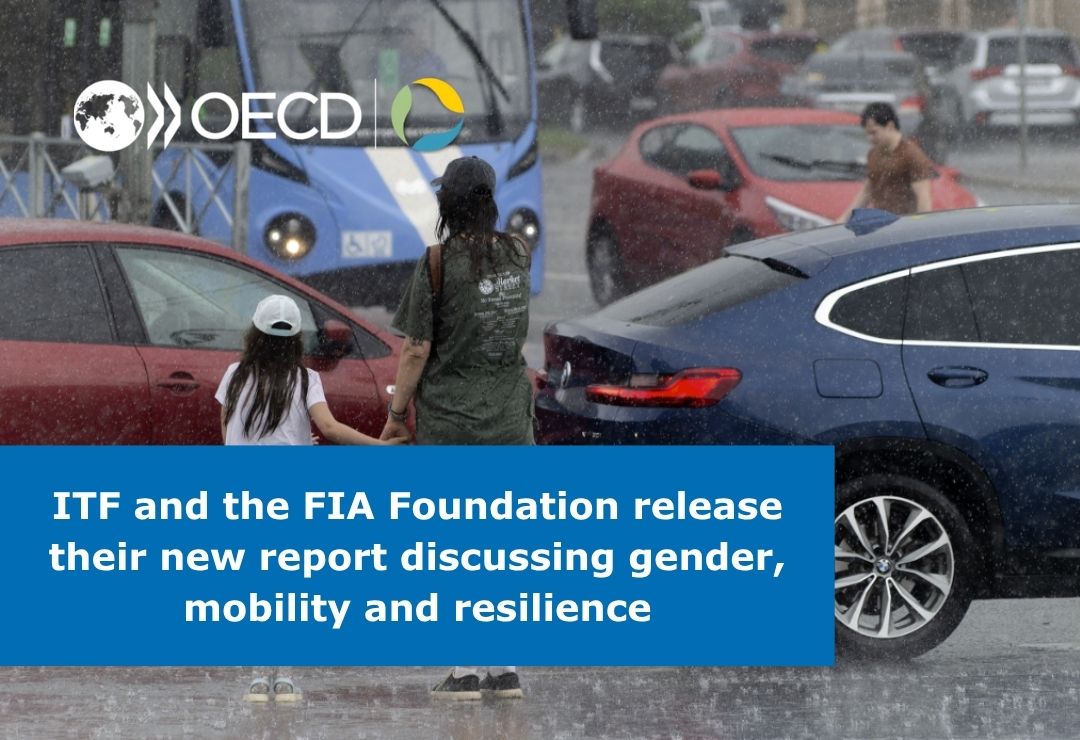
The International Transport Forum and the FIA Foundation launch their new report: Keep Life Moving A People-centred Approach to Transport Resilience
The ITF and FIA Foundation report 'Keep Life Moving: A People-centred Approach to Transport Resilience' explores why recovering transport systems is not enough. Speakers from the OECD, UNDP, Japan, and Bogotá discuss how resilience must also address gender inequalities, care-related mobility needs and access to essential services during and after disruptions.
A transport network can return to normal operations after a crisis, but that does not necessarily mean that everyone can return to their daily lives. This is the challenge at the heart of 'Keep Life Moving: A People-centred Approach to Transport Resilience', a report that argues resilience should be measured not only by how quickly infrastructure and services recover, but by whether people regain access to the opportunities, services and support they depend on.
From floods and extreme weather to infrastructure failures and social unrest, disruptions rarely affect all users equally. Existing inequalities shape both vulnerability and recovery, often leaving women, caregivers, older people and people with disabilities facing barriers long after services are restored. A gender lens on transport resilience shows where systems are weakest—and what policymakers can do differently.
The same themes framed the OECD webinar 'From Disruption to Recovery: Making Transport Work for Everyone', which launched the report. Restoring services, speakers agreed, is only part of recovery—true resilience depends on whether people can still reach jobs, education, healthcare and care networks. Vulnerability is not inherent to any group but emerges from social roles, care responsibilities, resource access and mobility constraints.
Recovery of the system is not recovery for its users
Josephine Macharia from the International Transport Forum and lead author of the report argues that traditional approaches to resilience are too narrowly focused on restoring system performance.
Disruptions can be internal or external to the transport system, intentional or unintentional, sudden or chronic. A flood, for example, is an external and unintended event. Yet, as climate change increases both the frequency and severity of extreme weather, such events are recurring rather than isolated shocks.
Beyond the average user
The report identifies three ways in which disruptions amplify existing inequalities.
- Immediately after a disruption, women's mobility and access are often restricted more severely. Public transport and active mobility may be suspended, and emergency preparedness measures frequently overlook the needs of pregnant women, nursing mothers and carers of young children or older adults.
- During recovery, women often resume regular travel more slowly, because of caregiving responsibilities, safety concerns and reduced trust in the system.
- Over the longer term, disruptions can entrench existing inequalities, particularly within the workforce.
To address this, the report calls for three shifts in policy thinking.
First, from planning for the 'average user' to recognising differentiated needs through disaggregated data and a combination of quantitative and qualitative research. The authors argue that system-wide transport indicators can hide how disruptions affect different groups of people: travel surveys reveal what people do, but not what alternatives were available, which journeys became impossible, or whose needs went unmet. The report therefore recommends complementing operational data with time-use surveys, qualitative research and participatory methods.
Second, from restoring infrastructure to supporting the everyday functions that mobility enables—which requires stronger links between transport, social services and emergency management.
Third, from individual adaptation to governance and collective capacity. Examples from Australia and New Zealand highlighted emergency management structures that address both the technical and social aspects of resilience through ongoing cooperation with communities.

A community-based approach to resilience
Ronald Jackson from the UNDP's Crisis Bureau placed the report within a broader context of overlapping risks, including climate change, conflict, economic instability, and public health challenges.
Drawing on the UNDP's risk-informed development approach, he argued for a shift away from event-centric planning towards a better understanding of vulnerability, inequality, and social resilience. A recurring theme was that women should be recognised not simply as vulnerable populations, but as critical actors in resilience-building and decision-making.
Examples from several countries illustrated this in practice. In the Maldives, disaster risk management has evolved from a 'siloed community-based national framework to a more comprehensive, community-driven approach' that integrates gender and disability inclusion. In Ethiopia, UNDP supports local governments and civil society organisations to strengthen resilience capacities; in Zimbabwe, women have received scooters to improve market access and transport agricultural produce before crises hit, building economic resilience. In Burundi, efforts to rebuild after the 2023–2024 floods have focused on reimagining the port of Bujumbura as part of a wider system rather than simply repairing damaged infrastructure.
What travel data reveals about care
Haruki Sawamura of Japan's Policy Research Institute for Land, Infrastructure, Transport and Tourism presented findings from ongoing research into the mobility needs of women, families and young people.
Using national and metropolitan travel surveys as well as supplementary research, the program found that women in their twenties and thirties usually make fewer trips than men but undertake more complex chains of journeys. In addition, 'women's daily travel was about 1.5 times more likely to include escorting', reflecting the continuing importance of care-related travel.
Several methodological challenges arose throughout this case study. For example, journey data can show what people do, but not necessarily why certain trips are difficult. Detailed analysis across sections is difficult because sample sizes quickly become too small. And most importantly, observed travel patterns cannot reveal unmet needs. As Sawamura noted, 'availability and usability are not the same thing'. A transport service may exist on paper, but still fail to support the full range of journeys people need to make.
Designing cities around care
Bogotá's experience demonstrates how care can become an organising principle for urban policy rather than a niche social concern.
According to Diana Sandoval, advisor on accessibility and mobility at the District Mobility Secretariat of Bogotá, the city is home to approximately 1.6 million caregivers. Nearly 90% are women, and many spend close to seven hours each day on unpaid care and domestic work.
The city's response has been to develop a district-wide care system centred around a network of care blocks. First introduced in 2020 and formalised in 2023, the model aims to recognise, reduce and redistribute unpaid care work. Today, 27 care blocks provide integrated access to services such as childcare, laundry facilities, education and training. Caregivers and those they care for can access services simultaneously, while mobile care buses extend coverage to rural and peripheral communities.
One reason the model expanded rapidly was that it relied largely on existing public facilities rather than new infrastructure. Different institutions coordinated services within buildings that already existed, allowing the programme to scale quickly even during the pandemic.
Mobility considerations were embedded from the beginning. Since most care-related trips in peripheral areas are made on foot and are disproportionately undertaken by women, proximity alone was not enough. Communities were therefore asked what would make everyday care journeys safe, and their responses informed measures including lower speed limits, raised pedestrian crossings, improved signage and tactical urbanism interventions. The initiative illustrates how resilience can be strengthened not only through infrastructure investments but also through redesigning services around daily human needs.
Key challenges for policymakers
The discussion highlighted several priorities for building more inclusive and resilient transport systems. These include recognising women's contributions to community resilience, better understanding diverse care-related mobility needs, and strengthening political leadership and cross-sector coordination. Participants also stressed the importance of building long-term relationships with communities, rather than engaging them only during crises, and using localised data to identify inequalities that broad averages often conceal.
Despite different views on where authorities should start, speakers agreed that resilience must be built before disruption occurs. This requires understanding people's everyday mobility needs, collecting better data on often-overlooked care-related journeys and ensuring that transport planning reflects the experiences of different groups. Ultimately, resilience is about more than restoring infrastructure after a crisis; it is about ensuring that everyone can maintain access to mobility and recover from disruption. As the report emphasises, vulnerability is not inherent to particular groups but results from the interaction of social roles, care responsibilities, access to resources and mobility constraints.