Île-de-France launches centralised carpooling service to scale shared mobility
Since late 2025, the Île-de-France region has taken a major step in expanding shared mobility, launching a centralised, subsidised carpooling service designed to complement public transport, particularly in outer suburban areas where mass transit coverage is thinner.
Operated by Île-de-France Mobilités in partnership with carpooling operator Karos, the new ecosystem brings together previously fragmented services into a single mobile app. The objective is clear: to make everyday carpooling, especially home-to-work travel, as seamless and attractive as conventional public transport.
How the service works
At the heart of the initiative is Covoit IDFM, a dedicated mobile application that centralises trip offers and matches passengers with drivers for both planned and last-minute journeys.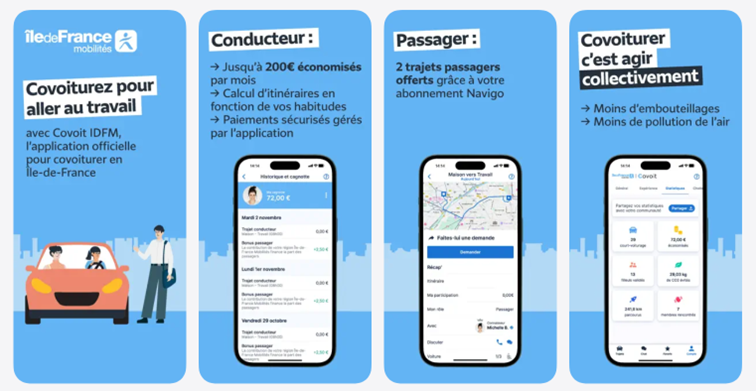
Users enter their origin, destination and departure time, after which the platform proposes itineraries and available drivers. Then, they can book journeys in advance or request them at short notice through so-called 'flash' trips. The app also allows users to track travel history, financial savings and CO2 reductions, while integrating ratings and in-app communication. By consolidating multiple legacy services into one interface, the region aims to widen the driver pool and simplify access to subsidised rides.
The platform replaces several regional carpooling applications that had operated in parallel since 2021, marking a shift towards a unified system fully integrated into the wider public transport ecosystem.
Workplace commuting lies at the core of the strategy. More than 400 employers and university campuses are already partnering with Île-de-France Mobilités to promote the service among staff and students.
This institutional engagement is particularly valuable for employment sites located far from high-capacity transport corridors. Beyond improving accessibility, the scheme also helps reduce commuting costs and supports organisational carbon-reduction commitments. Hospitals and night-shift employers represent especially strong use cases, given the limited supply of traditional public transport.
To reflect the diversity of suburban geographies, the region is deploying two service formats:
- The first is app-based planned carpooling, available across the region and primarily dedicated to commuting and study trips.
- The second takes a more structured approach: fixed carpooling lines operating in a manner similar to bus services, with designated roadside stops where passengers can wait without prior booking and signal drivers via the app or SMS.
One such corridor already links Cernay-la-Ville, Saint-Quentin-en-Yvelines, Les Ulis and Pont de Sèvres, with further lines scheduled for rollout through 2026.
Financial incentives to drive adoption
As with earlier schemes, financial incentives remain central to the model’s appeal.
Navigo pass holders benefit from two free trips per day, reinforcing the service’s positioning as a public transport complement. Drivers receive subsidies starting at €2 per passenger for trips under 20 km, rising by €0.10 per kilometre up to 30 km, with a per-trip cap of €3 and a monthly ceiling of €200.
 Non-subscribed passengers pay only a modest contribution, designed primarily to discourage cancellations rather than recover costs. Subsidies are intentionally restricted: they do not apply to trips wholly within Paris, journeys starting or ending outside the region, or corridors already well served by heavy public transport. The pricing structure therefore targets structural gaps rather than competing with rail or metro networks.
Early results show rapid uptake
Although launched discreetly on 1 December, the service has already recorded strong early adoption. It counts around 50,000 registered users and 380,000 completed passenger journeys, representing some 7 million kilometres travelled and nearly 890 tonnes of CO2 emissions avoided.
These figures build on an existing upward trend: in 2025 alone, close to 3.5 million carpooling trips were subsidised across the region’s previous platforms—an increase of 25% year on year—indicating that behavioural change was already gaining momentum.
Why carpooling—and why now? The Île-de-France case and the EU policy backdrop
The programme reflects a broader recognition that mass transit alone cannot address all suburban mobility needs. Outer Île-de-France is characterised by dispersed housing, business parks and lower rail density, creating structural first- and last-mile gaps that conventional fixed-route services struggle to serve efficiently.
 Subsidised carpooling offers a flexible, lower-cost alternative. By leveraging existing private vehicle capacity, public authorities can expand mobility coverage without major infrastructure investment, while also reducing per-passenger emissions.
Île-de-France’s approach aligns with a growing European policy trend: integrating shared, app-enabled mobility into public transport frameworks rather than leaving it solely to commercial ride-hailing markets. In fact, legislative and strategic initiatives reinforce this direction through plans such as the Multimodal Digital Mobility Services (MDMS) Regulation. Aiming to enable integrated journey planning, booking and payment across transport modes, the approach includes shared mobility through data sharing and platform interoperability. In parallel, the Intelligent Transport Systems (ITS) Directive expands requirements around mobility data availability, facilitating the integration of carpooling and other shared services into public journey planners and Mobility-as-a-Service (MaaS) ecosystems.
By centralising governance within a public mobility authority, the region retains oversight of pricing, data, service quality and network complementarity. This ensures that shared mobility supports congestion reduction and decarbonisation goals rather than undermining collective transport systems.
Scaling the model
With strong early demand and institutional backing, the region’s ambition is now to scale the service geographically and operationally, expanding fixed corridors, deepening integration with Navigo ticketing and growing the suburban driver base.
If sustained, the initiative could offer a replicable blueprint for metropolitan regions seeking cost-effective ways to bridge suburban mobility gaps.
In an era defined by decarbonisation, digital platforms and constrained public finances, Île-de-France’s centralised carpooling system demonstrates how shared mobility can evolve from a niche practice into a structured extension of the public transport network.

- Related Members