Catalonia doubles down on interurban bus services with two shock plans to meet record demand
With interurban bus ridership reaching an all-time high of 90 million journeys in 2025, POLIS member Catalonia is accelerating investment to strengthen services across the territory.
The first Interurban Bus Shock Plan (2025–2026) is already delivering tangible improvements, and a second emergency plan for 2026 has now been approved. Together, they represent almost €40 million in targeted funding aimed at strengthening services across the territory, improving reliability, and ensuring that public transport remains a realistic alternative to private car use.
First Shock Plan: 73 actions and €17 million already making a difference
The first Shock Plan was introduced as a rapid response to increasingly visible pressure on the bus network: overcrowding at peak times, service delays, and routes where demand had simply outgrown existing capacity. Rather than waiting for long-term infrastructure solutions, Catalonia opted for fast, operational measures that could be implemented quickly and with immediate impact.
In total, the plan includes 73 actions, supported by €17 million, including €9 million from the Climate Fund, which reinvests revenues from environmental taxation into projects that reduce emissions and support sustainable mobility. Implementation has progressed rapidly, with most measures already in place: 68 out of 73 actions have been delivered, including full completion in Tarragona and Lleida. The measures range from increasing service frequency and expanding fleets to timetable adjustments, improved passenger information, and stronger coordination with operators, as practical steps designed to make daily travel smoother and more reliable.

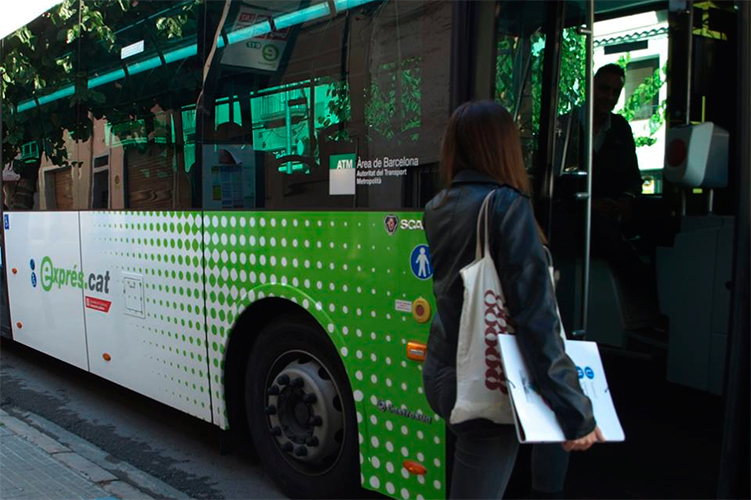
Users line up for on-demand bus service in Catalonia. Credit: Generalitat de Catalunya
Second Shock Plan: €21.5 million for over 50 corridors in 2026
With demand continuing to rise into early 2026, Catalonia is now moving forward with a second interurban bus emergency plan, allocating €21.5 million to deliver improvements across more than 50 corridors. This second plan targets the routes where capacity is already stretched to the limit, where passengers are unable to board or are forced to travel standing. It also prioritises connections to education and healthcare facilities, as well as better mobility coverage in rural and low-density areas, reinforcing the idea that access to transport is a basic public service.
A key driver behind the second plan is the ongoing disruption affecting the Rodalies commuter rail network, where frequent incidents and declining service reliability have pushed many passengers to seek alternatives. While buses cannot replace rail’s high-capacity role, they have proven essential as a flexible and scalable solution during infrastructure works and periods of reduced rail performance. At the same time, broader social and economic trends are reshaping mobility demand. Housing pressures have pushed more residents further from major urban centres, commuting patterns are expanding, and trips to decentralised education and healthcare facilities are increasing. Fare integration and discounted ticket schemes have also encouraged more people to shift towards public transport. Together, these trends are making the interurban bus network more important than ever.
With record ridership, changing commuting patterns, and rail disruption accelerating modal shifts, Catalonia’s interurban bus network has become essential to the region’s transport resilience. The first shock plan has already proven that rapid interventions can deliver real improvements and measurable climate gains. The second plan now aims to scale up that success. ensuring that mobility rights are protected across the entire territory, from metropolitan corridors to rural communities alike.