Talk MED to Me
Discover how the Green Living Areas Mission is reshaping sustainability in the Mediterranean through its Institutional Policy Dialogues. These forums bring together Euro-Mediterranean stakeholders to replicate and adapt successful policies, such as Bologna's Sustainable Urban Logistics Plan and Barcelona's superblocks, thus improving quality of life across the region.
The Green Living Areas (GLA) Mission aims to improve the lives of Mediterranean citizens by promoting the development of green living areas. As part of the Interreg Euro-MED Programme, it undertakes projects that bring local communities to life with green development at their core, reducing negative climate impacts on the region’s ecosystems and enhancing climate resilience.
The Institutional Policy Dialogues brought to life by the GLA Mission are forums gathering Euro-Mediterranean stakeholders to address pressing sustainability challenges. The goal is to discuss and transfer successful policies by fostering dialogue among key policy-makers and public stakeholders to improve the quality of life in the Mediterranean in fields such as mobility, spatial planning, energy, and environment.
Creating a policy transferability platform

Institutional Policy Dialogue in Brussels, POLIS
The primary target audience of the Institutional Policy Dialogue is the policy-oriented partners of projects funded under the Interreg Euro-MED programme (the Thematic Community Projects). Nonetheless, the GLA Mission is also mobilising key Euro-Mediterranean stakeholders to form a Core Group of what will become the EUCLID Policy Hub, which will bring in their expertise to inform policy discussions but also to benefit from the results of the Thematic Community Projects.
The EUCLID Policy Hub is the end goal of the initiative—a working community set up to implement exchanges on policy instruments related to Green Living Areas, including the target audiences mentioned above, that will become self-sustained beyond the lifetime of the GLA Mission.
The first edition of the Institutional Policy Dialogue took place in Brussels in October 2024, kick-starting a process extending until 2029 and potentially beyond, allowing participants to experiment with the concrete and effective use of policies in the different Green Living Areas topics.
Before the event, the GLA Mission carried out an in-depth process of policy mapping to identify so-called policy champions—policy-makers in charge of a successful policy instrument with a high replicability and adaptability potential. These were selected and prioritised according to a set of ranking criteria, including the policy’s adaptive capacity, temporality, spatial scope, innovation level, financial operationality, and more.
Among the policy champions and instruments selected for discussion were two POLIS members: Bologna and their Sustainable Urban Logistics Plan (SULP), and Barcelona and their Superblocks policy.
Bologna’s vision
The SULP of the Metropolitan City of Bologna is a forward-looking policy instrument that complements the city’s Sustainable Urban Mobility Plan (SUMP), exemplifying how cities can integrate logistics into broader mobility and climate agendas. Designed to reduce freight-related emissions and improve last-mile delivery efficiency, Bologna’s SULP is indeed part of a wider strategy for which the city received this year’s European Mobility Week Award, which recognised its exceptional efforts in making sustainable mobility more accessible to the public.
Despite its success and high potential for replicability, the implementation of the SULP on the ground has not been without its challenges. As a key urban node within the Trans-European Transport Network (TEN-T), and uniquely positioned on three of its corridors (Scan-Med, Mediterranean, Adriatic-Baltic), Bologna faces the dual challenge of addressing its own local needs while contributing to transnational transport efficiency and connectivity.
To address this complexity, Bologna's SULP focuses on measures such as stricter time windows for polluting freight vehicles, the use of low-emission delivery zones, and transhipment areas where diesel vans transfer goods to electric cargo bikes or smaller clean vehicles. These interventions aim not only to cut congestion and emissions but also to preserve the city’s historic centre and improve air quality.
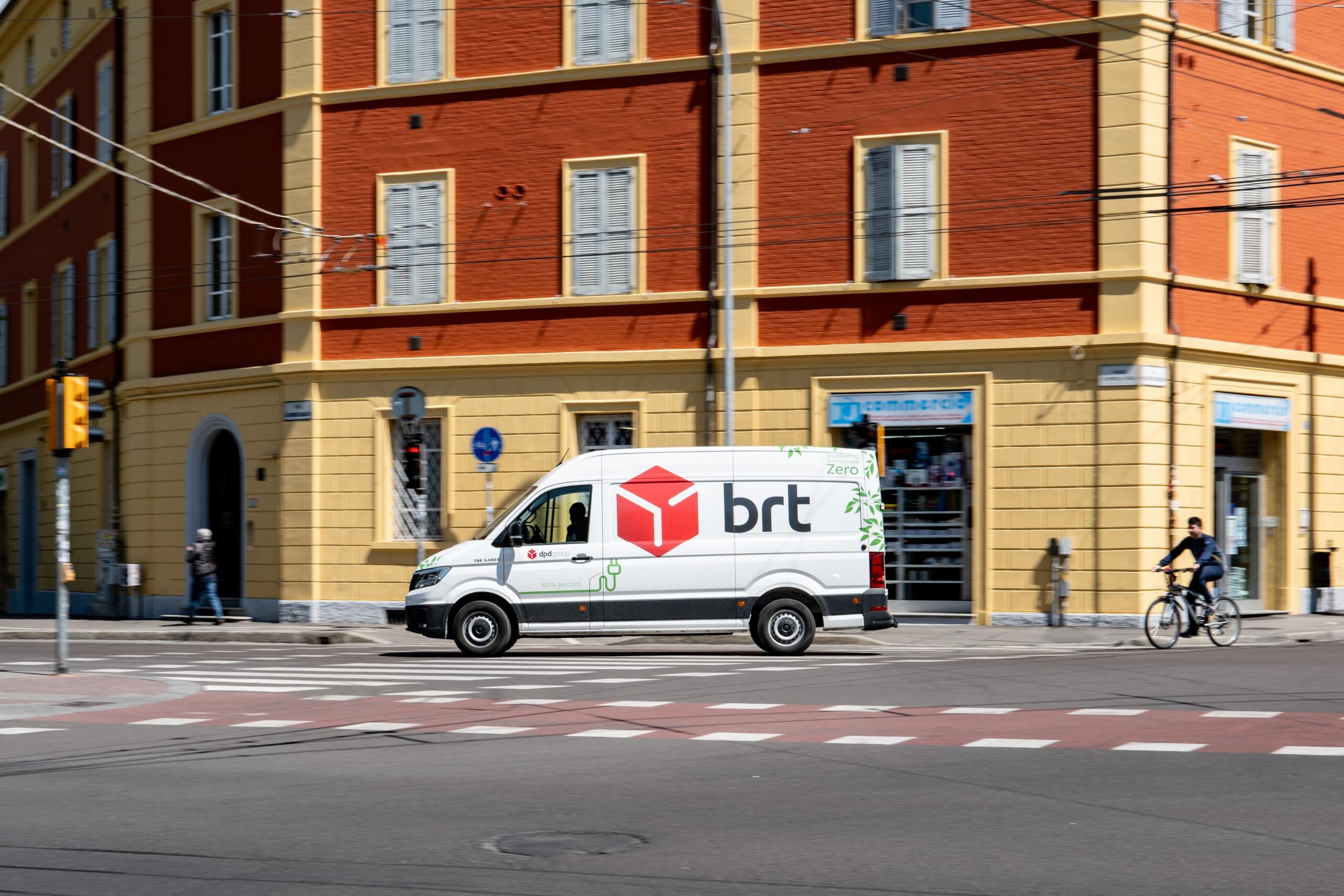
Delivery in Bologna, Mino Surkala
Yet, the implementation process has revealed structural hurdles—chief among them a lack of data and the difficulty of fostering sustained collaboration between public and private stakeholders. Cross-sectoral coordination, particularly involving logistics operators, urban planners, and regional authorities, has proved vital for aligning goals and ensuring practical feasibility.
Bologna's approach also reflects broader Mediterranean urban logistics trends, where compact historic cores and fragmented suburban areas complicate freight operations. The city’s evolving model illustrates the value of co-created solutions, consolidation hubs at the urban periphery, and adaptive infrastructure that responds to seasonal and climate-related pressures.
For cities looking to replicate Bologna’s success, key considerations include city typology (size, infrastructure, and existing logistics networks), institutional capacity of local authorities (human and technical resources), and cultural governance models (local practices, governance structures, and priorities influencing logistics models).
Barcelona’s superblock
Barcelona’s superblock policy is now a widely heralded urban design planning instrument in Europe and beyond. By reorganising city blocks to prioritise pedestrians and cyclists, the policy instrument has reclaimed over 23 hectares of public space from vehicular use. The measurable impact is significant: air quality has improved notably in Sant Antoni, where NO₂ levels decreased by 33%, and in Poblenou, local business activity surged by 30% following implementation. These results earned Barcelona international recognition for environmental and urban liveability advances.
However, replicating such a disruptive policy beyond compact urban centres like Barcelona is not an easy feat—it requires nuanced adaptation and interdisciplinary collaboration, especially among urban planning, mobility, and environmental sectors. Indeed, the policy’s success is closely tied to Barcelona’s dense urban form and integrated transit networks. In different territorial contexts, especially those with sprawling urban fabrics or weaker mobility systems, superblocks would need to be integrated within peri-urban and rural zones—otherwise, the policy would merely function as a standalone urban intervention rather than contributing to territorial cohesion.
Moreover, without strategic integration with wider transport, housing, and land use plans, superblocks may inadvertently shift congestion elsewhere or accelerate and gentrification by increasing property values and pricing out vulnerable residents. Addressing these risks demands equity-focused planning—ensuring that the redistribution of public space benefits all, particularly underserved neighbourhoods, and that green corridors and essential services are equitably distributed across urban and peri-urban zones.
What makes superblocks particularly distinctive is their ecosystemic nature—synchronising mobility, biodiversity, energy, and public space to build more liveable communities. But this complexity requires a context-sensitive approach, strong governance, robust data, and phased implementation. When adapted with care, Superblocks offer a flexible and powerful framework for transforming urban life.
So... Where do we go from here?
The 2nd Institutional Policy Dialogue, scheduled for 15-16 October in Brussels, will mark another milestone in the Mediterranean’s path toward more resilient, inclusive, and sustainable urban policies. As the EUCLID Policy Hub continues to grow, its evolving Core Group will map new flagship policy instruments with high adaptability and relevance.
But beyond the event itself, what lies ahead is the cultivation of a lasting community—one where tested innovations like Bologna’s SULP and Barcelona’s superblocks are not only discussed, but iterated upon, transferred, and scaled. The ambition is clear: to build a self-sustained platform where cities learn from each other, adapt policies to local contexts, and collectively shape greener, more liveable futures. In doing so, the Green Living Areas Mission continues to lay the groundwork for long-term policy transformation, empowering Mediterranean cities to lead the way in climate resilience and social equity.
Click here to read the article in its original format.
About the author:
Cláudia Ribeiro, Projects & Proposals Lead & SMC Platform Coordinator, POLIS. With a master's degree in Political Science from Universitat Pompeu Fabra and the University of Konstanz, Ribeiro has managed mobility EU-funded projects on urban logistics, e-mobility, and sustainable mobility. She is responsible for developing research and innovation (R&I) proposals at POLIS and coordinates the Small and Medium-Sized Cities Platform (SMCs).
 Stanislavskyi