
Play Policy
What if cities could gather meaningful input on mobility and climate decisions from millions of citizens through the games they already play? The GREAT Project explores how videogames can turn everyday digital activity into a powerful, inclusive tool for shaping sustainable urban transport policy.
When it comes to sustainable mobility, reducing car dependency, improving public transport, and reclaiming public space are just some of the top priorities facing cities and regions across Europe and beyond. Yet, even when technical solutions are well understood, implementation remains difficult. Mobility plans frequently stall because public engagement is slow, participation is limited to a small and familiar group of voices, and decision-makers struggle to understand what citizens truly prioritise.
Despite the rise in co-creation and participatory planning, a persistent issue remains: those most affected by urban planning decisions are often the least represented in formal consultation processes. Young people, low-income residents, and those with limited time or confidence to engage with formal institutions remain underrepresented, even though they are often the most dependent on affordable public transport and safe active travel options.
But what if cities and regions could consult citizens of all ages and backgrounds about cleaner transport choices at the scale and speed required by the climate transition? And what if the challenge is not a lack of interest in urban planning and sustainable mobility, but rather a lack of accessible channels for people to make their voices heard?
The GREAT Project (Gamification for Real-world Environment and climate Action Training) set out to explore a different route to participation. Its starting point was a democratic challenge: large parts of society are not involved in planning processes at all, either because they do not vote, cannot vote, do not feel represented, or simply do not engage with formal consultation channels. At the same time, gaming is one of the most widespread forms of everyday digital participation in the world, with billions of people playing regularly.
GREAT’s core idea was to connect these two realities by using videogames as a civic channel—one capable of reaching citizens at scale, gathering structured input on climate priorities, and generating evidence that can support policy decisions.
A scalable channel for climate engagement
Mobility is where climate policy becomes tangible. Decisions about bus lanes, cycling infrastructure, pedestrianisation, parking reform, or low-emission zones involve direct trade-offs between space, convenience, cost, and fairness. For city leaders, the challenge is not only selecting interventions but also building legitimacy early enough to implement them successfully.
GREAT tested whether games could support this process by embedding civic questions into platforms people already use. Working with PlanetPlay, a not-for-profit gaming platform where users’ playing experience supports climate action, the project integrated short survey experiences into popular mobile games. Instead of requiring citizens to attend meetings or complete consultation forms, participation was embedded into everyday digital activity.
The results were striking. GREAT’s in-game survey campaign, titled Play2Act, reached around 130 million people, with over one million actively engaging and roughly 200,000 completing full responses. The project generated data from almost every country in the world, and crucially reached many citizens under the age of 18— an audience almost entirely absent from most traditional consultation processes. This scale is not only impressive but policy-relevant. Cities are making urgent decisions on transport infrastructure while working toward European climate targets, yet often with limited insight into how different groups experience mobility systems or which measures they are likely to accept.
Game-based engagement offers a way to close this gap by generating large datasets quickly and cost-effectively. Through Play2Act, GREAT documented how game-based survey campaigns can capture public opinion across global audiences at a scale that traditional consultations rarely achieve, while also enabling analysis by age, geography, education level, and gender. For cities and regions, this demonstrates that citizen engagement can be both faster and broader than the small samples typically used to inform mobility policy.
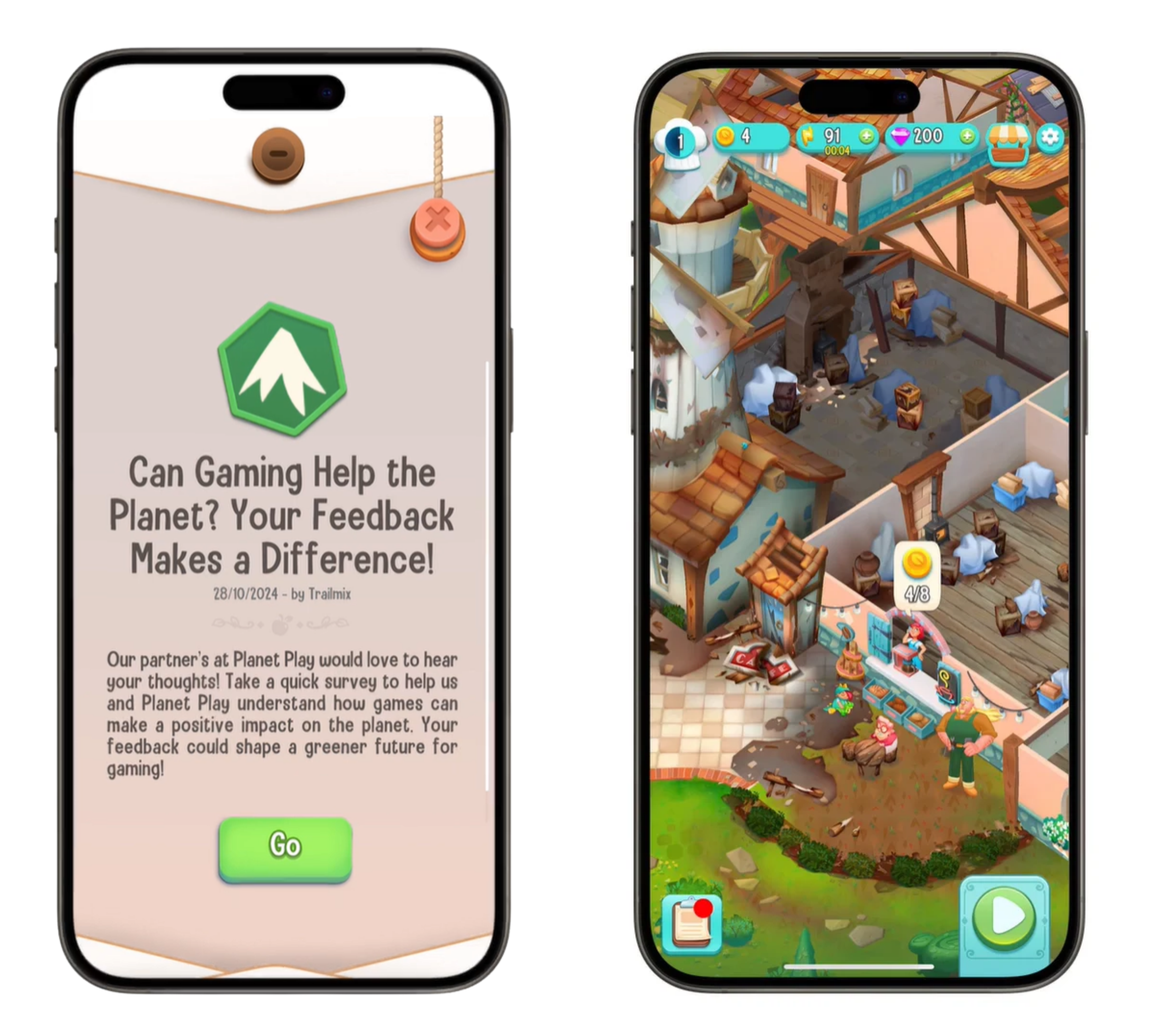
In-game notification redirects users to Play2Act survey — Credit: Planet Play
How games can help with urban trade-offs
Mobility planning is defined by compromise. Expanding cycling infrastructure may require reallocating road space, improving bus reliability may require dedicated lanes, and reducing traffic in city centres may affect access for businesses and commuters. Even when policies are technically sound, backlash often emerges when people feel change is imposed without dialogue.
GREAT’s approach argues that games are uniquely suited to addressing this challenge. Rather than asking citizens to react to a finished proposal, game-based participation can place them inside simplified decision scenarios and capture how they weigh competing outcomes such as safety, affordability, emissions, accessibility, or comfort. In this way, games make policy trade-offs more visible and understandable.
For cities developing sustainable urban mobility plans, this offers a key advantage: games can help test policy acceptance early, identify where opposition is likely to emerge, and reveal what conditions citizens expect before supporting change.
From global surveys to local urban insight
While the global campaigns demonstrated scale, GREAT also tested how game-based engagement performs in specific local contexts. Rooftops Reimagined, a case study in Cyprus, used game-based methods to explore barriers to adopting greener rooftops and climate-resilient building strategies. Although not directly focused on mobility, the findings are highly relevant: participants did not reject the concept of green infrastructure outright. Instead, they raised practical concerns around maintenance responsibilities, costs, and governance. Many emphasised the need for clearer long-term planning and accountability. This insight translates to transport policy: citizens may support cycling infrastructure, but lose confidence if maintenance is poor, or they may support public transport investment but remain sceptical if service quality does not improve.
The key lesson is that public support is often conditional. Game-based engagement helps uncover these conditions early, shifting consultation from simple approval measurement to more actionable governance insight. These findings were translated into policy briefs and reports designed for decision-makers.
Can cities trust the data?
For many public authorities, the central question is legitimacy: engagement only matters if decision-makers trust the results enough to use them. GREAT addressed this through a structured methodology. The project’s analysis of the Play2Act campaigns included mechanisms to identify unreliable responses and filter out random or low-quality inputs. Large sample sizes also enabled more robust interpretation than traditional consultations, which often rely on small, unrepresentative datasets.
Secondly, the project prioritised transparency. Methods and results were made openly accessible through Zenodo, allowing external scrutiny and reuse. This also enhances transferability: cities can examine methods, adapt question formats, and replicate campaigns for local needs rather than relying on closed systems.
Reaching the people consultations miss
If there is one area where GREAT’s model stands out, it is inclusion. Traditional consultations often skew towards older residents, homeowners, and those already engaged in politics. GREAT sought harder to reach groups such as young people, people with disabilities, and those who may not normally participate in planning processes.
What they saw is that embedding engagement into games expands the pool of participants dramatically. It also reaches citizens who would never attend a town hall meeting or respond to a municipal survey link. In later Play2Act survey iterations, GREAT also improved gender balance and successfully engaged more participants who identified as women.
However, the project does not claim to solve all participation gaps. Digital inequality remains a real limitation. Some citizens lack access to devices or cannot participate through gaming environments. GREAT’s conclusion is pragmatic: game-based participation can widen inclusion significantly, but cities must still combine it with other methods to avoid replacing one exclusion barrier with another.
What cities can do next
GREAT did not stop at research findings. It produced practical tools designed for replication, including a toolkit outlining how to design and run game-based engagement processes: how to frame questions, select platforms, interpret results, and communicate findings back to stakeholders.
For cities and regions, the entry point is straightforward. A municipality could pilot a six-month experiment focused on a concrete mobility challenge, using existing game-based formats and a structured reporting framework. The advantage? Speed, as policymakers rarely have time for long consultation cycles, and traditional engagement often produces limited datasets. Game-based approaches offer a way to collect large volumes of citizen input quickly, cost-efficiently, and with relatively low administrative burden.
A lesson for urban leaders
GREAT’s key takeaway is that participation can be redesigned. Videogames can function as a legitimate engagement channel, generating large-scale datasets, revealing implementation barriers, and reaching audiences missed by conventional methods. For cities advancing clean mobility policies, this does not replace formal planning or democratic processes, but it strengthens them by improving speed, reach, and insight.
As Europe’s mobility transition accelerates, the challenge is no longer whether citizens should be involved, but whether institutions are willing to engage them in the spaces they already inhabit. GREAT suggests that one answer may already be in millions of pockets, on the home screen, inside a game.
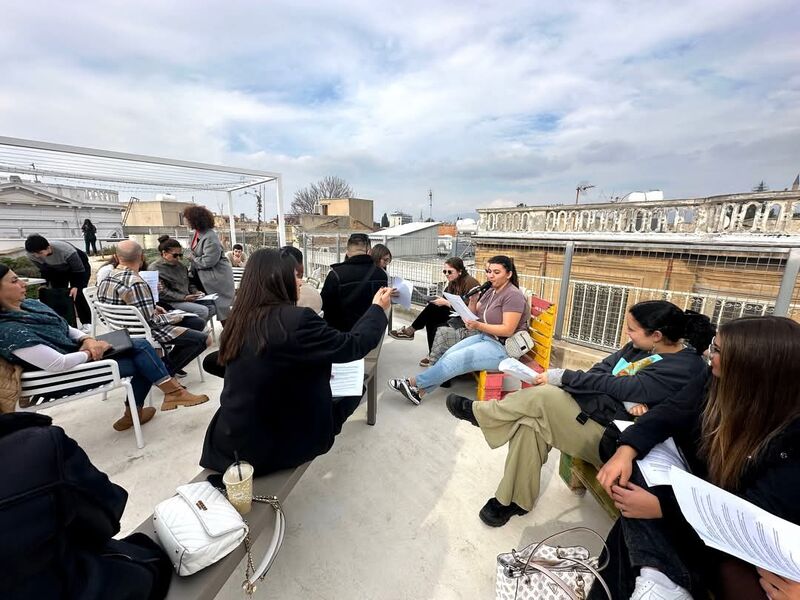
Rooftops Reimagined event in Nicosia, Cyprus — Credit: Frederick University Cyprus
Click here to read the article in its original format.
About the author
Carlotta Inserra, Membership & Communications Manager, POLIS. Inserra is the main point of contact for the network’s expanding membership, where she oversees and supports members’ engagement and promotes POLIS’ Working Group activities. She also contributes to the Interreg SMALL project, where she channels her commitment to inclusive and accessible sustainable mobility for all.
 Credit: m-art, Adobe Stock