Karlsruhe Mobility Lab Forward
The Karlsruhe Mobility Lab is a dynamic ecosystem where science, business, and public actors co-create future mobility. With cutting-edge solutions from autonomous transport to sustainable logistics, Karlsruhe TechnologyRegion has revealed itself as a leading hub for smart, connected, and climate-friendly urban mobility.
From autonomous shuttles and inclusive public transport to open data platforms and integrated logistics, the Karlsruhe Mobility Lab is powering a mobility revolution—one rooted not just in vision, but in real-world action. Situated in one of Europe’s densest mobility research networks, the Lab brings together scientists, businesses, government bodies, and citizens to pilot the ideas that will shape the cities and regions of tomorrow.
The Lab’s impact extends well beyond regional borders. Events like the Annual POLIS Conference 2024 provided a global stage for Karlsruhe’s mobility ecosystem to demonstrate what makes it unique: a seamless blend of research, practice, and collaboration that’s accelerating Europe’s transition to sustainable transport.
An ecosystem built on collaboration
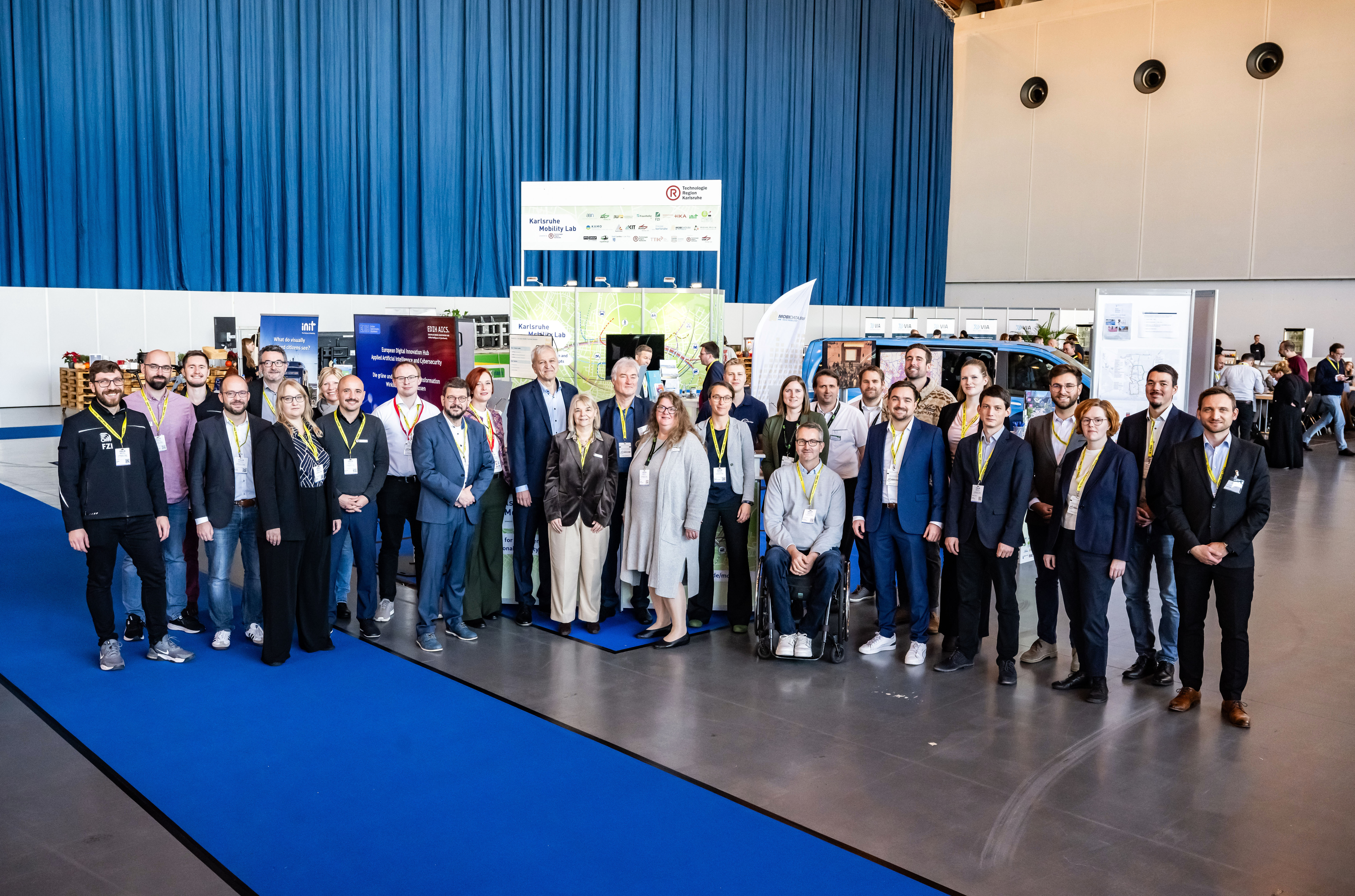
The KML/TRK collective stand at #POLIS24, ARTIS-Uli Deck/TRK GmbH
At the heart of the Karlsruhe Mobility Lab lies a commitment to cross-sectoral partnership. Managed by the Karlsruhe TechnologyRegion (TRK), the Lab unites research institutes like Karlsruhe Institute of Technology - KIT, Fraunhofer ISI, and Karlsruhe University of Applied Sciences - HKA with transport innovators such as Planung Transport Verkehr GmbH - PTV Group, INIT, and public agencies like the Baden-Württemberg Institute for Sustainable Mobility - NVBW.
‘A major focus of the Karlsruhe Mobility Lab is on the further development of local public transport and new mobility concepts,’ explains Jochen Ehlgötz, Managing Director of TechnologieRegion Karlsruhe GmbH. ‘Researchers from the region are making a significant contribution to the global mobility transition.’
What sets the Lab apart is that its concepts are already being tested in real-life contexts—with citizen engagement at the core. Whether it is data-sharing platforms or inclusive mobility apps, projects are evaluated for both technological feasibility and social impact.
Innovation in action
The Karlsruhe Mobility Lab does not just imagine future mobility—it builds it. Its wide portfolio of projects reflects a shared belief in innovation with purpose.
A prime example is the MobileCity app, developed by a consortium led by Fraunhofer ISI. This award-winning tool (it won the German Mobility Prize 2023 in the category ‘Digital Transformation & Data Driven Mobility’) brings high-level transport modelling to mobile devices, helping municipalities and companies easily develop scenarios and measure their impact.
In the field of autonomous mobility, the FZI Research Centre for Information Technology offers immersive simulations of self-driving shuttles using virtual environments that mirror real-world conditions. These simulations complement ongoing trials at the Test Area for Autonomous Driving Baden-Württemberg (TAF BW), turning theoretical possibilities into practical applications.
Inclusivity is another essential pillar. INIT’s ASSISTIVEtravel system offers people with physical disabilities real-time travel information through a smartphone app. It enables users to locate free wheelchair spaces, request assistance, and even stream updates to hearing aids—making public transport more accessible and responsive.
Karlsruhe is also rethinking logistics with regioKArgo, an initiative exploring how passenger and goods transport can coexist on existing tram lines. Led by the Alb Valley Transport Company (AVG), the regioKArgoTramTrain project exemplifies sustainable, scalable innovation in urban freight.
Digital foundations, research powerhouses
The region’s mobility expertise is underpinned by a robust digital infrastructure. At the centre is MobiData BW®, the federal state’s integration platform for mobility data. Operated by NVBW, it consolidates and shares transport data across Baden-Württemberg, powering apps, analytics, and smart planning tools. For municipalities and planners, it acts as a central competence hub, supporting everything from data collection to the deployment of AI-driven services.

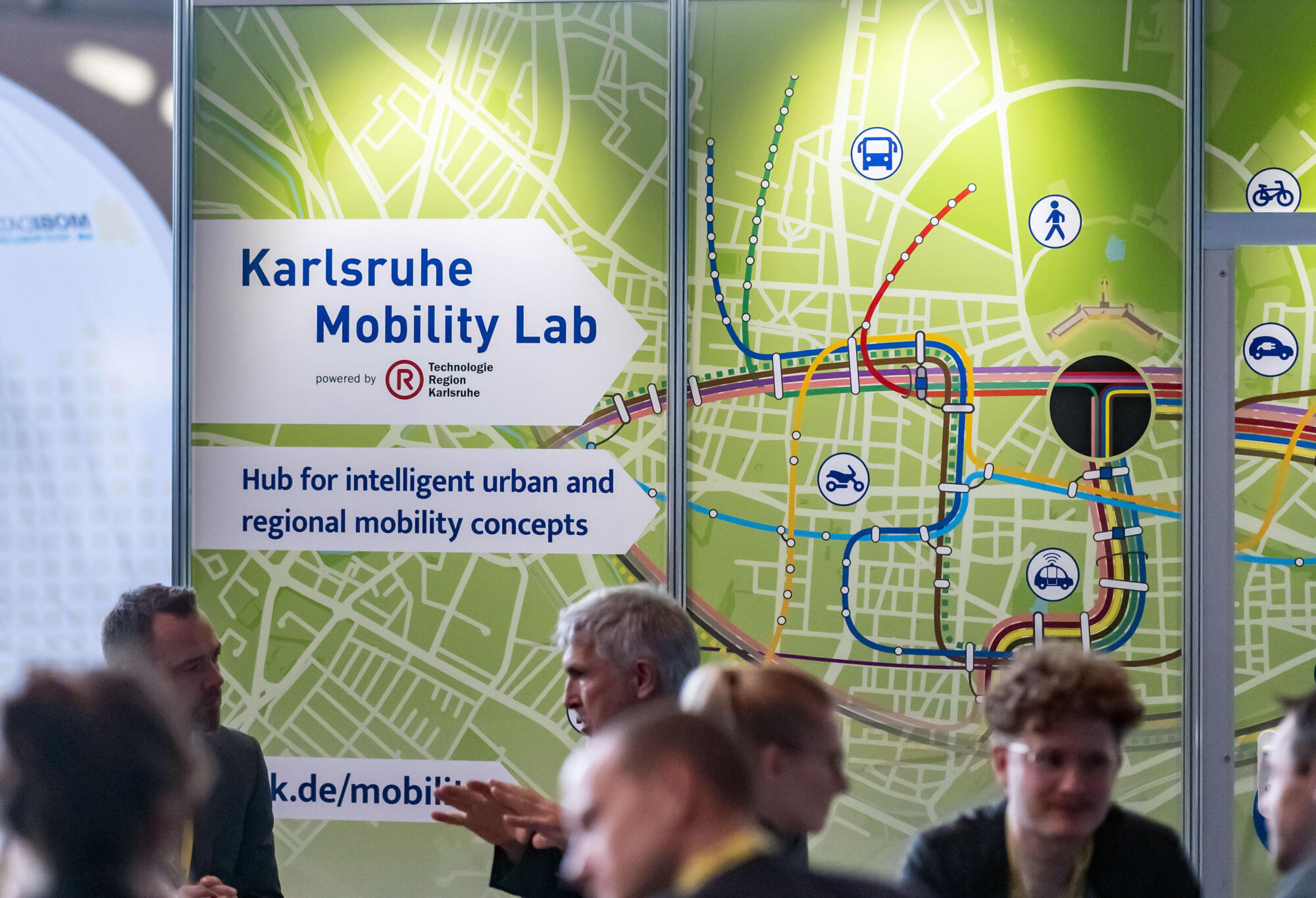
The KML/TRK collective stand at #POLIS24, ARTIS-Uli Deck/TRK GmbH
Global players like PTV Group are using Karlsruhe as a base to export mobility solutions worldwide. With tools like PTV Vissim and PTV Flows, they are helping cities anticipate traffic flows, optimise multimodal networks, and explore dynamic demand scenarios. These solutions were demonstrated using immersive tech like the Apple Vision Pro, offering planners a glimpse into the future of interactive traffic management.
Meanwhile, institutions like the KIT Mobility Systems Centre are researching how automation and logistics will reshape both urban and rural mobility. Their findings are tailored for public sector decision-makers, enabling evidence-based implementation of next-gen transport solutions.
Karlsruhe University of Applied Sciences, one of the largest and most research-intensive universities of its kind in the state, adds even more depth. With projects like move.mORe, the university promotes cross-border collaboration for sustainable mobility in the Upper Rhine region—emphasising infrastructure, automation, and public engagement.
Also anchoring the region’s mobility expertise are institutions like the Baden-Württemberg Institute for Sustainable Mobility - NVBW and the German Centre for Future Mobility - DZM, both of which have chosen Karlsruhe as a strategic base for national and international collaboration.
Empowering local actions
At a municipal level, the Karlsruhe Mobility Lab is a vital partner in enabling cities and regions to take ownership of the mobility transition. For cities like Landau, this has meant co-developing integrated transport strategies that balance sustainability with usability.
‘Local authorities are crucial to the success of the transport transition and the implementation of innovative projects,’ says Dr. Dominik Geißler, Mayor of Landau. ‘Collaborating through the Karlsruhe ecosystem has enabled us to expand our networks, present our ideas internationally, and shape mobility solutions that work on the ground.’
Landau’s comprehensive mobility concept—funded under the ‘Climate Protection Through Cycling’ programme—includes a connected network of bike lanes linking schools and transport hubs, improvements to public transit, and upgrades to motor traffic infrastructure. The city is becoming a blueprint for mid-sized urban transformation.
The private sector, too, is embracing innovation for the common good. The Automotive Engineering Network e.V., a key mobility cluster in the region, is showcasing the URBANE project—funded under the EU Horizon programme—to explore smart, sustainable last-mile delivery options in urban environments.
Karlsruhe: A working model for Europe’s mobility future
The strength of the Karlsruhe Mobility Lab lies in its ability to unite diverse actors around shared goals: smarter mobility, sustainable transport, and inclusive design. Its solutions are not theoretical—they are being deployed, tested, and improved in the real world.
As other regions in Europe seek to navigate the complexities of digitalisation, automation, and decarbonisation, Karlsruhe offers not just a roadmap—but a working model. One built on open data, applied research, and local leadership. One that shows how powerful mobility innovation can be when it is rooted in collaboration, practicality, and citizen benefit.
The more you know:
About the Karlsruhe Mobility Lab...
Located in one of Germany’s key mobility and technology regions, the Karlsruhe Mobility Lab is a collaboration platform where science, industry, public authorities, and transport innovators jointly develop solutions for the mobility of tomorrow.
Its focus lies on intelligent, networked, and sustainable mobility that balances environmental goals with practical user needs.
... and TechnologieRegion Karlsruhe
TechnologieRegion Karlsruhe GmbH is a cross-regional and transnational alliance for location marketing and innovation acceleration. Founded by stakeholders in business, science, and public administration, its mission is to turn ideas into applied solutions across sectors like mobility, digitalisation, energy, and bioeconomy.
KML’s key regional partners
The Karlsruhe Mobility Lab is supported by a strong network of regional mobility leaders and institutions. Partners at the Annual POLIS Conference 2024 included:
- TechnologieRegion Karlsruhe GmbH
- Automotive Engineering Network e.V. (AEN)
- Fraunhofer Institute for Systems and Innovation Research ISI
- FZI Research Centre for Information Technology
- Karlsruhe University of Applied Sciences (HKA)
- Karlsruhe Institute of Technology (KIT) with KAMO and KIT Mobility Systems Centre
- INIT Group
- PTV Planung Transport Verkehr GmbH
- Nahverkehrsgesellschaft Baden-Württemberg (NVBW)
- TransportTechnologie-Consult Karlsruhe GmbH (TTK)
- Karlsruher Verkehrsverbund (KVV), AVG & VBK
- Karlsruhe Trade Fair Centre (Messe Karlsruhe)
- UITP Regional Training Centre Karlsruhe
- Mobility Portal of the Karlsruhe TechnologyRegion/The City of Karlsruhe
- The City of Landau
Click here to read the article in its original format.
About the author:
Jochen Ehlgötz, Managing Director, TechnologieRegion Karlsruhe (TRK) GmbH. Since 2017, Ehlgötz has worked to strengthen TRK’s economic and innovation mobility, energy, digitalisation, and bioeconomy, while expanding TRK’s regional, national, and international cooperation with networks, such as the International Association of Public Transport Companies (UITP). From 2006 to 2017, he led Karlsruhe’s Office for External Relations, developing the city's first internationalisation strategy.
 ARTIS-Uli Deck/TRK GmbH