
Assessor: trusted third party in traffic management 2.0
Harmonising traffic management and innovative traffic information is no easy task – but the newly created role of the Assessor within the SOCRATES2.0 project seems to be the best solution. Nuno Rodrigues, Giovanni Huisken, Anton Wijbenga and Joost Vandenbossche tell us why.
Smoother, safer, and more sustainable traffic in the European Union: road authorities, service providers and car manufacturers all collaborated in SOCRATES2.0 to work towards these objectives.
It is clear these goals require effective collaboration between traffic management and innovative traffic information and navigation services. So, the partners created a cooperation framework, including four newly defined intermediary roles: the Assessor, the Strategy Table, the Network Monitor and the Network Manager. The public and private partners seated at the Strategy Table use the validated insights from the Assessor to make data-driven strategic decisions on how to improve the new jointly developed road user navigation services.
The Assessor plays an independent expert role when evaluating both technological and commercial aspects of the cooperation. It supports the management of the Service Level Agreements and ensures everyone honours the cooperation principles. In its independent unbiased role, the Assessor can act as a trusted third party. It collects and interprets information that is preferably not shared with the whole consortium. The Assessor only shares the individually agreed upon information with the rest of the partners.

The SOCRATES2.0 Cooperation Framework - Credits: SOCRATES2.0
The Assessor in practice
Each week of 2020, the Assessor assessed the performance of the services delivered by the SOCRATES2.0 partners for Smart Routing, one of the three SOCRATES2.0 services piloted in Amsterdam. The advice was jointly developed and delivered by local road operators (city of Amsterdam, Province of North Holland and Rijkswaterstaat), public and private data service providers (NDW, Be-Mobile, TomTom) and end-user service providers (Be-Mobile and TomTom).
Weekly performance reports were collected from the public service providers, the three Traffic Management Centres in the Metropolitan Region Amsterdam, and from private service providers. These provided information on the technical and functional performance of their services. And quantitative figures on the usage of the Smart routing service by service providers and road travellers. For some cases, this led to valuable insights on the observed and measure behavioural change.
Information for strategic decision-making
Earlier, the partners seated at the Strategy Table had defined the key performance indicators (KPIs) for insights on the success of the Socrates Smart routing service. The Assessor task is to validate and translate the weekly performance reports into the defined KPIs on network performance (travel time, speed, and traffic volumes). It also looked at the success of service providers in “nudging” road users towards the Socrates route advise.
Also, the Assessor monitors and reports on the performance of the other intermediary services. Like the availability and accuracy of current and predicted traffic states provided by the Network Monitor, or the amount and quality of service request from the Network Manager.
All this information is presented at the monthly Strategy Table meetings with all partners. The objective of those meetings is for Socrates partners to identify, discuss and agree on new or adjusted measures to help achieve the service goals or KPI targets. The partners who delivered services within the Smart Route service jointly assessed the services’ performance over the previous months based on the Assessor’s data-driven monthly report. They also identified what could be improved in the cooperation through new business opportunities.
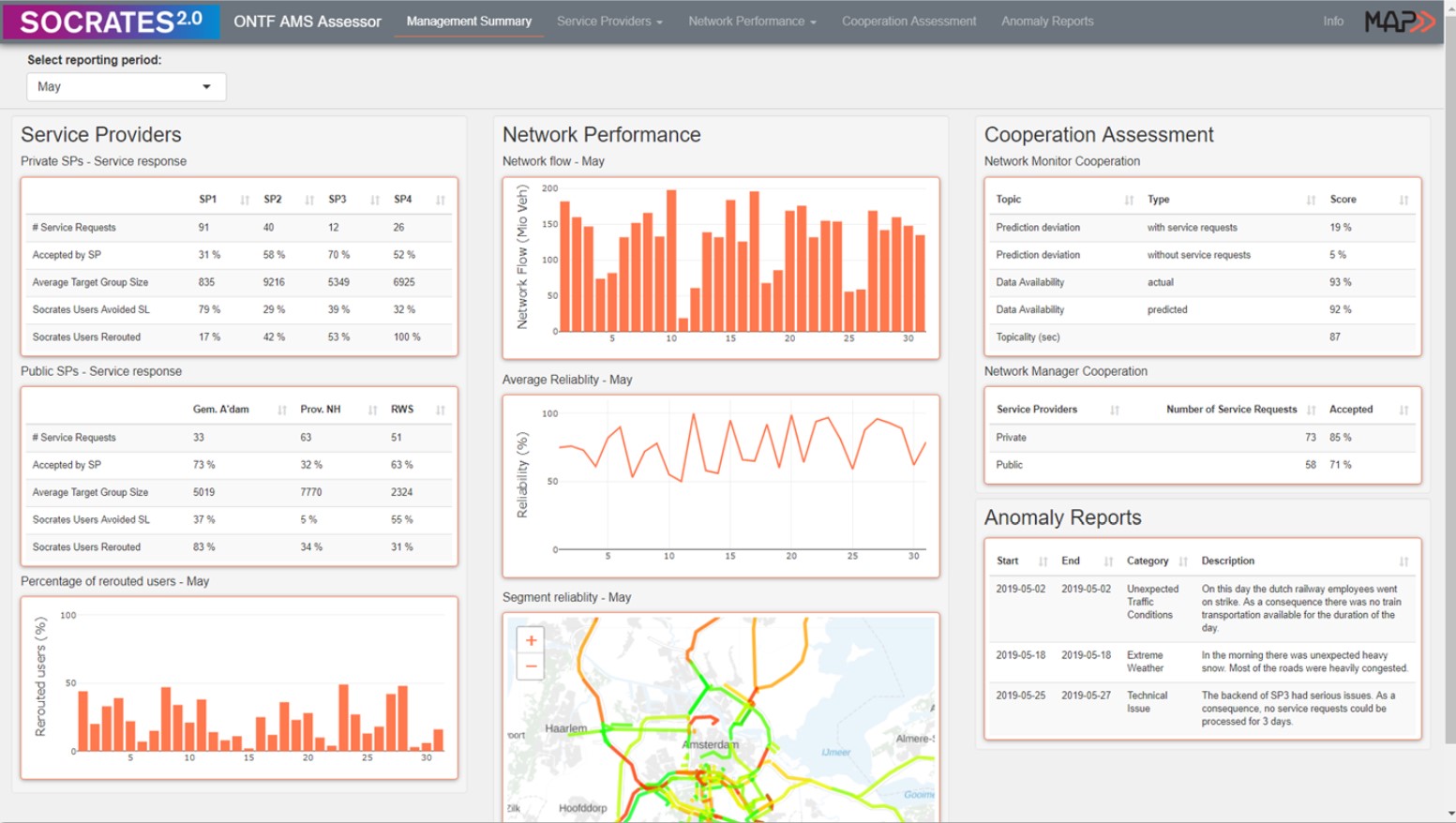
Assessor’s monthly report to Strategy Table - Credits: MAPtm
Waterfall method: how many drivers follow traffic advice?
In order to fuel the SOCRATES2.0 data driven strategic decision-making process, the Assessor and the service providers developed a new feedback loop report protocol called the ‘Waterfall method’. The goal of the Waterfall is to capture detailed insights from service providers on the implementation and performance of SOCRATES2.0-generated routing advice.
To show that the change in network traffic performance was the result of services delivered by the service providers, insight is needed into the number of road users being influenced. Since the SOCRATES2.0 services were deployed alongside existing information and navigation services, insight was also needed into the number of road users influenced by the existing services and those influenced by SOCRATES2.0-specific services. The Waterfall method provides these numbers and helps to differentiate between the value of existing services and SOCRATES2.0-induced services.
Every week, the service providers submitted the Waterfall report to the Assessor, including the following information:
- Aggregated volumes of road users (travellers) who received route advice, and how many changed or likely changed their routes accordingly or did not change their routes.
- Reasons service providers accepted or rejected to provide advice to road users based on SOCRATES0-induced services.
- Context information, for example, Traffic Management Centre logging, weather reports, road works.
The service providers post-processed their monitoring data, which means their service operational data and users’ ‘track and trace’. This helped them determine the number of road users for each of the Waterfall report fields. The Assessor could then use these numbers as an indication of:
- The possible impact of the measures deployed by the partner.
- The partner’s effort to implement the SOCRATES0 service request.
- The resolving power or sensibility of the SOCRATES0 services.
- The contribution of one partner compared to the other partners.
The Assessor: next level
SOCRATES2.0 partners are currently consolidating the developed cooperation framework, building on the large amounts of results and insights gathered over the past four years. The Assessor role and concept is still in its early stages, but it is already seen by all partners as a new necessary role to support sustainable and trusted public-private traffic management cooperation. The Assessor role is already being described, prescribed, and further developed at a next level, in new upcoming implementations of SOCRATES2.0-inspired public-private interactive traffic management schemes.
____________________
About SOCRATES2.0

Credits: SOCRATES2.0
SOCRATES2.0 stands for ‘System of Coordinated Roadside and Automotive Services for Traffic Efficiency and Safety’. It is a European project based on a cooperation of road authorities, service providers and car manufacturers. Together, these partners will improve car mobility by promoting a cleaner, more efficient, and safer flow of traffic. The key lies in developing intelligent ways to collect, exchange and use traffic data throughout the complete value chain for traffic management and information services. At this moment, traffic data is collected by both road authorities and service providers. Increasingly, cars and drivers themselves also produce essential traffic information. By exchanging and integrating all available information from road authorities, service providers and road users, SOCRATES2.0 can create a complete and consistent picture of the expected traffic situation.
____________________
About SOCRATES2.0 Cooperation Framework
In the SOCRATES2.0 project, a consortium of eleven public and private organisations explore different ways of working together to realise new or enhanced smart traffic information and navigation services. The partners are defining and piloting sustainable public-private cooperation and business cases in traffic management, resulting in the so-called SOCRATES2.0 Cooperation Framework. This is an important step in the direction of implementation of future (in-car) smart mobility services.
____________________
About the Assessor
The Assessor is one of the intermediary roles defined within the newly created SOCRATES2.0 cooperation framework between public and private organisations for interactive traffic management. The Assessor validates information and insights gained from the services delivered by the SOCRATES2.0partners. Then translates it into the predefined goals and key performance indicators (KPIs), like: hHow many road users followed the partners’ advice to take another route to avoid a traffic jam? What impact does each partner have on the overall service performance?
____________________
About the authors
Nuno Rodrigues, Giovanni Huisken, Anton Wijbenga and Joost Vandenbossche are, respectively, Liaison manager at SOCRATES2.0 and New Business manager at MAPtm, Deputy Project Manager SOCRATES2.0 at Rijkswaterstraat, Traffic and Data Scientist at MAPtm and Co-lead Mobility Lab at Be-Mobile.
 Credits: MAPtm