
Providing real-time information with GBFS: Discover its potential with the POLIS Tutorial
General Bikeshare Feed Specification (GBFS) makes it easy for travellers to find and use shared mobility options such as bike sharing and car sharing. The third module of the POLIS tutorial series on data standards and specifications in urban mobility, organised with POLIS member MobilityData, delved into the specifics and real-life applications of the open standard.
The online Technical Tutorial took place on 3 February 2026, hosted by POLIS in partnership with MobilityData. This is part of a new tutorial series on data standards and specifications in urban mobility.
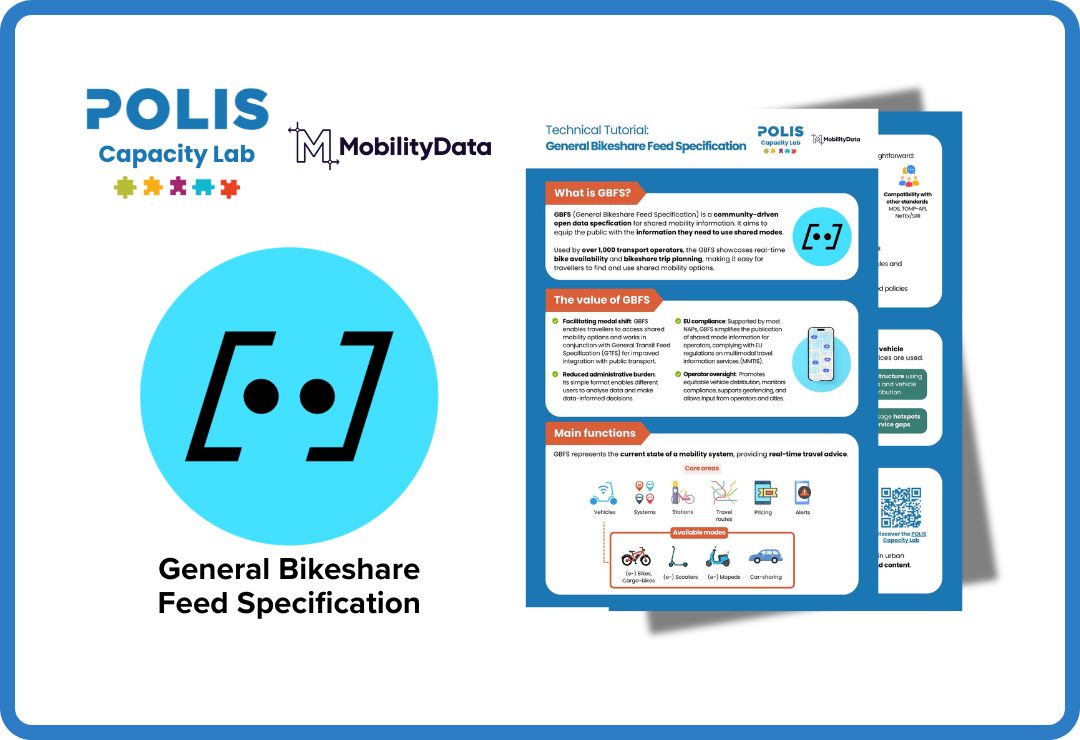
The session focused on the components of GBFS and its value for cities and regions. GBFS is a community-driven open data specification for shared mobility data, designed to share information about the current state of a mobility system, providing real-time travel advice. Used by over 1,000 transport operators worldwide, it is an open and independent standard that aims to be easy to use.
Several mobility data experts contributed to the session. Isabelle de Robert, Regional Director Europe at Mobility Data, illustrated the main functions and use cases of GBFS. Félix Gravet, Backend Developer at Geovelo, explained how the Geovelo app integrates GBFS data, and Antoine Augusti, Tech Lead at transport.data.gouv, showcased how the open standard can be used at a national level. Lastly, Alex Pazuchanics, Head of Mobility Insights at Vianova, illustrated the potential applications for transport operators. The session closed with an interactive Q&A, diving deeper into technical aspects and policy implications.
POLIS members who took part in the tutorial were introduced to the scope of GBFS and its latest extensions and understood its relevance for cities and regions. By presenting real-world examples, participants learned how GBFS can be easily implemented by shared mobility operators and trip planning apps.
A factsheet with an overview of GBFS and its applications is publicly available here.
POLIS members can access the recording and presentation in the Members Area here.
About the POLIS Capacity Lab
The POLIS Capacity Lab equips mobility practitioners, city officials, and regional planners with the knowledge, tools, and skills needed to implement innovative and sustainable urban mobility solutions. Through peer-to-peer learning, interactive workshops, and structured training, the Capacity Lab strengthens technical and strategic capabilities, accelerates the adoption of innovative solutions, and bridges the gap between policy and practice.
Tutorials are structured online sessions (1–2 hours) that guide participants in using specific tools, methods, or products to solve real urban mobility challenges. Interactive elements such as Q&A and demonstrations help participants immediately apply what they’ve learned. The POLIS tutorial series on data standards and specifications in urban mobility focuses on real-world applications and tangible benefits, helping POLIS member cities and regions understand, implement, and work with data standards. It also creates a space for dialogue with standard-setting bodies, ensuring the collective voice of local authorities plays a stronger role in shaping Europe’s digital mobility future.
To have full access to POLIS Capacity Lab activities and content, find out how you can become a POLIS member here.
- Related Members