Mobility for All
How can a regional SUMP prevent rural-urban trade-offs while being a champion of inclusion? Guided by a motto charged with the powers of accessibility, affordability, and participation, FrankfurtRheinMain leads the way. In this article, Sebastian Schöneck explores how the German Region is putting very ambitious words and plans into action.
POLIS member Region FrankfurtRheinMain is on a mission to ensure sustainable mobility across the entire Region. With its new mobility strategy, the Regional Authority FrankfurtRheinMain has applied the SUMP principles to the whole Region. This regional SUMP places inclusion at the heart of mobility, while endeavouring to guarantee access to efficient and sustainable mobility for all its citizens – regardless of whether they live in the urban core, the peri-urban or rural parts of the Region.
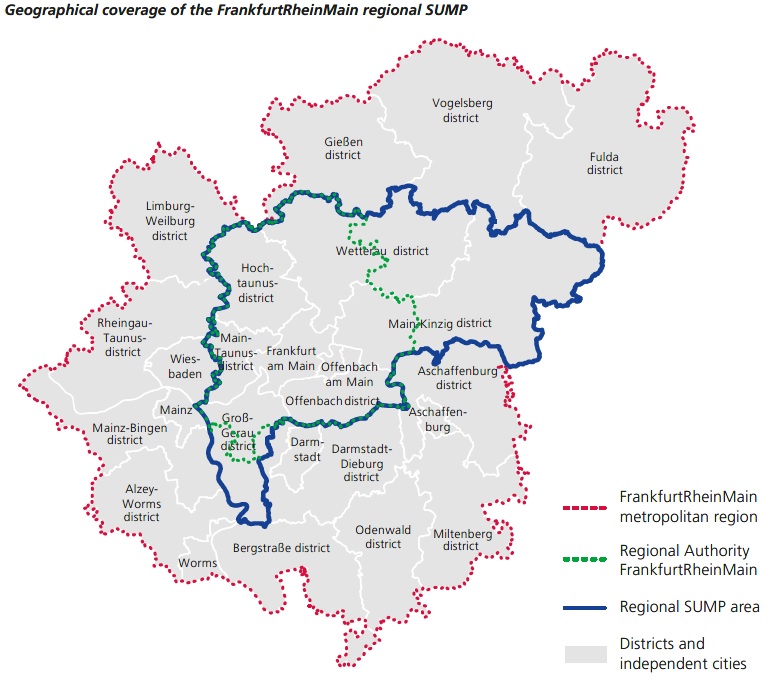
The Regional SUMP for FrankfurtRheinMain covers the whole functional area in the core of the Metropolitan Region — Credits: Region Authority FrankfurtRheinMain
FrankfurtRheinMain on the move
The FrankfurtRheinMain Region, which includes the major cities of Frankfurt and Offenbach, is located in the central-western part of Germany and has been an important industrial and transport centre for over a century. Today, the area is a financial core, as well as a prime logistics hub.
At the end of 2020 the Regional Authority FrankfurtRheinMain adopted its first SUMP. It comes to no surprise, as over the last few years Sustainable Urban Mobility Plans (SUMPs) have become a mainstay of transport policy agendas in cities and regions across Europe. Indeed, these plans address major mobility challenges such as congestion, pollution, climate change, road crashes, on-street parking, and the integration of new mobility services by delivering changes through cooperation across different levels of government, and with local residents and other principal stakeholders. In brief, SUMPs have become decisive indicators of how well cities and regions are addressing issues of accessibility, environmental sustainability, security, and cost effectiveness of transport options.
FrankfurtRheinMain’s plan provides a concrete roadmap for the transition to a more sustainable, efficient and reliable mobility system in one of Europe’s core production, trade, finance and transport heartlands. Given the complex mobility challenges in this polycentric Region, the SUMP principles are applied to the greater functional transport area in FrankfurtRheinMain, covering the major cities and six surrounding counties - serving an astonishing €2.7 million inhabitants.
Cooperation is key
Development of SUMPs requires strong policymaking, integrated with comprehensive citizen participation. Without such structural dialogue between local and regional stakeholders the plans will never deliver the strategic designs built on integration, participation, and evaluation – which are at the heart of the SUMP principles.
FrankfurtRheinMain has delivered the best of both. In the course of the first two and a half years of planning and consultation, the FrankfurtRheinMain Regional Authority developed a new mobility department, tasked with ensuring regional cooperation and coordination between the multiple SUMP goals. Simultaneously, public participation was one of the central components, with citizen’s forums held in different parts of the Region to bring the physical possibility for raising one’s voice as close as possible to interested people. In addition, an online-participation tool allowed to comment and bring in ideas and at any time in a digital manner.
The main objective is to develop an integrated mobility system built from existing plans, intimately connected with land-use planning and broader regional development strategies. This strategy aims to bridge divisions between urban and peri-urban districts within FrankfurtRheinMain, creating a transport network which truly rivals the use of passenger vehicle, ensuring equal access to employment and services.
Reaching for the stars
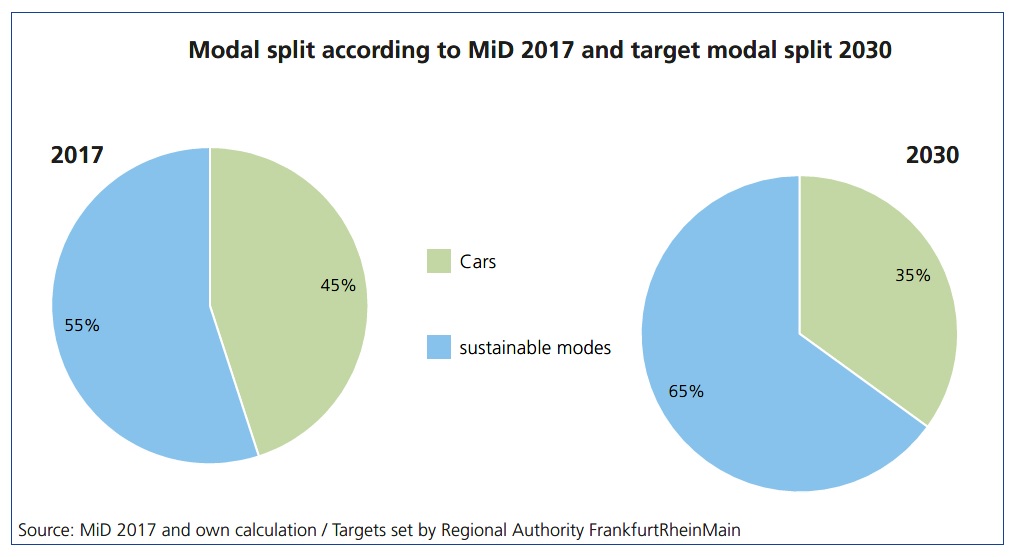
Modal split in 2017 and the targeted shift to more sustainable modes until 2030 — Credits: Region Authority FrankfurtRheinMain
Today, 55% of people in the Region travel by foot, bicycle, public transport, or other sustainable modes of transport. The SUMP aims to support the expansion of this share to 65% by 2030, - putting the Region on track to reach the EU climate goal of reducing CO2-emissions by 55% by the same year.
How will this be achieved? By building on the famous concept of the 15-minute city, and taking its principles to a regional level. Concretely, an integrated cycleway network and a regional network of multimodal mobility hubs will enhance pedestrian traffic, as well as support active travel, and last mile travel. In doing so, FrankfurtRheinMain will show is ambition to become a '5-Minute-Region', that is a region that ensures that all sustainable mobility options can be reached within a five-minute walk from any citizen’s house.
Meanwhile, rail-centred community developments will connect citizens to a strong public transport network while taking a more rigorous approach to commercial traffic management. These priorities will be delivered through lighthouse projects like the construction of cycle highways or a rail ring around Frankfurt. This will be coordinated with a 'rail coach' for the reactivation of previously terminated connections, fostering public on-demand solutions for the wider Region, introducing express bus lines, and developing urban cableways.
Presenting the SUMP at the European Week of Regions and Cities (EWRC), the Deputy Director of the FrankfurtRheinMain Region Mr. Rouven Kötter outlined its importance for the 'renaissance of rail'.
Accessibility, inclusiveness and participation in FrankfurtRheinMain
The underlying principle of the Region’s SUMP is 'Mobility for all', guided by the principles of affordability, accessibility and availability.
The Region has been working on accessibility for some time, implementing public transport where transit options are scarce. The eHopper pilot project in the Offenbach district, for example, is a novel on-demand service adapted to the needs of its users and operators. The bus does not have a rigid timetable, but rather combines requests from customers to determine its schedule. Drawing from this approach, the Raum für moderne Mobilität project ('Space for up-to-date Mobility'), co-funded by the Federal Ministry of Transport, is delivering integrated transit. This regional network of mobility hubs on different rail stops in the Region will indeed offer accessible shared or rental mobility solutions - especially in the peri-urban and rural parts. Soon, there will be no reason to take the car!
Action does not stop here, though. The regional transport provider Rhein-Main-Verkehrsverbund (RMV) is seeking to guarantee inclusive physical access on all trains and train stations, while examining the walking accessibility of all mobility services in the Region. This has been made possible by close cooperation between the Region’s municipalities and RMV, ensuring needs are met and specific requirements are identified.
The principle of accessibility has been brought into the Region’s approach to active travel. FrankfurtRheinMain has established a new pedestrian forum that brings together urban planners from the municipalities with multiple NGOs and associations from the field. This cooperation was at the heart of the SUMP’s development and integrated into its establishment.
Connecting a city is one thing, connecting an entire region is a whole new ball game. As FrankfurtRheinMain pursues its ambitious plans, regions across Europe will be taking notes.
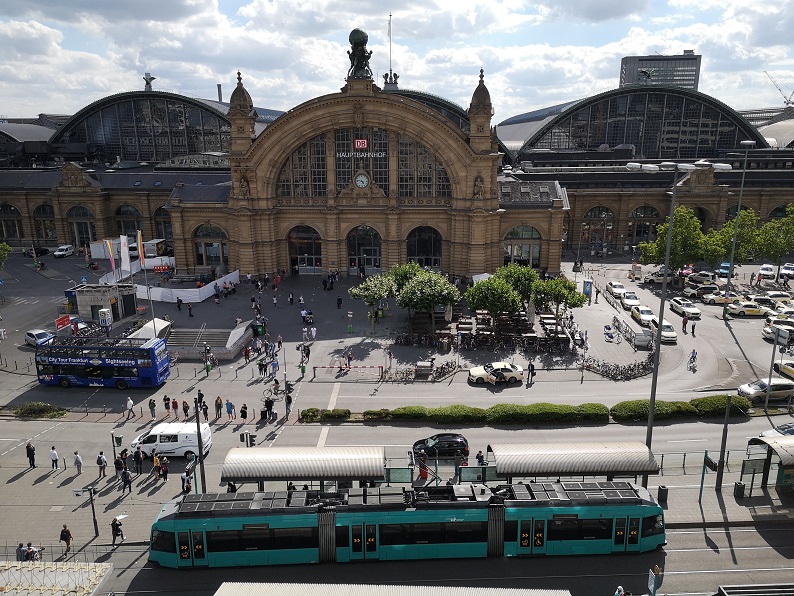
Frankfurt Central Station is at the heart of the Region’s mobility system — Credits: Region Authority FrankfurtRheinMain
____________________
FrankfurtRheinMain on the move: a Sustainable Urban Mobility Plan (SUMP) for the Region
The towns and cities of the FrankfurtRheinMain conurbation have unanimously called for a regional SUMP, because they want to act together to achieve high-quality transportation and identify specific measures to achieve mobility for all, avoid unnecessary traffic and improve management of necessary traffic.
Read more about the SUMP here.
____________________
Regions make a splash
Several POLIS regional members joined the European Week of Regions and Cities (EWRC), an annual four-day event which spotlights the importance of regions and cities in the transition towards a sustainable and smart future, and their capacity to foster the innovation required to achieve this. FrankfurtRheinMain, Ile-de-France, Lille Metropole and others, united to discuss how regions can – and should – enhance their sustainable mobility agendas.
Read more here.
____________________
Regions at POLIS
POLIS is not just a network of cities; our regions are also incredibly valued members. POLIS has long recognised the role of regions and the importance of elevating their voice at European level. From Catalonia’s new bus networks to Baden Württemberg’s expansion of human resources for sustainable transport, POLIS member regions have been playing a pivotal role in developing and testing public transport services, active travel infrastructure and e-mobility.
____________________
About the author
Sebastian Schöneck was Policy Officer at the European Office of the Metropolitan Region FrankfurtRheinMain.
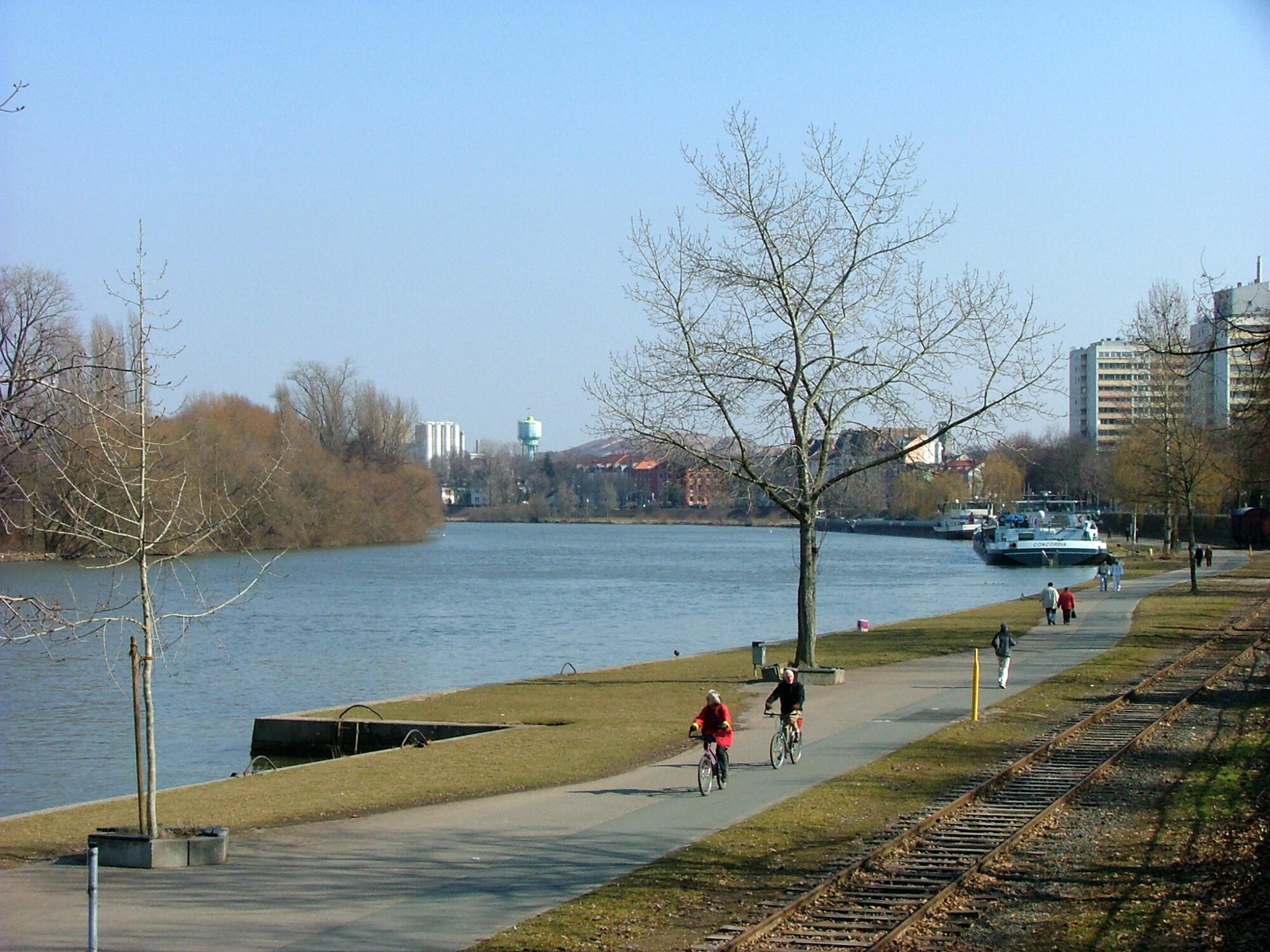 Credits: diba, CC BY-SA 2.0 DE, via Wikimedia Commons