POLIS and Eurocities launch Joint Charter on Automated Mobility in European Cities and Regions
As Cooperative, Connected and Automated Mobility (CCAM) is increasingly being pushed towards large-scale deployment in Europe, POLIS and Eurocities have launched a Joint Charter calling for cities and regions to play a central role in shaping how automated vehicles (AVs) are introduced and deployed.
Across Europe, automated mobility is moving beyond pilots and isolated demonstrations. Supported by growing European and national initiatives, increasing attention to industrial competitiveness and the ambition to scale up CCAM solutions, AVs deployment discussions are gaining momentum. As this transition accelerates, there is a growing need to ensure that automated mobility supports broader public objectives and strengthens, rather than disrupts, urban mobility systems.
Why now?
For years, automated mobility has largely been tested through pilots and demonstrations. Today, attention is increasingly shifting towards how these AVs can move into longer-term and larger-scale deployment. As highlighted by Eurocities in their new policy statement on automated mobility, the next EU budget cycle and future research and innovation frameworks offer a critical opportunity to scale automation responsibly.
This creates important opportunities, but also raises critical questions. Which use cases should be prioritised? How should automated mobility fit within existing transport systems? And who should shape the decisions that will determine how these AVs interact with cities and regions? Current discussions are often driven by technological readiness and industrial perspectives. Yet deployment decisions will ultimately have to work in real urban environments and respond to local mobility needs.
Cities and regions at the centre of innovation
Cities and regions, together with their public transport authorities, are responsible for making mobility systems work in practice. They manage public space, integrate services into existing transport networks, ensure safety and balance local priorities.
As highlighted already in POLIS’ earlier discussion paper on the role of cities and regions in automated mobility, deployment decisions can have significant impacts on urban areas, including congestion, public transport systems, the use of public space and wider sustainability objectives. Automated mobility should therefore not become an objective in itself. It should support broader goals such as improving accessibility, strengthening public transport, reducing congestion, and contributing to safer and more liveable cities. As managers and orchestrators of local mobility systems, cities and regions should therefore play a central role in shaping how these technologies are introduced and governed.
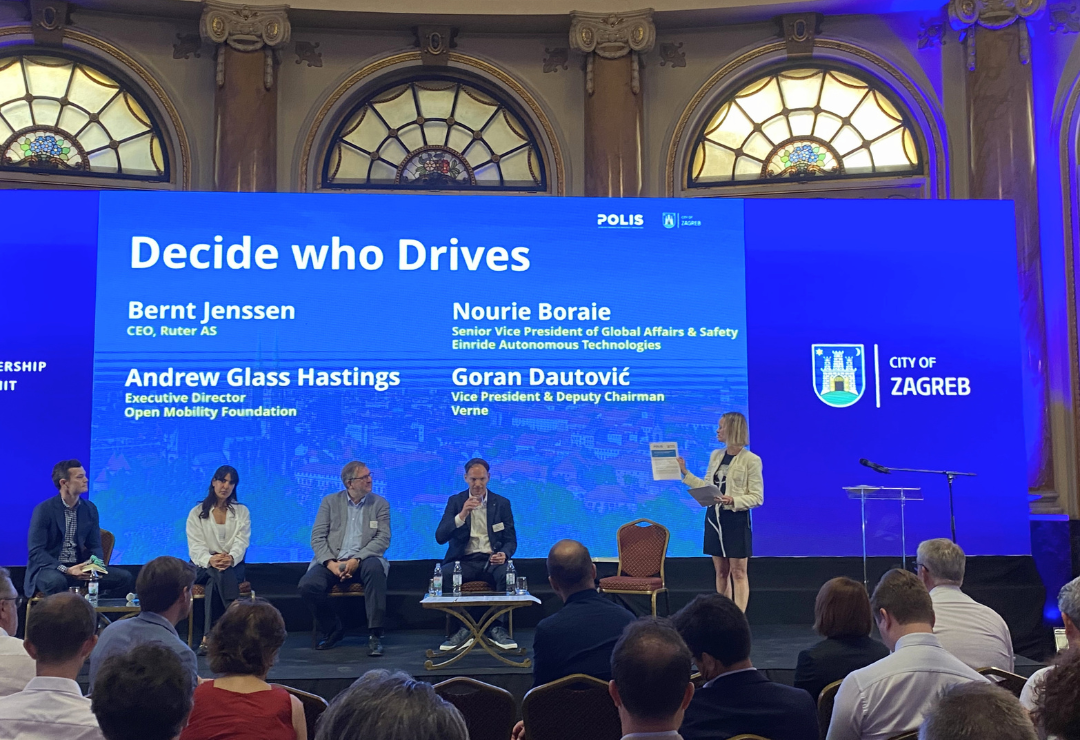
Revealed during the Leadership Summit in Zagreb, the Joint Charter sets out a shared vision and ten principles for the deployment of AVs in urban and regional areas. Rather than focusing only on technology deployment, the Charter highlights the conditions needed to ensure that automation delivers public value. It addresses themes including governance, public transport integration, infrastructure and data needs, societal impacts, and the regulatory frameworks needed for future services.
The overall objective is simple: automated mobility should adapt to the needs of cities and people, not the other way around.
Looking beyond pilots: a call for action
Moving from pilots towards long-term deployment requires more than technological progress alone. It also requires governance, clear policy direction and cooperation across different levels. The Charter aims to support a common approach to deployment, ensuring that automated mobility contributes to resilient regional and urban systems, competitive public transport and broader safety and sustainability objectives.
Read the Joint Charter on Automated Mobility in European Cities and Regions here.
Cities and regions that share this vision are invited to endorse the Charter and contribute to a common European approach for automated mobility deployment. Should you be interested, please contact Laura Babio (lbabio@polisnetwork.eu) and/or Clarisse de Cerjat (clarisse.decerjat@eurocities.eu).